

 > Blogs > CNC vs Hand Finishing in Hookah Molds: Precision and Craftsmanship
CNC vs Hand Finishing in Hookah Molds: Precision and Craftsmanship
Core keywords: CNC vs hand finishing in hookah molds, precision hookah manufacturing, metal mold polishing
In the evolving world of modern hookah production, the debate between CNC vs hand finishing in hookah molds reflects the balance between automation and artistry. Each technique plays a vital role in achieving quality, precision, and aesthetic refinement—especially for glass and metal components that define the final product’s performance and appearance.
Manufacturers worldwide now blend both approaches to produce durable, visually appealing designs that meet the expectations of premium brands and global distributors.
CNC vs Hand Finishing in Hookah Molds: Core Differences
The foundation of CNC vs hand finishing in hookah molds lies in process and purpose. CNC (Computer Numerical Control) machining uses automated, computer-guided tools to carve molds with micrometer accuracy. It ensures reproducibility and dimensional precision for stems, bases, and connectors.
By contrast, hand finishing introduces the human touch—refining edges, smoothing imperfections, and adjusting contours that machines may overlook. While CNC ensures mathematical consistency, handcrafting perfects aesthetic subtleties and surface texture, enhancing the sensory quality of precision hookah manufacturing.
The Role of CNC in Precision Hookah Manufacturing
In large-scale precision hookah manufacturing, CNC technology dominates initial mold creation. It delivers near-perfect symmetry and dimensional accuracy, which is essential for airtight fittings and modular assembly.
Advanced CNC systems cut stainless steel, aluminum, or brass with tolerance variations as low as 0.02 mm. This level of detail ensures that every glass or metal part fits seamlessly, reducing post-processing requirements. For manufacturers producing hundreds of molds monthly, CNC precision directly translates into higher efficiency and consistent quality.
Furthermore, CNC machining allows digital customization—brands can tweak parameters like airflow chamber diameter or stem curvature without reconstructing entire prototypes, saving time and resources in the production cycle of metal mold polishing.
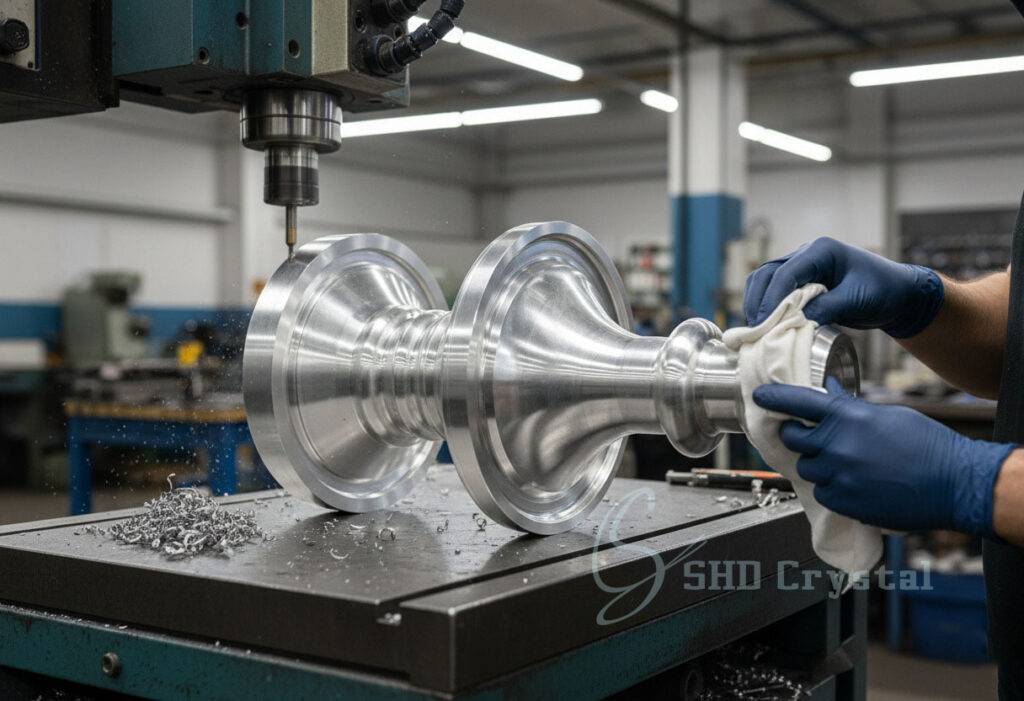
The Importance of Hand Finishing in Hookah Mold Design
Despite technological progress, artisanship remains irreplaceable in CNC vs hand finishing in hookah molds. Hand finishing brings individuality and tactile refinement, especially when working with decorative surfaces or complex organic shapes.
Skilled technicians manually polish, engrave, and buff molds to enhance texture and clarity before production. This stage—often referred to as metal mold polishing—not only removes micro-imperfections but also determines how light interacts with glass during forming. The smoother the mold interior, the clearer and more reflective the final hookah component will appear.
Hand finishing is also essential for prototype and luxury collections, where visual nuance and flawless curvature define brand prestige. It bridges industrial science with craftsmanship—turning mechanical output into a piece of art.
Efficiency vs. Aesthetic Value
In comparing CNC vs hand finishing in hookah molds, efficiency and artistry coexist rather than compete. CNC machining delivers repeatable accuracy and structural reliability, ideal for high-volume precision hookah manufacturing. However, hand finishing adds refinement—critical for premium brands seeking distinction through shine, smoothness, and design balance.
Manufacturers often adopt a hybrid workflow: CNC for 90% of geometric accuracy, followed by manual inspection and metal mold polishing for final surface perfection. This integration minimizes error while maximizing beauty and performance—a synergy that defines modern production excellence.
Future Trends in Hookah Mold Fabrication
As technology evolves, the line between CNC vs hand finishing in hookah molds continues to blur. Advanced robotic systems now simulate hand movements for fine detailing, while augmented reality tools assist technicians in detecting surface deviations invisible to the naked eye.
In the coming years, sustainability will also influence design choices—energy-efficient CNC machines and eco-friendly polishing compounds will support greener precision hookah manufacturing. This fusion of automation, craftsmanship, and environmental awareness will shape the next era of hookah production.
Conclusion
The debate surrounding CNC vs hand finishing in hookah molds ultimately highlights collaboration, not competition. CNC machining ensures dimensional excellence and mass consistency, while hand finishing preserves the artisanal touch that defines luxury. Together, they create the foundation for functional art—a balance that represents the pinnacle of precision hookah manufacturing.
From industrial-scale runs to bespoke limited editions, SHD Crystal guarantees flawless engineering, aesthetic precision, and exceptional durability.
Partner with SHD Crystal to experience innovation shaped by human artistry—where every mold reflects the future of precision hookah manufacturing.


