
Blogpost keywords: embossed carved glass plate, palace-style tableware, exclusively for banquets
Embossed carved glass plate design represents a specialized category within high-end tableware, where decorative relief, material refinement, and ceremonial function converge. Commonly associated with formal dining environments, this form of glassware is developed not for everyday use, but for curated banquet settings that demand visual authority and controlled elegance.
In palace-style dining traditions and contemporary luxury banquets alike, tableware serves as part of the overall spatial narrative. Plates are not merely functional objects, but visual anchors that reinforce hierarchy, rhythm, and occasion. Within this context, embossed carving becomes a deliberate design choice rather than ornamentation for its own sake.
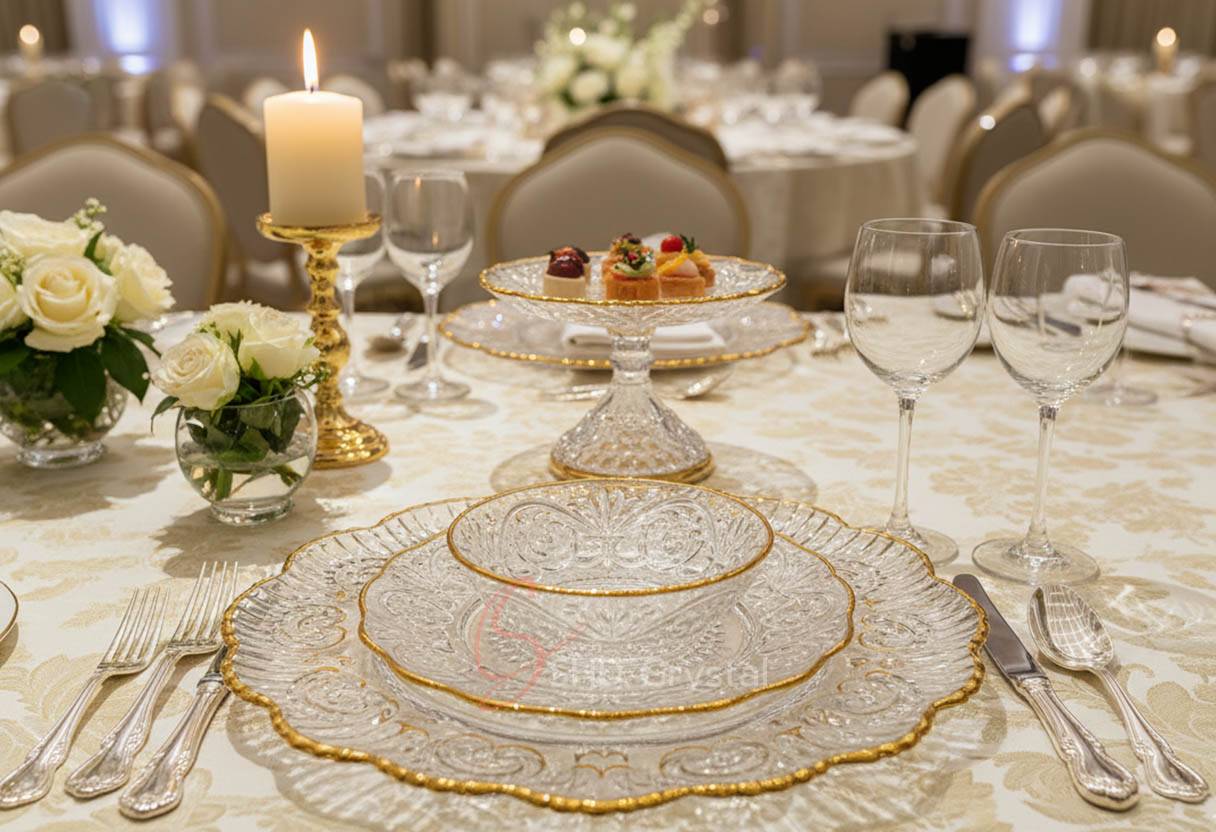
Embossed Carved Glass Plate in Formal Dining Presentation
An embossed carved glass plate is distinguished by its raised or recessed patterns formed directly into the glass surface. Unlike applied decoration, embossing integrates relief into the structure of the plate itself, ensuring durability and consistent tactile definition.
In palace-style tableware systems, such plates are often used as charger plates or ceremonial service pieces. Their primary role is to establish tone at the table, framing porcelain or fine china courses while remaining visually present. For settings exclusively for banquets, this layered approach allows the plate to contribute to the experience without interfering with food presentation.
Relief depth is carefully calibrated. Overly aggressive carving can distort reflections or create uneven highlights under banquet lighting, while shallow relief risks appearing flat at a distance. Balanced embossing ensures clarity from multiple viewing angles, especially in large dining halls.
Craft Techniques and Material Control
Producing embossed carved glass plate designs requires precise mold engineering or hand-assisted carving processes, depending on the desired outcome. In either case, glass flow, cooling rate, and surface finishing must be tightly controlled to preserve pattern definition.
A common misconception is that heavier glass automatically signals higher quality. In practice, palace-style tableware prioritizes proportion and stability over mass alone. Excessive thickness can dull relief details and reduce optical refinement. Well-executed plates distribute weight strategically, reinforcing rims and bases while keeping decorative fields visually light.
Polishing is another critical stage. Relief edges must remain crisp, yet comfortable to handle, particularly when plates are moved repeatedly during banquet service. This balance is essential for items used exclusively for banquets, where functionality and ceremony intersect.
Design Language in Palace-Style Tableware
Palace-style tableware typically draws from classical geometry, symmetrical motifs, or heritage-inspired patterns. Embossed carving supports this language by adding dimensionality without introducing color or surface coating that could limit versatility.
In modern banquet environments, clear or lightly toned glass plates allow compatibility with varying table linens, lighting schemes, and floral arrangements. This adaptability is one reason embossed carved glass plate designs remain relevant across both traditional and contemporary palace-style settings.
When integrated into a complete tableware system, these plates act as visual transitions between furniture, textiles, and service ware, reinforcing cohesion throughout the dining experience.
Practical Use in Banquet Environments
In real banquet scenarios, embossed carved glass plate pieces are typically deployed for formal openings, ceremonial courses, or display settings rather than continuous service. Their durability supports repeated use across events, while their design signals exclusivity and intention.
For venues and event planners, investing in tableware exclusively for banquets simplifies visual planning. The plates become a recognizable element that elevates each occasion without requiring constant redesign.
Conclusion
Embossed carved glass plate design plays a structural role in palace-style tableware, combining craftsmanship, visual authority, and ceremonial purpose. When developed with precision and restraint, these plates enhance banquet settings through form, light, and proportion rather than excess decoration.
Considering Glass Tableware for Formal Dining Programs
For institutions and venues seeking tableware exclusively for banquets, embossed carved glass plate solutions offer a refined way to establish identity and consistency. Thoughtful selection ensures that each formal setting communicates intention, elegance, and enduring quality.
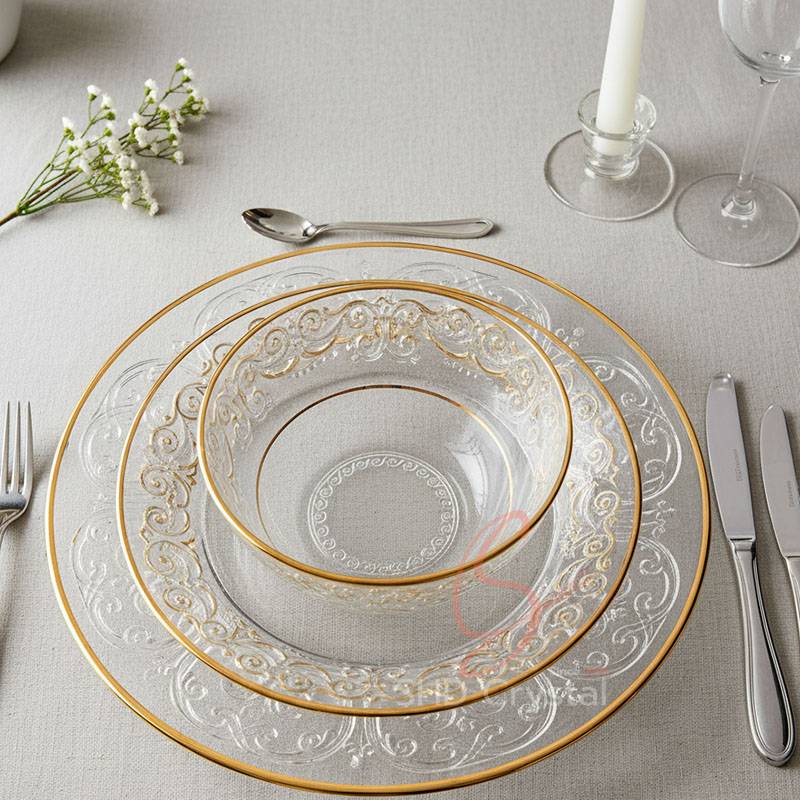
Working With Handcrafted Crystal for Formal Tableware Programs
For banquet environments where presentation carries ceremonial weight, material choice and execution matter as much as design intent. SHD Crystal focuses on handcrafted crystal glass production, combining traditional glass shaping techniques with controlled finishing processes to support embossed carving, refined relief depth, and visual balance.
With experience in producing decorative crystal glass pieces for formal dining and display settings, SHD Crystal supports the development of palace-style tableware that is exclusively for banquets, where consistency, proportion, and surface integrity are essential. This hands-on approach allows design concepts to be translated into tangible glass forms with clarity, stability, and lasting visual presence, aligning craftsmanship with the demands of high-level dining programs.