
Blogpost keywords: hookah type comparison, hookah airflow characteristics, smoking session design
Exploring different hookah styles reveals how structure, airflow behavior, and craftsmanship shape the overall experience. A detailed hookah type comparison goes beyond appearance, focusing on how engineering decisions influence hookah airflow characteristics and the intended smoking session design. From traditional ceremonial builds to compact portable models, each category reflects a different balance between performance, usability, and cultural context.
Hookah Type Comparison Through Design and Function
A meaningful hookah type comparison begins with understanding how airflow, heat, and water interact inside the system. When a user inhales, pressure differences pull vapor from heated shisha down through the stem and into the water chamber, where cooling and filtration occur before smoke reaches the hose.
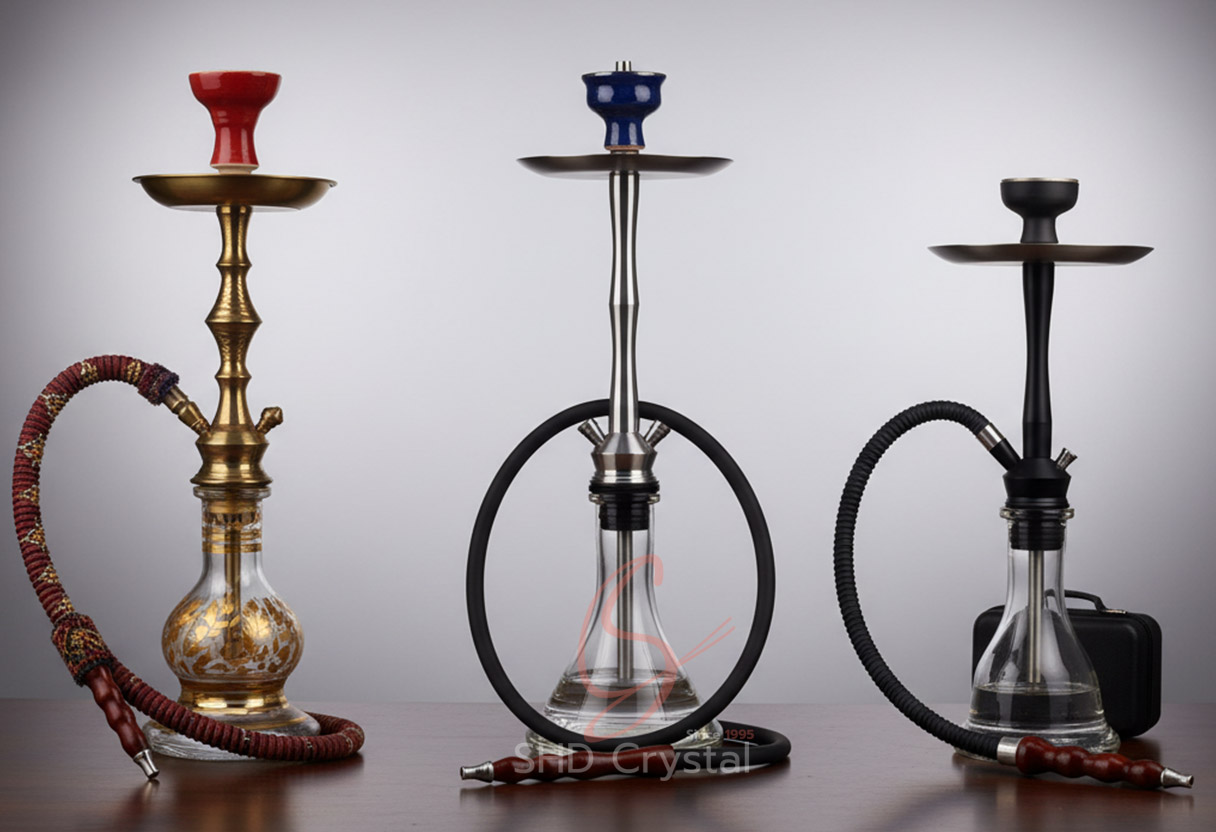
Across all types, performance depends on consistent hookah airflow characteristics and a session design that matches user intent:
- Bowl: influences heat stability and vapor release
- Stem: shapes airflow direction and resistance
- Water chamber: moderates cooling and smoothness
- Hose: completes the airflow path to the user
Different hookah types optimize these elements differently, leading to distinct smoking session design outcomes.
Traditional Hookahs: Ritual-Oriented Smoking Session Design
In any hookah type comparison, traditional hookahs represent a ritual-focused approach. Heavy materials, wide water chambers, and slower airflow produce dense smoke and pronounced flavor layering. These designs emphasize relaxed pacing rather than rapid output, resulting in specific hookah airflow characteristics that favor resistance and cooling over speed.
Traditional smoking session design prioritizes atmosphere and continuity. Sessions tend to be longer, quieter, and more communal, aligning airflow behavior with cultural expectations rather than efficiency.
Modern Hookahs: Precision Airflow and Controlled Sessions
Modern builds redefine the hookah type comparison through engineering precision. Stainless steel stems, modular parts, and diffusers refine hookah airflow characteristics, reducing turbulence and improving consistency between draws.
In modern smoking session design, airflow predictability and ease of maintenance take priority. Users experience cleaner flavor transitions and more controlled resistance, making these models well-suited for frequent use and shared environments.
Portable Hookahs: Compact Design With Adapted Airflow Characteristics
Portable hookahs complete the hookah type comparison by introducing mobility-focused design constraints. Smaller chambers and lightweight materials shorten airflow paths, requiring careful tuning to maintain smoothness.
While compact, well-designed portable models preserve balanced hookah airflow characteristics through micro-diffusers and sealed connections. Smoking session design here favors shorter, more flexible use cases—travel, outdoor settings, or casual solo sessions—without abandoning performance fundamentals.
Comparative Performance Insights Across Hookah Types
Rather than relying on headline metrics, a functional hookah type comparison evaluates how airflow behavior aligns with session intent:
-Traditional models: slower airflow, higher resistance, extended sessions
-Modern models: optimized airflow, stable resistance, consistent output
-Portable models: shortened airflow paths, faster cooling cycles
These differences highlight how hookah airflow characteristics directly support different smoking session design goals rather than defining quality in absolute terms.
Evolving Preferences and Design Direction
Recent market observation shows growing interest in hookahs that balance visual identity with airflow reliability. Designers increasingly treat smoking session design as a system-level decision, integrating materials, airflow geometry, and user behavior into a cohesive experience.
As a result, modern hookah type comparison discussions are shifting away from tradition-versus-modern debates toward understanding how airflow characteristics and session design support specific lifestyles and usage patterns.
Conclusion
A thoughtful hookah type comparison demonstrates that no single design is universally superior. Traditional hookahs honor ritual and depth, modern hookahs deliver control and precision, and portable hookahs prioritize flexibility. What matters most is how hookah airflow characteristics align with the intended smoking session design.
Choosing the right hookah means selecting a system whose airflow behavior, pacing, and structure match your personal or social smoking style—turning each session into a balanced blend of comfort, performance, and intention.