
Blogpost Keywords: large crystal vase factory, architectural crystal centerpiece, production-ready crystal prototyping
A large crystal vase factory should be evaluated as a long-term project partner rather than a simple supplier. Once crystal pieces move beyond tabletop scale, the challenges shift from decoration toward engineering judgment, production discipline, and repeatability. When sourcing an architectural crystal centerpiece for hospitality venues or upscale residential interiors, the factory’s process logic becomes just as important as its craftsmanship.
In large decorative installations, scale introduces new variables such as structural balance, base weight distribution, and light interaction. These factors determine whether a design can move from concept to production-ready crystal prototyping without compromising safety or visual integrity.

How a Large Crystal Vase Factory Approaches Early Project Review
A capable large crystal vase factory rarely begins discussions with price alone. Instead, the evaluation starts with context. Placement height, viewing distance, lighting direction, and expected interaction all influence proportion, wall thickness, and base mass decisions.
This context-driven approach is a key indicator of production-ready crystal prototyping. The objective is to prevent visually attractive designs that later reveal structural weaknesses during manufacturing or installation.
Another important aspect is how quality standards are defined. For an architectural crystal centerpiece, evaluation typically focuses on symmetry, optical consistency, and base leveling under real lighting conditions rather than theoretical perfection.
A large crystal vase factory that can clearly describe these criteria usually demonstrates experience in translating design intent into scalable production outcomes.
Sampling strategy is also a strong indicator of capability. Instead of promising a flawless first sample, experienced manufacturers follow staged validation.
Early prototypes verify scale and balance, while later samples refine clarity, edge finishing, and surface polish. This progressive method is central to production-ready crystal prototyping and significantly reduces risk when working with oversized crystal forms.
Frequent Sourcing Mistakes in Large Crystal Projects
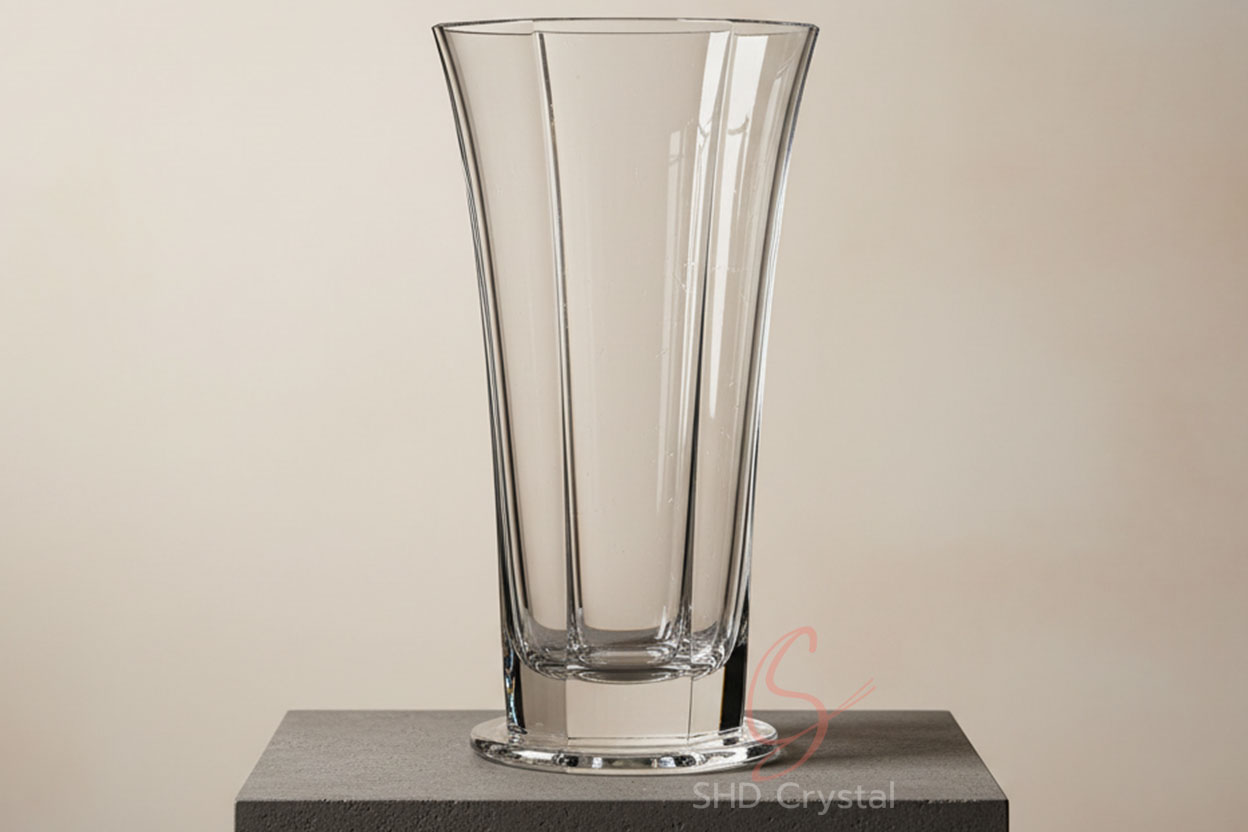
One common sourcing mistake is approving designs based only on photographs. Still images rarely reveal edge distortion, minor waviness, or subtle base imbalance that becomes noticeable once installed.
For an architectural crystal centerpiece, rotational inspection under controlled lighting provides a more reliable evaluation.
Another overlooked factor is transport protection. A professional large crystal vase factory treats packaging as part of the overall product system. Rim edges, base contact points, and vertical load zones must be supported during transit.
This level of planning aligns closely with production-ready crystal prototyping, where the final installation environment is considered from the earliest design stages.
Repeatability is another critical factor. Producing a single successful sample differs greatly from manufacturing a coordinated series. A structured large crystal vase factory controls forming conditions, annealing cycles, and inspection steps to prevent visual variation between units.
This consistency becomes essential when multiple pieces form a continuous architectural crystal centerpiece installation.
Signals That Indicate Real Project Capability
Change management is often a clear indicator of manufacturing maturity. When design revisions occur, an experienced large crystal vase factory reassesses stress points, balance zones, and forming feasibility rather than simply adjusting dimensions.
This disciplined approach protects production schedules and keeps production-ready crystal prototyping aligned with project timelines.
Clear documentation is equally important. Confirmed dimensions, finish references, and transparent approval records reduce the risk of miscommunication. In large-scale decorative installations, even minor deviations can appear exaggerated under architectural lighting.
Reliable communication therefore becomes an essential part of delivering a successful architectural crystal centerpiece.
Conclusion
A large crystal vase factory suited for architectural interior projects demonstrates more than decorative skill. It combines risk awareness, repeatability control, and structured production-ready crystal prototyping that allows large crystal pieces to move confidently from design concept to finished installation.
Planning Oversized Crystal Features with Greater Confidence
When developing an architectural crystal centerpiece, early collaboration with an experienced large crystal vase factory helps align scale, lighting context, and production-ready crystal prototyping requirements.
For designers, hospitality developers, and interior architects, this early alignment significantly increases the likelihood that oversized crystal installations will achieve both visual impact and long-term structural reliability.
Manufacturers with advanced crystal forming and polishing expertise, such as SHD Crystal, are able to support this process through precision crystal shaping, controlled annealing, and refined finishing techniques. These capabilities allow large crystal decorative pieces to maintain optical clarity, balanced structure, and consistent quality across multiple units.