
Blogpost keywords: champagne glass oem, high-use glassware durability, service cycle resistance
A champagne glass OEM program serving hospitality does not produce display pieces. It produces tools that are expected to survive repetition.
In real service environments, glasses are not handled carefully. They are lifted in batches, placed quickly, washed under pressure, and returned to circulation within minutes. Over time, failure is rarely caused by a single event. It is the result of accumulation.
This is where high-use glassware durability becomes a defining factor, not a secondary feature.
Champagne Glass OEM as a System of Service Cycle Resistance
A professional champagne glass OEM approach is not centered on individual product strength, but on performance across repeated cycles. This is where service cycle resistance becomes a more accurate measure than simple durability.
In practice, glassware does not fail because it is weak. It fails because stress is repeated in predictable ways.
Understanding those patterns is what separates standard production from engineered OEM supply.
The Hidden Stress Points in Daily Service
Most failures in hospitality glassware are not visible in design drawings. They appear only after continuous use.
Edge Contact Is the First Breakdown Point
When glasses are placed on hard surfaces, the rim and base edges absorb micro-impact. These impacts are small but consistent.
A well-executed champagne glass OEM program distributes these forces rather than concentrating them. This is a key factor in improving high-use glassware durability without changing the visual profile of the glass.
Washing Cycles Introduce Thermal Fatigue
Commercial dishwashing exposes glassware to rapid heating, chemical detergents, and cooling sequences. Over time, these cycles weaken structural integrity.
True service cycle resistance is not about surviving a single wash. It is about maintaining stability after hundreds or thousands of cycles.
This is why experienced OEM manufacturers evaluate how glass behaves under repeated thermal stress, not just initial strength.
Movement and Storage Create Continuous Contact
In high-turnover environments, glasses are rarely stored individually. They are stacked in racks, transported in trays, and frequently touch one another.
A capable champagne glass OEM supplier anticipates this constant movement. Structural balance, wall thickness distribution, and base stability all contribute to reducing damage during handling.
These adjustments are often subtle, but they directly influence high-use glassware durability in real-world conditions.
Why Appearance Degrades Before Structure Fails
One overlooked aspect of glassware performance is that visual degradation often occurs before structural failure.
Surface dullness, micro-scratches, and loss of clarity affect perception long before a glass breaks. In hospitality settings, this directly impacts brand presentation.
OEM programs focused on service cycle resistance consider not only breakage rates but also long-term appearance stability. This ensures that glassware remains visually consistent across extended service periods.
Where Performance Matters Most
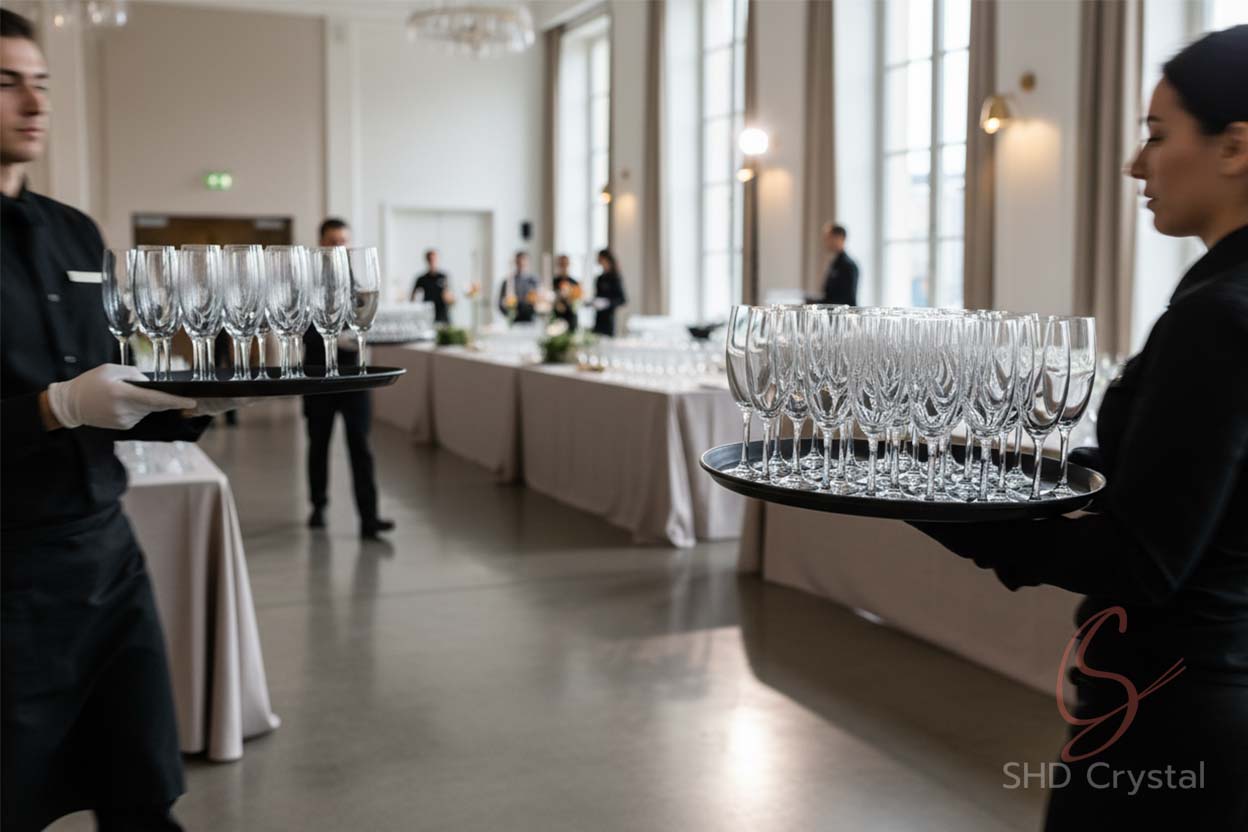
The importance of champagne glass OEM capability becomes most evident in environments where usage frequency is extreme.
Hotels, banquet operations, cruise lines, and event services depend on glassware that can move continuously through service cycles without interruption. Replacement is not just a cost issue. It affects operational flow.
Suppliers who understand high-use glassware durability help reduce these disruptions by delivering products designed for sustained performance rather than short-term use.
Conclusion
A reliable champagne glass OEM program is defined by how well it performs under repetition. By focusing on high-use glassware durability and engineered service cycle resistance, manufacturers create glassware that aligns with the realities of continuous service environments rather than ideal conditions.
Engineering Glassware for Continuous Service
For brands and hospitality buyers, selecting a champagne glass OEM partner is not only about design but about long-term performance.
At SHD Crystal, production is structured around real service conditions, where repeated handling, washing, and transport define product lifespan. Through controlled forming processes, optimized thickness distribution, and refined finishing, each piece is developed to support high-use glassware durability without compromising clarity or proportion.
As an OEM-focused manufacturer, SHD Crystal integrates structural engineering with scalable production, ensuring consistent service cycle resistance across large-volume orders. This approach allows glassware to maintain both performance and visual integrity throughout extended use cycles in demanding environments.