
Blogpost keywords: custom glass blowing, handcrafted glass art, bespoke glass design
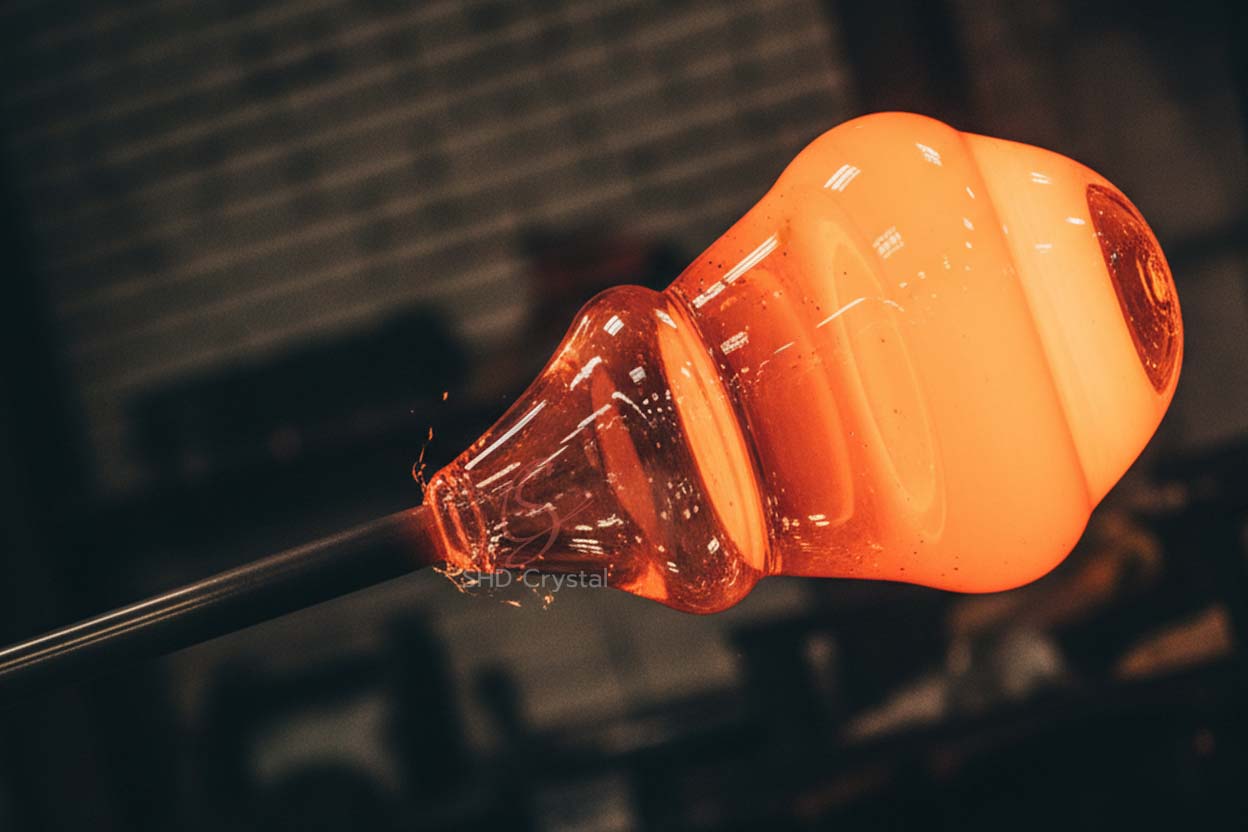
Custom glass blowing begins in a state where material has not yet decided its form. Molten glass exists between structure and movement, and every decision made during this stage determines how the final object will behave.
In custom glass blowing, form is not imposed—it is negotiated. The maker works within a narrow window where temperature, gravity, and motion interact. This is why handcrafted glass art carries a different presence from molded products. It retains a sense of origin, a trace of how it came into being.
Where Custom Glass Blowing Enters Design Practice
In contemporary projects, custom glass blowing is rarely used for decoration alone. It is applied where material must respond to space.
Architectural lighting, for example, often relies on bespoke glass design to control diffusion and scale. A pendant cannot simply exist; it must relate to ceiling height, surrounding materials, and ambient light levels. Standard products rarely resolve all these variables.
Handcrafted glass art becomes relevant here because it allows adjustment during formation. Curvature, thickness, and volume can be refined while the material is still responsive, making custom glass blowing a practical design tool rather than a purely artistic one.
Material Behavior as a Design Constraint
Glass does not behave like solid material during production. In custom glass blowing, it moves, stretches, and settles under its own weight.
This behavior defines what is possible. A form that appears simple in drawing may collapse under heat if not properly balanced. Conversely, certain organic shapes become achievable precisely because the material is fluid.
In bespoke glass design, understanding this behavior is essential. The final object is not only the result of intention, but of how the material was allowed—or guided—to move.
What Handcrafted Glass Art Reveals
A handcrafted object often carries subtle evidence of its making. In custom glass blowing, this appears as slight variations in thickness, gentle asymmetry, or soft transitions between surfaces.
These characteristics are not defects. They are indicators of process. In handcrafted glass art, uniformity is less important than coherence. The object should feel resolved, even if it is not perfectly identical to another.
This distinction is important for clients. Bespoke glass design offers consistency in concept, not replication in detail.
Common Misunderstandings Around Bespoke Glass Design
One of the most common assumptions is that custom glass blowing is inherently less precise than industrial production. In reality, it is precise in a different way.
While molds define exact repetition, handcrafted glass art relies on controlled variation. The goal is not identical duplication, but repeatable character. A series of pieces should belong together without appearing mechanically identical.
Another misconception is that bespoke glass design is limited to decorative use. Many applications—lighting covers, specialty containers, or architectural elements—require functional performance that can only be achieved through controlled forming.
From Prototype to Scalable Production
A key stage in custom glass blowing is the transition from one piece to many. What works as a single object must be translated into a process.
Prototyping allows the maker to define limits: acceptable variation, structural stability, and finishing requirements. Once established, these parameters guide production.
In handcrafted glass art, scalability does not eliminate individuality. Instead, it defines a range within which variation is acceptable. Bespoke glass design at this stage becomes a balance between control and flexibility.
Where the Craft Is Moving
Custom glass blowing is increasingly positioned between art and industrial production. Designers are pushing for forms that feel less standardized, while manufacturers are improving control over consistency.
This shift is visible across industries. Interiors demand objects that feel specific to a space. Hospitality projects require identity without sacrificing durability. Art and design are no longer separate categories.
Handcrafted glass art continues to evolve because it can operate in both worlds. Bespoke glass design adapts without losing its core logic: material first, form second.
Conclusion
Custom glass blowing remains relevant because it resolves a fundamental challenge—how to shape a fluid material into a stable, purposeful object. Through controlled process and material understanding, handcrafted glass art and bespoke glass design provide solutions that extend beyond decoration into function, identity, and long-term use.
From Process to Production: Custom Glass Blowing with SHD Crystal
At SHD Crystal, custom glass blowing is approached as a structured process rather than an isolated craft. Each project moves from concept evaluation to forming, annealing, and finishing with defined parameters for shape, thickness, and consistency.
For handcrafted glass art and bespoke glass design applications, this approach allows ideas to transition into production without losing their original intent. By aligning material behavior with production control, custom glass blowing can support both one-of-a-kind developments and scalable projects across interior, lighting, and functional categories.