
 > Blogs > Hookah Material Sustainability Analysis Explained Clearly
Table of Contents
Core keywords: hookah material sustainability analysis, sustainable hookah glass production, eco-conscious glass hookah
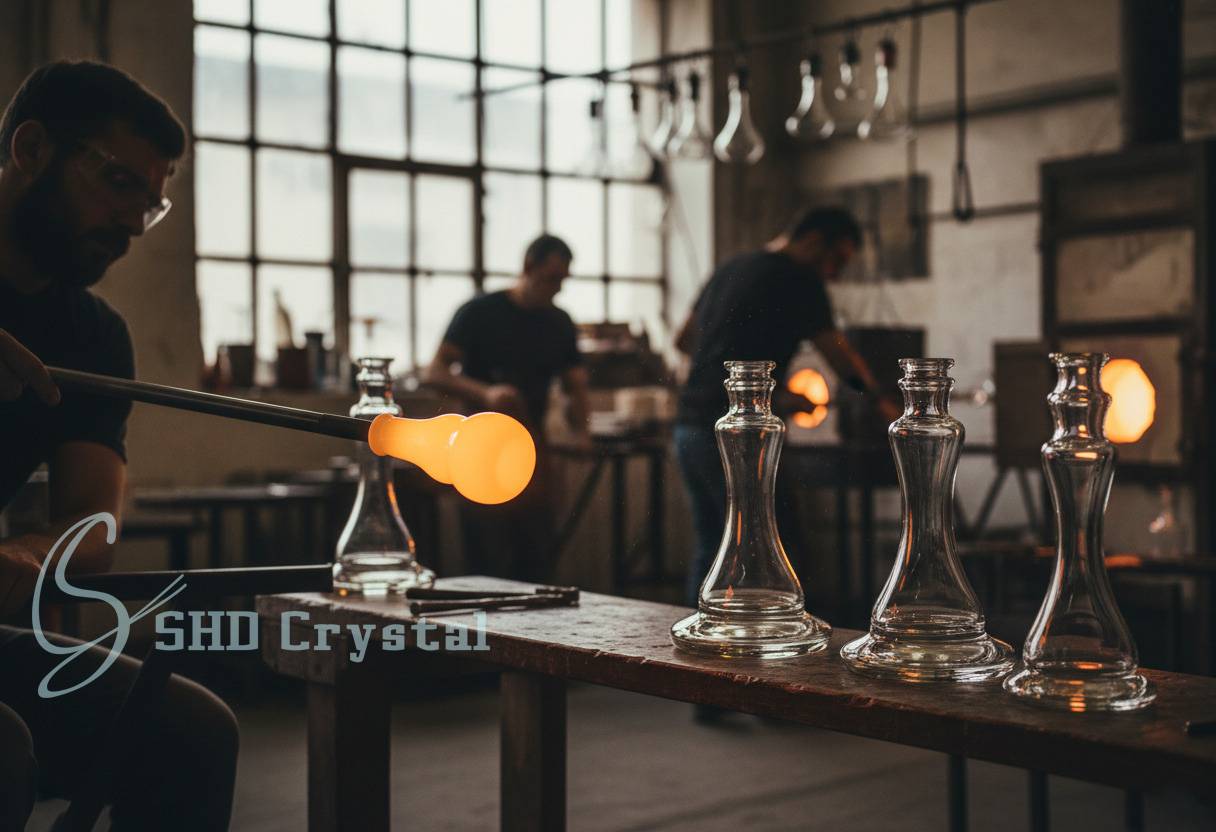
A professional hookah material sustainability analysis must go beyond marketing promises—it should deliver data, traceability, and measurable improvement. In today’s market, customers expect not only beauty and performance but also proof of environmental responsibility. For manufacturers, sustainability analysis is no longer optional; it is a foundation for compliance, waste reduction, and lasting brand trust. Responsible production now directly influences customer loyalty and B2B procurement decisions.
At SHD Crystal, our crystal glass hookah factory has developed a transparent framework that measures environmental performance from raw sand to recycled cullet, ensuring that every base reflects both craftsmanship and conscience. This dedication defines our role in sustainable hookah glass production and positions us as pioneers of responsible innovation.
How Hookah Material Sustainability Analysis Drives Responsible Innovation
Understanding the environmental footprint of glass hookahs requires a structured, data-backed approach. A hookah material sustainability analysis evaluates every stage—from raw material sourcing to melting, annealing, finishing, packaging, and end-of-life recycling—to reveal opportunities for improvement.
Our process begins with a comprehensive life cycle assessment (LCA) that defines boundaries and measurable metrics. By linking results to design optimization, we merge engineering with sustainability. This approach supports sustainable hookah glass production that delivers both luxury and accountability—turning verified data into a competitive advantage.
Data Framework: Measuring Sustainability
Each hookah material sustainability analysis we conduct aligns with globally recognized frameworks such as ISO 14040/44 (LCA) and the GHG Protocol.
Our approach evaluates three key pillars:
Material Input – glass composition, cullet ratio, energy consumption, and sourcing transparency.
Process Efficiency – furnace temperature control, yield rate optimization, and annealing stability.
End-of-Life Strategy – recyclability, transport efficiency, and closed-loop recycling systems.
By quantifying these pillars, we advance sustainable hookah glass production while enabling a full-circle model where waste transforms back into a valuable resource. This transparency differentiates our crystal glass hookah factory in an industry still catching up on sustainability standards.
The Role of Glass Durability in Sustainability
Durability remains a cornerstone of true sustainability. In a hookah material sustainability analysis, product longevity directly reduces carbon intensity per use. Our annealing experts monitor soak curves and cooling gradients to eliminate micro-stress fractures invisible to the naked eye. Uniform wall thickness and rounded rims minimize breakage during cleaning and transportation.
This durability ensures each eco-conscious glass hookah remains in service for years, entering recycling loops only when absolutely necessary—reducing emissions and replacement waste across its lifecycle.
Integrating Beauty and Responsibility
Sustainability should enhance, not limit, design creativity. At SHD Crystal, we apply sustainable techniques that preserve both aesthetics and environmental integrity:
- Frosted finishes use mechanical etching instead of chemical baths.
- Colored glass employs mineral-based pigments free of heavy metals.
- Coatings and decals are heat-fused into the glass structure for safe longevity.
These refinements embody the essence of eco-conscious glass hookah craftsmanship—uniting artistic excellence with measurable eco-performance. In our factory, design and sustainability evolve together toward a shared goal of sustainable hookah glass production.
The Factory Advantage: Transparency and Traceability
Each shipment from our crystal glass hookah factory includes verified documentation—composition data, furnace logs, and annealing profiles. Every hookah material sustainability analysis is batch-linked and timestamped for full audit readiness.
We also partner with suppliers to recover retired products and integrate them into closed-loop recycling systems. This process ensures that every eco-conscious glass hookah maintains its value beyond its service life—transforming environmental commitment into quantifiable, traceable performance.
Case Example: Measurable Results
A 2024 audit comparing our updated production process with a 2020 baseline revealed:
-22% reduction in furnace energy per ton of melt (kWh/ton).
-17% increase in recycled cullet use with no quality loss.
-30% lower breakage rate during shipment.
All internal data are validated through annual in-factory audits consistent with GHG Protocol reporting guidelines. These outcomes, verified through internal energy and yield audits aligned with ISO 14044, confirm that measurable progress in sustainable hookah glass production can be achieved without compromising quality.
Conclusion
Responsibility begins with measurement. Through advanced hookah material sustainability analysis, manufacturers can unite artistry, durability, and verified eco-performance.
Partner with SHD Crystal, a forward-thinking crystal glass hookah factory, where craftsmanship meets data-driven responsibility. From engineering to ethics, every eco-conscious glass hookah we produce stands as proof that luxury and sustainability can coexist beautifully.


