
 > Blogs > Optimizing the Mass Production Process for Glass Hookah
Optimizing the Mass Production Process for Glass Hookah
Table of Contents
Core Keywords: mass production process for glass hookah, glass annealing control
Turning artistic concepts into reliable glass masterpieces requires mastery of the mass production process for glass hookah. Every curve, seal, and finish must transition seamlessly from prototype to scale without losing clarity or strength. This process is not just manufacturing—it’s a synchronized system of material science, heat control, and precision inspection that preserves both form and function across thousands of pieces.
The Mass Production Process for Glass Hookah: Precision from Melt to Shipment
Scaling artistry demands structure. The mass production process for glass hookah begins long before molten glass meets a mold. It starts with material formulation, furnace stability, and strict quality checkpoints that turn craftsmanship into consistent excellence.
Industrial-grade protocols ensure that each piece performs perfectly—both visually and structurally—throughout the forming, cooling, and packaging phases.
Raw Material Control and Melting Accuracy
Glass quality begins with purity. Silica sand, soda ash, and stabilizers are screened and blended in precise ratios to eliminate chemical inconsistencies. Using automated feeders, furnaces maintain a ±5°C temperature window to ensure homogeneity.
This precision forms the foundation of the mass production process for glass hookah, where every molten gathering flows smoothly for predictable forming and uniform wall thickness.
Molding Geometry and Surface Precision
Shape defines both function and aesthetics. Molds are machined to sub-millimeter accuracy, ensuring that neck diameter and base symmetry remain within design tolerances. Internal coatings prevent sticking and micro-defects.
By synchronizing mold rotation with controlled cooling timing, the process stabilizes visual uniformity—crucial to achieving scalability in the mass production process for glass hookah.
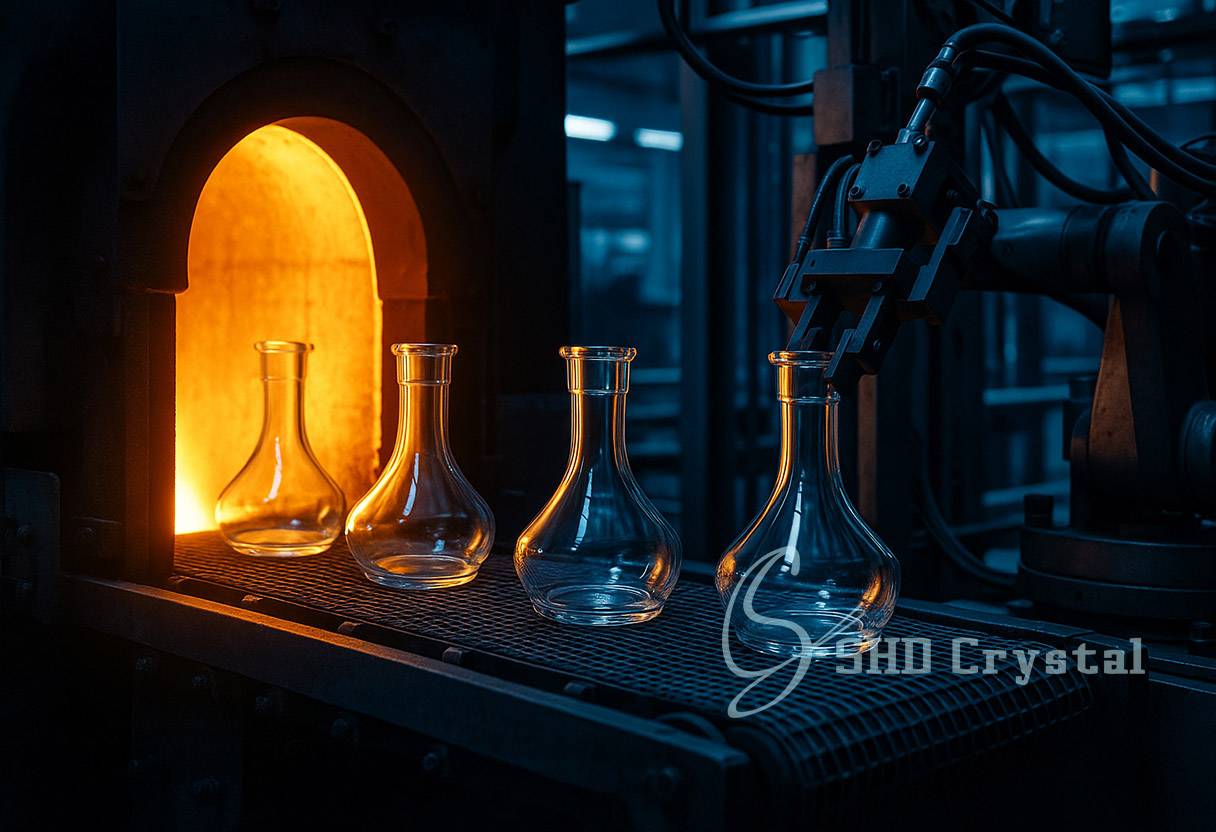
Thermal Conditioning and Glass Annealing Control
When glass cools too quickly, invisible internal stress can compromise strength. Through meticulous glass annealing control, cooling curves are regulated inside lehrs, with temperature and duration adjusted according to thickness and color density.
Infrared sensors record each batch profile, allowing engineers to verify structural stability before decoration or assembly.
This careful balance between time and temperature ensures that every base maintains its integrity from furnace to final shipment.
Decoration and Finish Durability
Surface artistry—whether lacquering, gradient coloring, or etching—undergoes adhesion and chemical resistance testing. Each decorative layer is UV-cured or thermally set, then validated through detergent scrub and heat cycling tests.
These finishing trials align with the mass production process for glass hookah, proving that beauty and endurance can coexist. Once coatings pass inspection, they are integrated into automated finishing stations for repeatable precision.
Quality Checkpoints and Statistical Process Control
Inspection is driven by data, not opinion. Dimensional gauges, vacuum-seal testers, and optical scanners monitor production samples during every shift.
The implementation of statistical process control transforms raw measurements into actionable data trends, highlighting variations before defects occur. With this system, stability is maintained across thousands of pieces, ensuring that the mass production process for glass hookah remains predictable at full output.
Packaging Engineering and Logistics Assurance
A flawless product deserves equal protection. Each glass base is secured with molded-pulp cradles, layered partitions, and reinforced edge guards. Packaging trials include vibration and drop simulations replicating international transport conditions.
Every crate leaving the facility represents not only fine glass hookah manufacturing, but also the reliability of an optimized production system designed for global shipment integrity.
Continuous Innovation and Environmental Balance
Sustainability integrates seamlessly into production through closed-loop water systems and cullet recycling, reducing furnace energy consumption by up to 15%.
These innovations make the mass production process for glass hookah both efficient and environmentally responsible—proof that precision engineering and eco-awareness can advance together in modern manufacturing.
Conclusion
Executed with discipline, the mass production process for glass hookah seamlessly unites art and engineering. Through controlled melting, precise geometry, and rigorous testing, each product achieves harmony between strength, clarity, and scalability—ready to perform at industrial scale with measurable confidence.
Partner with SHD Crystal to Refine Your Glass Hookah Production
Collaborate with SHD Crystal‘s engineering team to enhance your mass production process for glass hookah.
From custom mold development to glass annealing control and statistical process control, we help transform your concepts into scalable, dependable perfection.
Together, we ensure every piece delivers consistent quality, enduring performance, and lasting beauty.


