
Blogpost keywords: custom green glass vase, spectral absorption glass, controlled visual density
A custom green glass vase does not amplify light—it regulates it.
Positioned within a narrow spectral range, green glass allows partial transmission while selectively absorbing higher-intensity wavelengths. This creates an optical damping effect, where brightness is moderated rather than reflected. The result is a material presence defined by controlled visual density—visible, but never overwhelming.
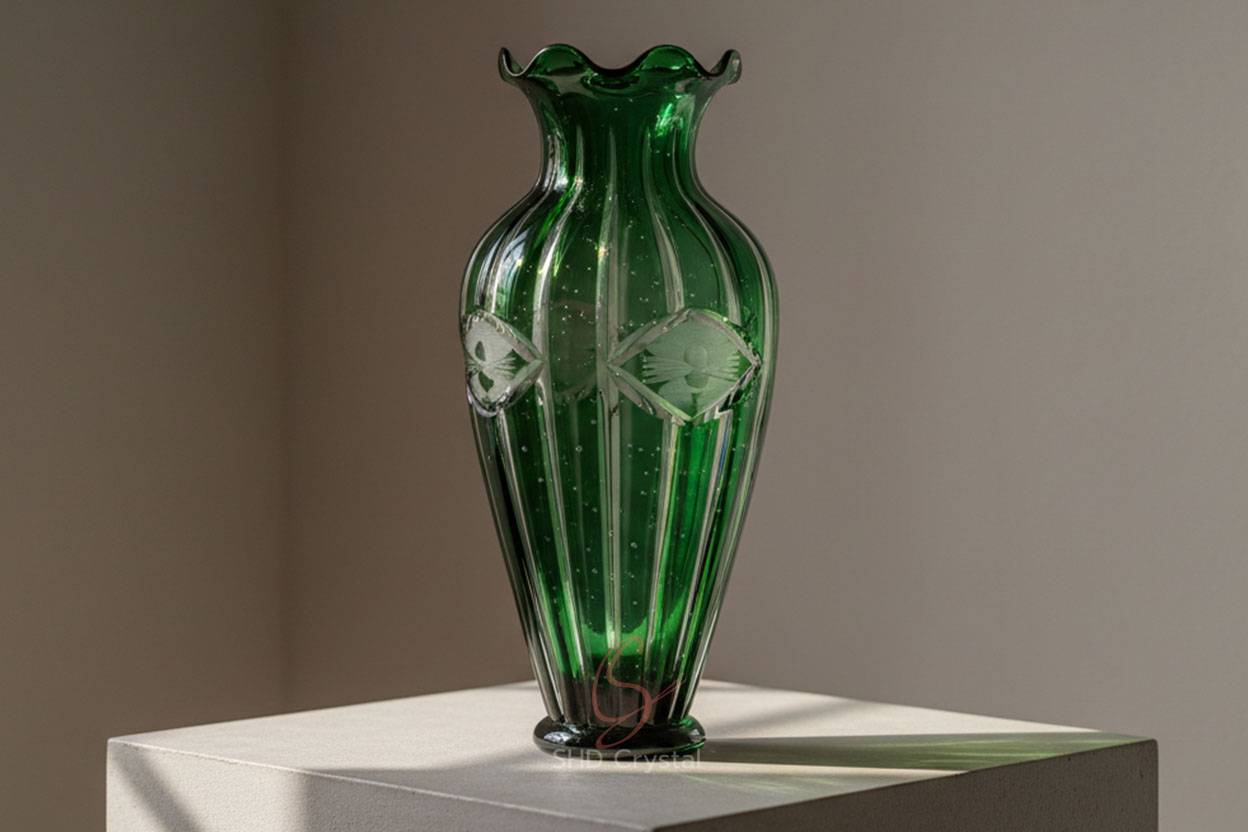
Instead of dispersing illumination outward, the glass slows light within its volume. As light travels through the body of a custom green glass vase, it gradually loses intensity, exiting as softened, diffused brightness. This behavior originates from spectral absorption glass, embedded at the material level rather than applied at the surface.
Custom Green Glass Vase and Spectral Absorption Glass Behavior
The defining characteristic of a custom green glass vase lies in how color is formed.
In true coloration processes, metal oxides are integrated into molten glass, becoming part of its internal structure. This enables spectral absorption glass to behave consistently across thickness variations. Thicker sections appear deeper in tone, while edges remain lighter and more transparent.
This internal gradient is not decorative—it is optical.
Because absorption remains partial, transparency is preserved. The custom green glass vase retains clarity while achieving controlled visual density, distinguishing it from painted or coated glass where color sits only on the surface.
Smooth surface continuity further supports this effect. Curved geometries allow light to transition gradually, preventing abrupt tonal shifts and maintaining visual coherence.
Controlled Visual Density in Spatial Context
Material behavior becomes most evident in context.
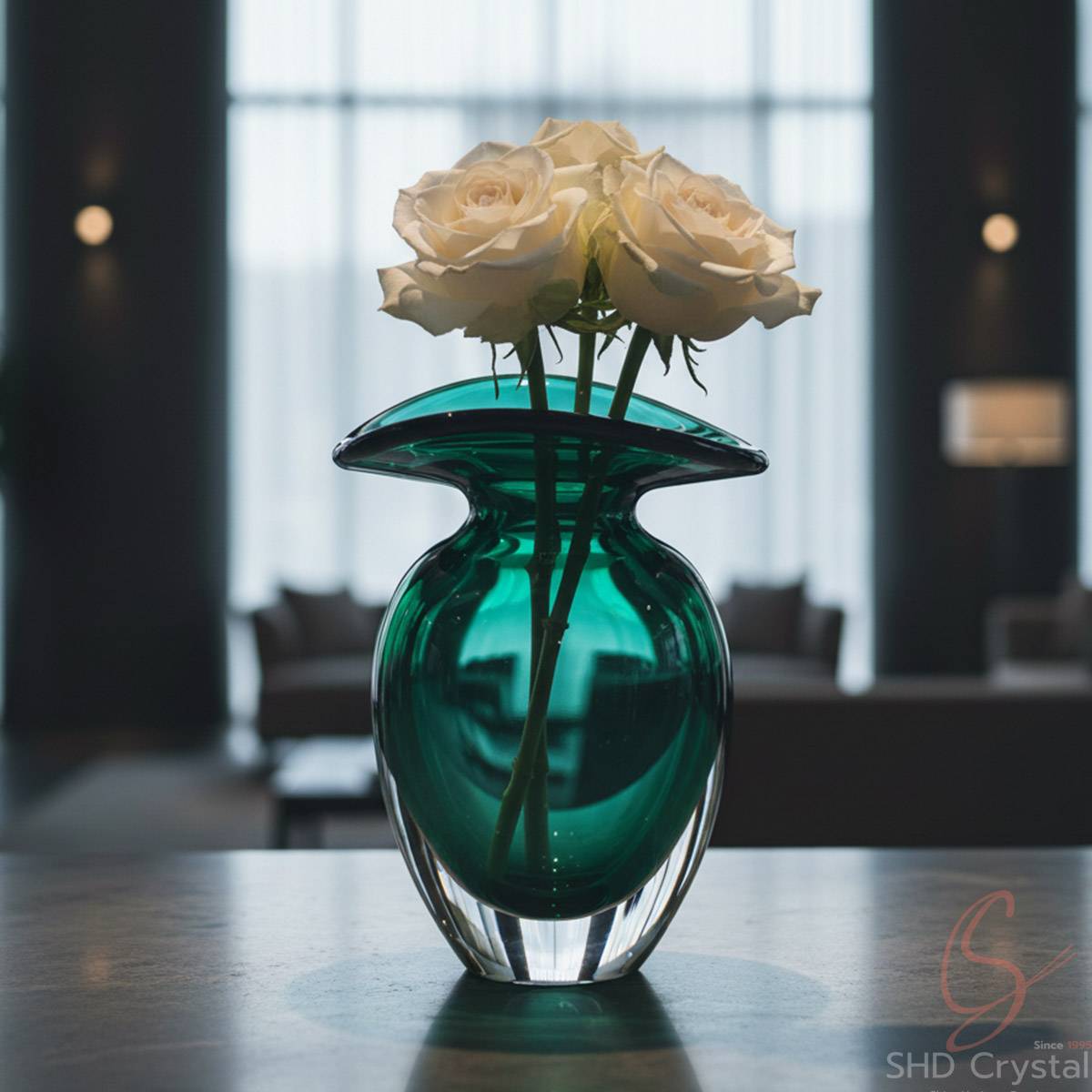
A custom green glass vase interacts with its surroundings by reducing visual sharpness. In bright or reflective environments, it acts as a moderating element, filtering excess light without introducing opacity.
This is where controlled visual density becomes functionally relevant. Rather than dominating a space, the object stabilizes it.
Designers often place such pieces near polished stone, metal, or glass surfaces. In these conditions, spectral absorption glass reduces glare while preserving reflections, allowing the environment to remain visually active but less aggressive.
The effect is subtle but measurable: highlights soften, contrast lowers, and the overall perception becomes more balanced.
Reading Material Quality Through Light Behavior
Material quality in a custom green glass vase is best evaluated through observation rather than specification.
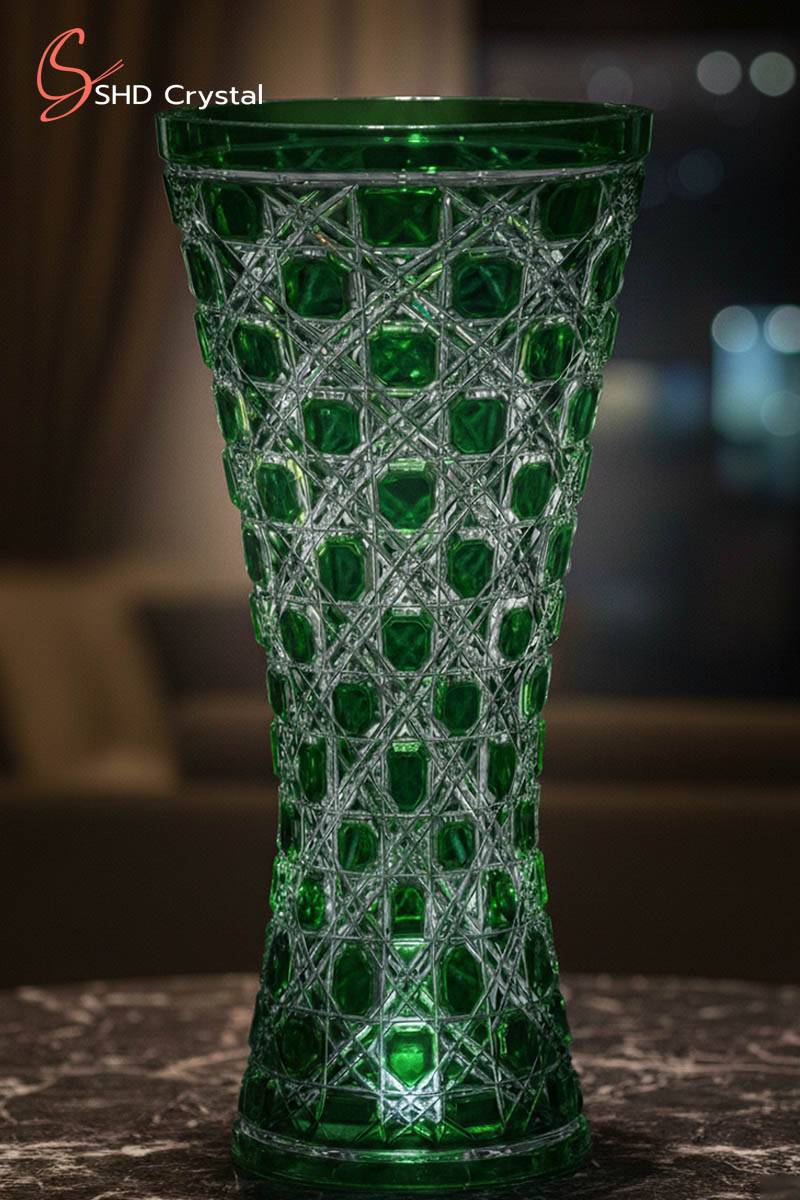
A well-executed piece reveals gradual tonal deepening toward its core, without losing brightness along the edges. This indicates consistent spectral absorption glass integration rather than superficial coloring.
Under changing light conditions, the object responds with restraint. Instead of dramatic shifts, the controlled visual density remains stable, reinforcing a sense of material integrity.
This restrained optical response is often what separates high-quality glass from visually similar but technically simpler alternatives.
Conclusion
A custom green glass vase expresses material control through optical damping, partial absorption, and gradual tonal layering. Through spectral absorption glass, it achieves controlled visual density—a balance between presence and restraint shaped by how light moves through the material.
A Material Approach to Softer Spatial Contrast
In environments where brightness and reflection require moderation, introducing a custom green glass vase offers a subtle solution. Through spectral absorption glass, it provides controlled visual density that softens visual intensity without reducing transparency.
SHD Crystal Optical Glass Manufacturing Capability
In colored glass production, achieving true optical behavior requires control at the material level. SHD Crystal supports the development of custom green glass vase designs through precise formulation of spectral absorption glass, ensuring consistent color integration and light transmission across different thicknesses.
Our process focuses on controlling melt composition, forming stability, and annealing conditions so that controlled visual density remains uniform throughout each piece. This is particularly critical for applications where optical performance—not just color—is the defining requirement.
By combining material formulation with precision forming, SHD Crystal enables clients to produce glass objects that maintain both visual refinement and stable optical behavior in real environments.