Blogpost keywords: custom crystal glass sculpture, handcrafted crystal sculpture, bespoke glass sculpture
A custom crystal glass sculpture rarely begins as a fixed drawing. Instead, it often starts as a movement—molten glass turning, stretching, collapsing, and reforming in ways that cannot be fully predicted.
This is where the idea of control changes. In traditional manufacturing, precision defines quality. But in handcrafted crystal sculpture, value often comes from controlled unpredictability—where each curve, fold, or asymmetry becomes part of the final identity.
Freeform glass does not aim to repeat. It aims to express.
Custom Crystal Glass Sculpture in Freeform Glass Blowing Practice
In the process of creating a custom crystal glass sculpture, free blowing plays a defining role. Unlike mold-based production, free blowing allows the artisan to shape the glass directly in its molten state.
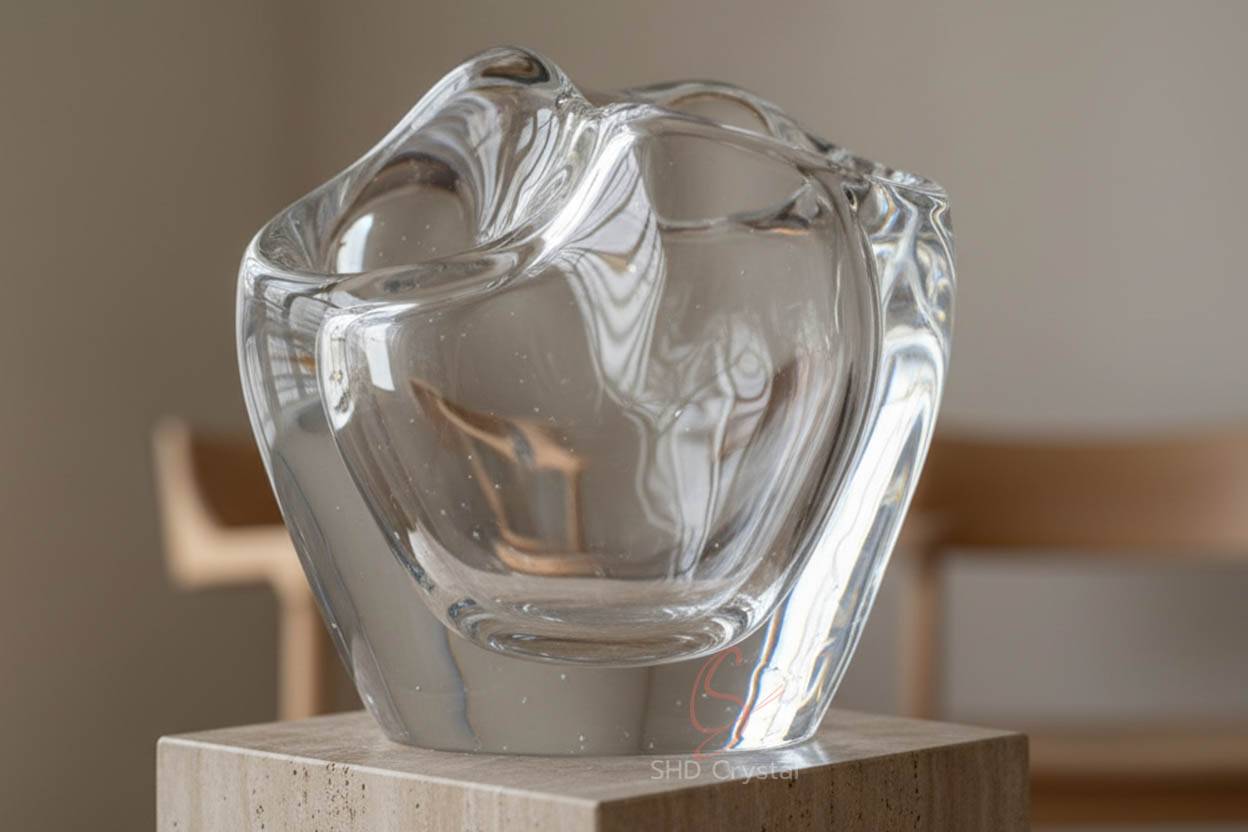
The material responds to gravity, airflow, and hand movement. A slight rotation can elongate a form. A pause can thicken a surface. A controlled tilt can create asymmetry that feels organic rather than forced.
This is why bespoke glass sculpture often carries subtle irregularities—not as defects, but as evidence of its origin. Each piece records the moment it was formed.
From Symmetry to Intentional Irregularity
Most industrial glass objects rely on symmetry to achieve balance. In contrast, a custom crystal glass sculpture may deliberately move away from uniformity.
Edges may shift, volumes may lean, and surfaces may stretch unevenly. These variations create tension within the form, allowing the sculpture to feel alive rather than static.
In handcrafted crystal sculpture, irregularity is not randomness. It is guided by experience—knowing when to stop shaping, when to allow gravity to act, and when to preserve a distortion because it adds character.
Light, Thickness, and Internal Movement
One of the defining qualities of a custom crystal glass sculpture is how it interacts with light. In freeform pieces, thickness is rarely uniform.
Some areas remain dense and heavy, bending light dramatically. Others become thin and translucent, allowing light to pass through more softly. This variation creates internal movement, even when the object itself is still.
For bespoke glass sculpture, this optical behavior becomes part of the design language. The sculpture changes throughout the day as lighting conditions shift, making it responsive to its environment.
Where Freeform Glass Sculpture Finds Its Place
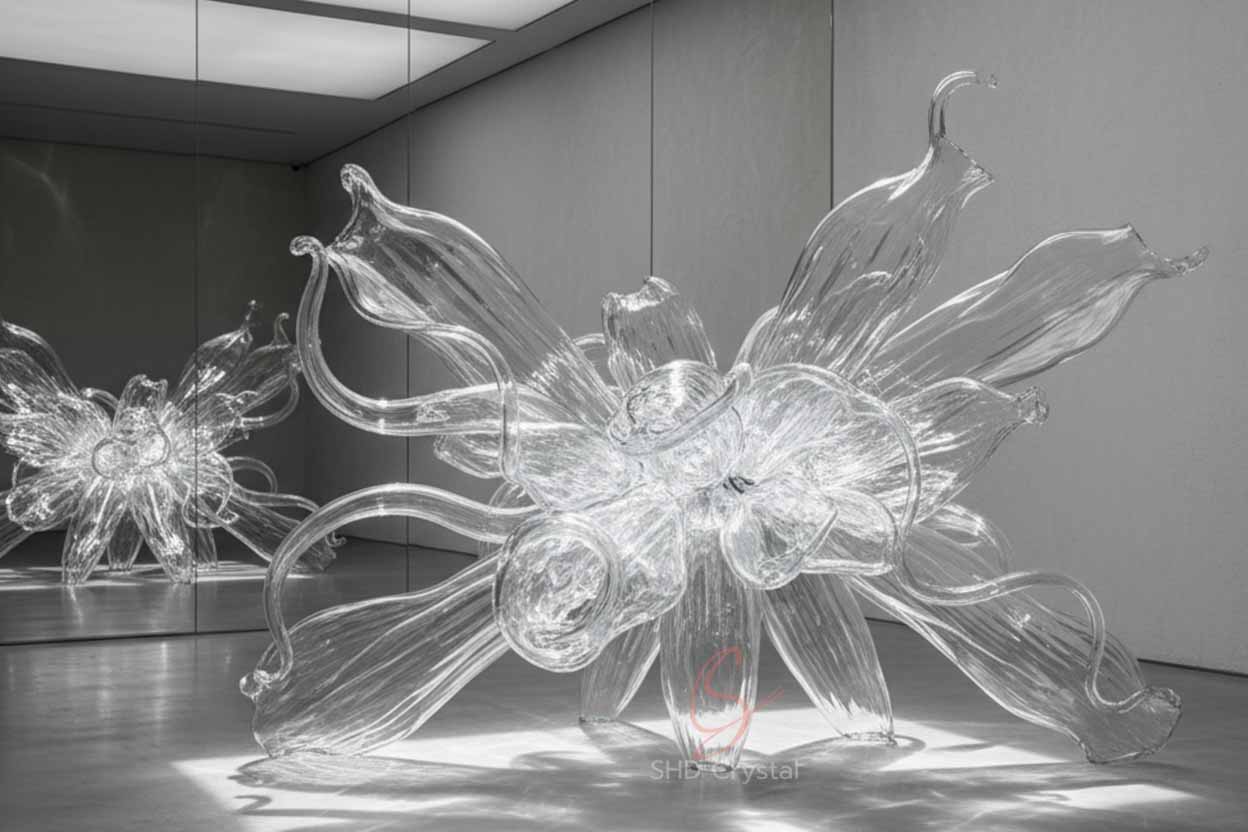
In interior and architectural settings, custom crystal glass sculpture is often used as a focal point—but not in an overpowering way.
Because of its transparency and irregular form, it interacts with space rather than dominating it. A handcrafted crystal sculpture may sit quietly in a residential interior, or stand more prominently in a hotel lobby or gallery.
In commercial environments, bespoke glass sculpture is often selected to introduce originality—something that cannot be replicated exactly, even within the same series.
Misconceptions About Free-Blown Glass Sculpture
A common misconception is that freeform glass is fragile due to its irregular structure. In reality, a well-produced custom crystal glass sculpture undergoes controlled annealing, reducing internal stress and ensuring stability.
Another misunderstanding is that irregular shapes are unpredictable in outcome. While each handcrafted crystal sculpture is unique, experienced artisans work within controlled parameters, ensuring that form, balance, and structural integrity remain consistent.
Conclusion
A custom crystal glass sculpture represents a different approach to making—one where precision and freedom coexist.
Through free blowing and intentional shaping, handcrafted crystal sculpture and bespoke glass sculpture move beyond repetition. They capture moments of material transformation, preserving them in forms that remain dynamic, expressive, and tied to the hand that created them.
From Freeform Creation to Spatial Installation
In real projects, a custom crystal glass sculpture is not only shaped in the furnace—it is completed within the space it is created for.
For design teams working on interiors or architectural concepts, translating a freeform idea into a stable, installable piece requires more than artistic control. Scale, weight distribution, mounting methods, and environmental lighting all influence how the sculpture will ultimately exist.
This is where collaboration becomes essential. A handcrafted crystal sculpture must retain its organic, free-blown character while adapting to practical constraints such as positioning, safety, and long-term maintenance.
Rather than standardizing the outcome, experienced production partners help guide each bespoke glass sculpture through this transition—preserving irregularity where it matters, while ensuring the piece performs reliably in its intended environment.