
Blogpost Keywords:yellow crystal vase factory, artistic vessel pieces for spas, contemporary flower pots for interior design
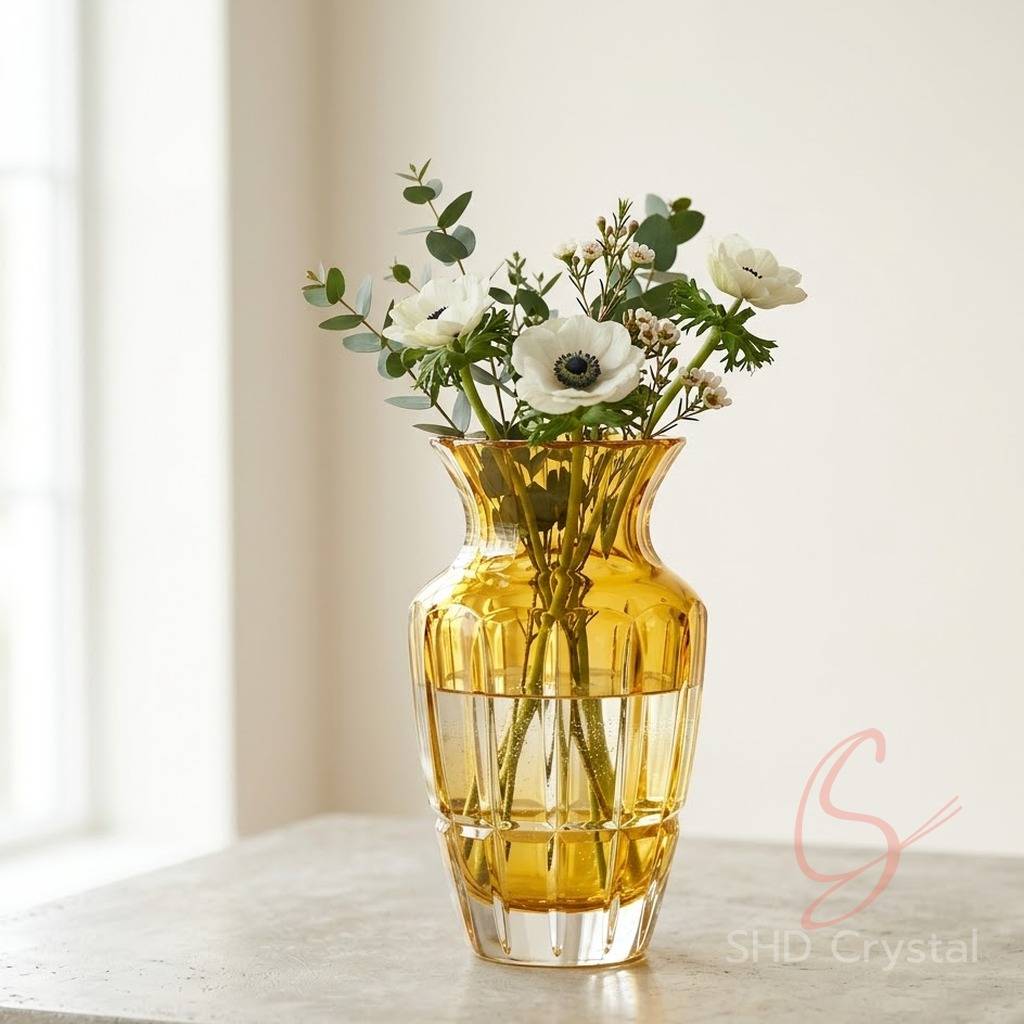
Yellow crystal glass differs fundamentally from clear or lightly tinted soda‑lime glass. The coloration relies on specific dopants — typically cadmium sulfide or cerium oxide — that demand precise temperature windows during melting. A yellow crystal vase factory must control furnace atmosphere to prevent oxidation shifts that turn yellow into greenish or brownish tones. Furthermore, crystal glass (lead content ≥10% or alternative barium/zinc formulations) has a narrower working range than standard glass, making process repeatability a critical technical challenge.
Material Behavior and Coloring Stability
In industrial glass production, yellow pigments are among the most sensitive to thermal history. If the melt dwells too long above 1450°C, cadmium compounds may volatilize, reducing color intensity. Conversely, insufficient homogenization yields streaky zones within the same vase. Professional yellow crystal vase factory operations implement scheduled sampling from the forehearth and use spectrophotometric analysis to verify L*a*b* values against a master standard. Batch recipes are locked, and each raw material lot — silica sand, potash, lead oxide, and coloring agents — is tested for purity before mixing. This level of material traceability is absent in low‑cost suppliers.
Mechanical and Optical Requirements for Spa Environments
Spas demand vessels that survive constant moisture, essential oil exposure, and occasional thermal shock (e.g., hot water refills). Products labeled artistic vessel pieces for spas must pass thermal shock testing: a typical specification requires no cracking when moving from 20°C to 85°C water within 30 seconds. Additionally, the glass must resist surface etching from alkaline cleaning agents. A competent yellow crystal vase factory will document the coefficient of thermal expansion (CTE) — ideally below 9×10⁻⁶/K for crystal — and provide chemical resistance data per DIN 12116. For spa applications, the rim geometry is also critical: a rolled or fire‑polished edge reduces chipping during handling by staff.
Dimensional Precision for Interior Design Flower Pots
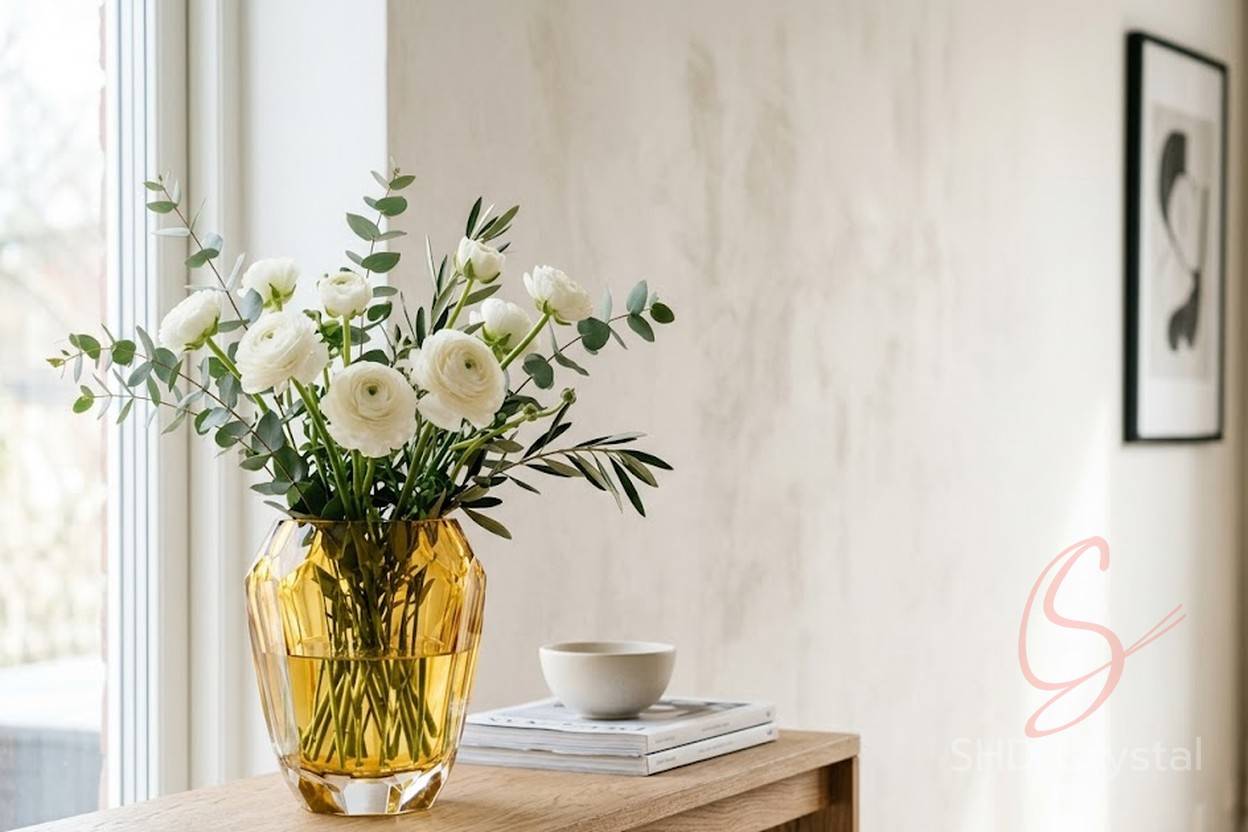
Interior designers often specify contemporary flower pots for interior design with tight tolerances on diameter, height, and wall thickness. A deviation of ±1.5 mm might be acceptable for a garden pot, but for a pot that fits into a precut hole in a reception desk or a custom planter sleeve, the required tolerance often drops to ±0.8 mm. Achieving this requires controlled pressing or blowing processes, followed by a precisely programmed annealing lehr. A professional yellow crystal vase factory uses automated calipers and laser micrometers on the production line, rejecting pieces that exceed tolerance bands. Furthermore, the bottom flatness must be within 0.3 mm to prevent rocking on hard surfaces — a hidden but crucial parameter for contemporary flower pots for interior design placed on polished concrete or marble.
Process Monitoring and Defect Prevention
Quality in a yellow crystal vase factory is not an after‑the‑fact inspection; it is built into each step. Typical process control points include:
Batch weighing accuracy – ±0.1% for major constituents, ±0.01% for colorants.
Melter atmosphere – monitored by oxygen sensors; reducing conditions favored for cadmium‑based yellows.
Gob temperature – maintained within ±3°C at the shear.
Mold lubrication frequency – adjusted to prevent surface wrinkles.
Post‑mold annealing – controlled cooling at 2–5°C per minute through the strain point (approx. 450°C for crystal).
Manufacturers that do not publish these parameters cannot guarantee consistent output. For artistic vessel pieces for spas, even minor residual stress can lead to spontaneous cracking weeks after delivery. A polarized light inspection (polariscope) reveals stress patterns; any piece showing more than 15 nm/cm retardation should be rejected.
Custom Tooling and Prototyping Workflow
When a client orders a new shape — for example, a low, wide contemporary flower pot for interior design with an integrated water reservoir — the factory must produce a mold. The technical workflow:
3D CAD model submitted by client or drawn in‑house.
Mold flow simulation to predict glass distribution and potential thin spots.
Prototype mold (cast iron or brass) for sample run of 10–20 pieces.
Dimensional and optical evaluation of prototypes.
Mold adjustment or re‑cut if tolerances not met.
Production mold (hardened tool steel) for full order.
A serious yellow crystal vase factory documents each step and provides a sample report including wall thickness map, color coordinates, and anneal stress readings. This transparency is especially important for artistic vessel pieces for spas where safety and aesthetics are equally critical.
Supplier Qualification: Technical Checklist
To select a yellow crystal vase factory, prepare a technical questionnaire:
What is the maximum lead time for a new mold?
What is the standard process capability (Cpk) for diameter and height?
Do you perform 100% stress inspection, or only sampling?
What is your acceptance criteria for color difference (ΔE) from the reference sample?
Can you provide a material safety data sheet (MSDS) for the crystal composition?
Have you previously produced artistic vessel pieces for spas or contemporary flower pots for interior design? Request production records.
Avoid factories that answer vaguely or cannot produce test data. In glass manufacturing, verbal assurances without documentation have little value.
Integration with Your Production Planning
Once a yellow crystal vase factory passes qualification, integrate their production schedule with your inventory needs. Crystal glass has a longer cooling cycle (24–48 hours annealing for thick walls) than soda‑lime glass, so lead times are inherently longer. Plan for 4–6 weeks from mold approval to first shipment, depending on quantity. For artistic vessel pieces for spas ordered seasonally, secure production slots 2–3 months ahead. For contemporary flower pots for interior design that need to match specific architectural deadlines, request a locked production calendar with penalty clauses for delays.
Summary of Technical Advantages
Working with a process‑controlled yellow crystal vase factory yields measurable benefits: lower defect rates (typically <2% vs. 5–8% for non‑specialized factories), reproducible color across batches, and documented mechanical properties. For artistic vessel pieces for spas, this means fewer field failures and better brand safety. For contemporary flower pots for interior design, it means consistent fit and finish that satisfies discerning designers. SHD Crystal operates with full technical disclosure — from batch formulas to annealing profiles — and welcomes client audits. Request our process capability report and sample test data to begin your technical evaluation. Contact us