
Blogpost keywords: glass hookah molding, precision mold forming, repeatable hookah shapes
As hookah products move from artisanal concepts into scalable lines, manufacturing methods play a decisive role in quality and consistency. Glass hookah molding has become a critical process for brands that require controlled shapes, predictable dimensions, and reliable repeatability. In professional production environments, molding is not about speed alone—it is about precision and stability over time.
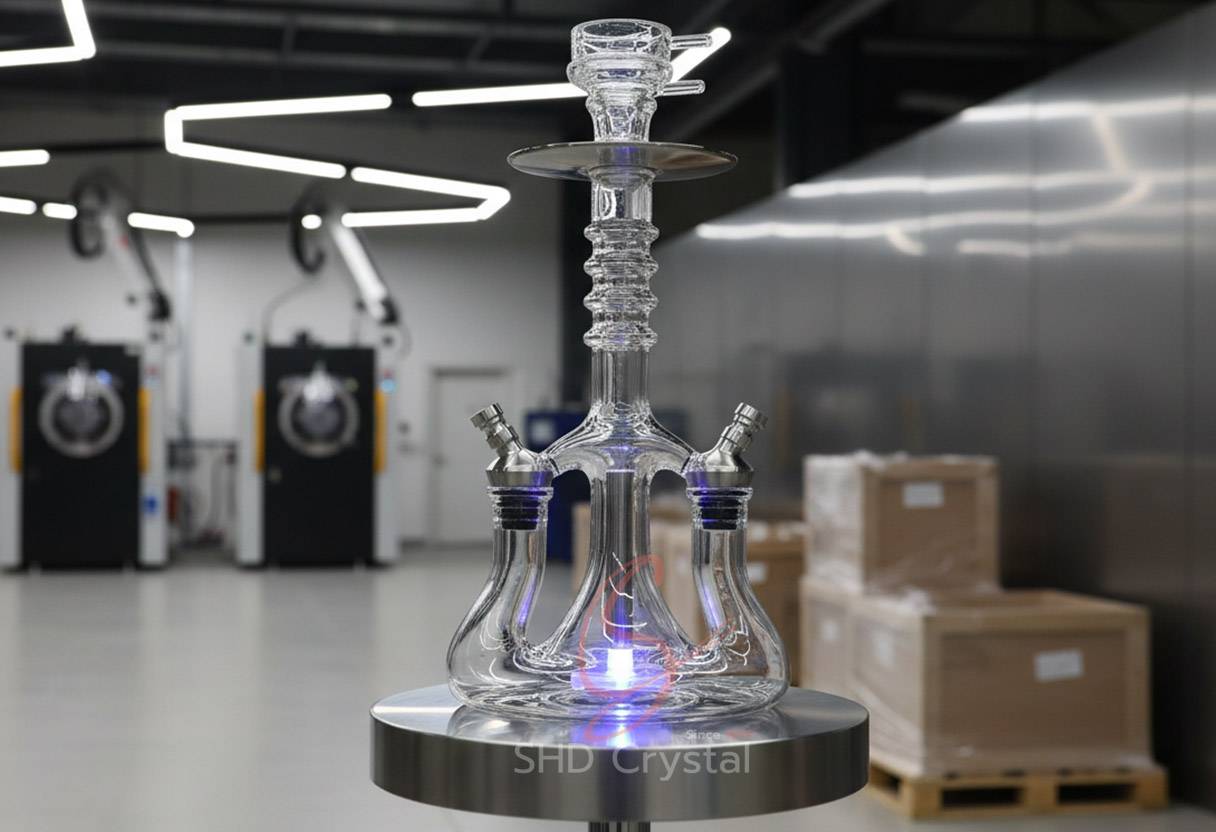
Why Glass Hookah Molding Matters in Modern Production
Glass hookah molding enables manufacturers to translate approved designs into consistent physical forms. Unlike free-form shaping, molding relies on predefined geometry, allowing dimensions and proportions to remain stable across batches. This approach is especially important when products are developed for international markets with strict compatibility and performance expectations.
By using structured molds, brands gain greater control over outcomes. Precision mold forming ensures that critical features—such as base diameter, wall thickness, and joint interfaces—remain aligned with the original design intent rather than drifting during production.
Precision Mold Forming as a Quality Control Tool
Precision mold forming focuses on accuracy at every stage of shaping. Mold design, material selection, and temperature control all influence how glass behaves during forming. When these factors are managed correctly, the result is a uniform surface finish and predictable geometry.
For hookah products, precision mold forming reduces variation that could affect stability or assembly. This consistency is essential for achieving repeatable hookah shapes, particularly when glass components must integrate seamlessly with metal stems or accessories.
Achieving Repeatable Hookah Shapes at Scale
Repeatable hookah shapes are not achieved by chance—they are the result of controlled processes and disciplined execution. Molding allows manufacturers to lock in proportions and replicate them accurately, even as production volumes increase.
Through glass hookah molding, brands can maintain visual coherence across product lines. Whether producing standard models or customized variants, the underlying geometry remains consistent. This repeatability simplifies quality inspection, replacement planning, and long-term product support.
Balancing Design Freedom and Manufacturing Stability
While molding introduces structure, it does not eliminate creativity. Glass hookah molding can accommodate complex profiles when molds are engineered correctly. Subtle curves, decorative transitions, and distinctive silhouettes can still be realized without sacrificing consistency.
In this context, precision mold forming becomes a bridge between design ambition and manufacturing reality. By validating molds through sampling and testing, manufacturers ensure that repeatable hookah shapes remain faithful to the original concept.
Manufacturing Reliability for OEM Projects
For OEM-focused brands, reliability is a strategic requirement. Glass hookah molding supports predictable lead times and stable output, reducing risk during scale-up. Clear mold ownership and documented processes further enhance control.
When combined with precision mold forming, OEM partners gain confidence that approved designs can be reproduced consistently. Repeatable hookah shapes allow brands to focus on market development rather than production troubleshooting.
From Mold Design to Production-Ready Glass
At SHD Crystal, molding is approached as an engineering discipline. As a professional hookah accessory and glass manufacturer, we support hookah OEM projects through mold development, sample validation, and controlled production. Whether refining glass hookah molding processes or ensuring precision mold forming for stable output, our team helps clients achieve repeatable hookah shapes that are ready for long-term production.