
Blogpost keywords: ribbed glass lamp shades OEM, optical surface structuring, controlled luminance spread
Ribbed glass lamp shades OEM projects often begin with a simple request: reduce glare without losing brightness. But once production starts, it becomes clear that ribbed glass is not just a visual choice. It is a way of controlling how light behaves before it enters the space.
From an OEM perspective, ribbed glass lamp shades OEM development is less about decoration and more about managing light distribution. The ridged surface introduces optical surface structuring that changes how light exits the glass. Instead of a direct beam, the result is a controlled luminance spread that feels softer, more stable, and easier on the eye.
In many lighting designs, this subtle shift determines whether a fixture feels comfortable or visually aggressive.
How Ribbed Glass Lamp Shades OEM Uses Optical Surface Structuring to Redirect Light
At the production level, the ribbed pattern is not arbitrary. Each ridge functions as a small optical interruption.
In ribbed glass lamp shades OEM manufacturing, optical surface structuring is defined by rib depth, spacing, and alignment. When light passes through these repeated structures, it is refracted slightly at every ridge. The effect is cumulative. Rather than one strong output, light is redistributed across multiple directions.
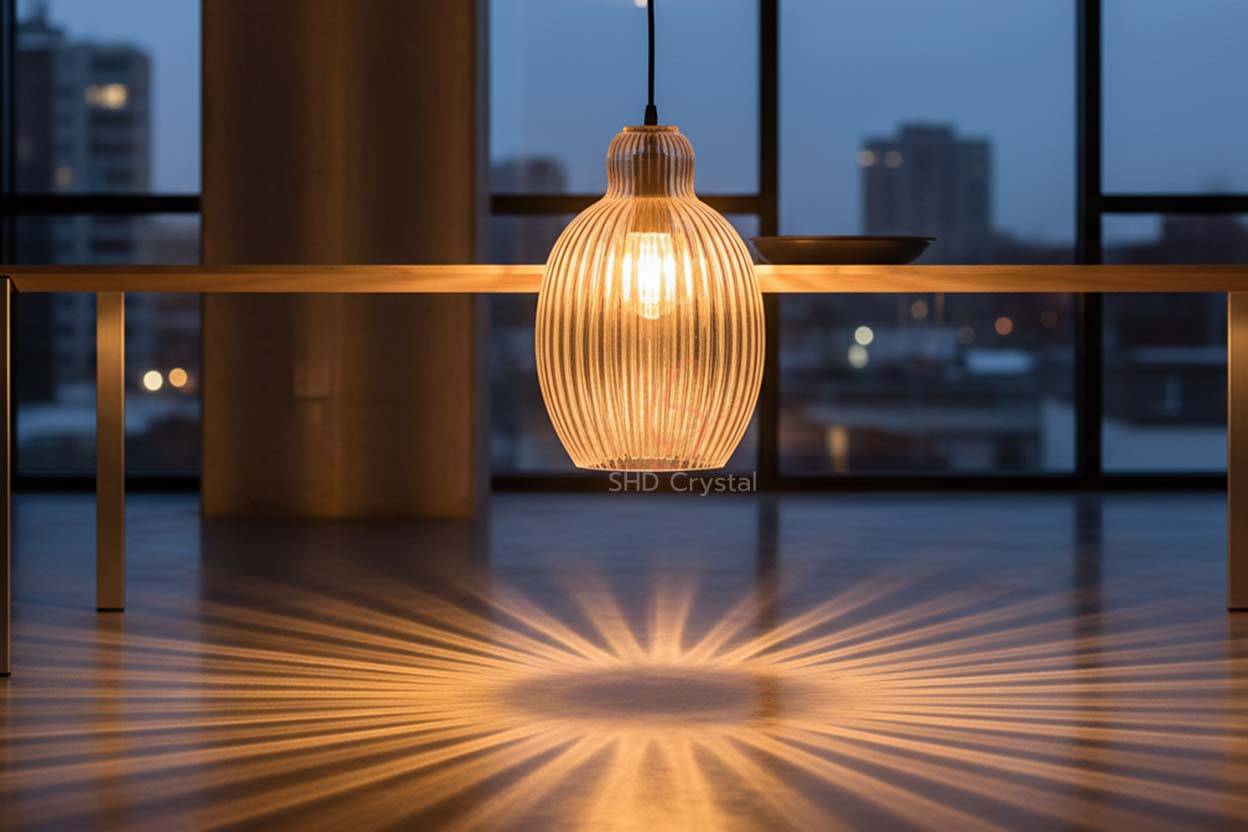
This is how controlled luminance spread is achieved.
What makes this process interesting is that the glass itself remains transparent. There is no coating or diffusion layer added. The control comes entirely from geometry. For lighting brands, this means that performance is built into the material rather than applied afterward.
From an OEM standpoint, this requires precise tooling. If rib spacing varies, the optical effect becomes inconsistent. A reliable ribbed glass lamp shades OEM partner treats surface geometry as a functional parameter, not a decorative detail.
Why Ribbed Glass Feels Softer Without Reducing Brightness
One of the most common misunderstandings is that diffusion means dimming. In practice, ribbed glass lamp shades OEM solutions maintain brightness while changing how that brightness is perceived.
With smooth glass, light travels in a direct path, making the source highly visible. This often creates harsh highlights. Through optical surface structuring, ribbed glass interrupts that direct path. The light is spread in smaller increments, resulting in controlled luminance spread.
The bulb is still producing the same output, but the eye receives it differently.
This is particularly useful in environments where comfort matters, such as dining spaces or hospitality interiors. Instead of reducing lumen output, designers use ribbed glass lamp shades OEM components to reshape how light is distributed.
Where Optical Performance Meets Visual Identity
Beyond function, ribbed textures introduce a visual rhythm that remains present even when the light is off.
In daylight, the ridges catch ambient light and create subtle reflections. At night, the same structure becomes part of the illumination pattern. A well-designed ribbed glass lamp shades OEM product therefore performs in both states: as a lighting component and as a visual object.
Consistency becomes critical in multi-light installations. When multiple shades are used together, controlled luminance spread must behave uniformly across all units. Any variation in optical surface structuring becomes noticeable once installed.
This is why experienced OEM manufacturers prioritize repeatability. The goal is not only to produce identical shapes, but to ensure identical light behavior.
Practical Considerations From Production And Design Alignment
From an OEM perspective, successful ribbed glass lamp shades OEM projects begin with clarity about the intended lighting effect. If the goal is subtle diffusion, rib depth may be shallow. If stronger light redistribution is required, deeper or more closely spaced ribs may be used. Optical surface structuring must be matched to the type of light source and fixture design. Material thickness also plays a role. Thicker glass enhances the refractive effect, contributing to controlled luminance spread. However, it also increases weight and production complexity. These trade-offs are typically evaluated early in development.
Sampling remains essential. Observing how ribbed glass behaves under real lighting conditions often reveals differences that are not visible in drawings or simulations.
Conclusion
Ribbed glass lamp shades OEM production demonstrates how surface geometry can directly influence lighting performance. Through precise optical surface structuring and controlled luminance spread, textured glass transforms raw illumination into a more balanced and usable visual experience.
Turning Surface Texture Into Functional Lighting Control
For lighting brands and designers, ribbed glass lamp shades OEM solutions offer a reliable way to shape light without relying on additional materials. At SHD Crystal, we focus on integrating optical surface structuring into production, ensuring that controlled luminance spread remains consistent across every unit while supporting both design intent and real-world application.