
Blogpost keywords: stemmed crystal tableware, transparent food bowls, custom fruit bowl development
Stemmed crystal tableware rarely begins as a category. It usually starts as a problem.
A chef wants the dish to feel lighter on the table. A designer wants height without clutter. A brand wants something recognizable, but not decorative in an obvious way. That is when stemmed crystal tableware enters the discussion—not as a trend, but as a structural solution.
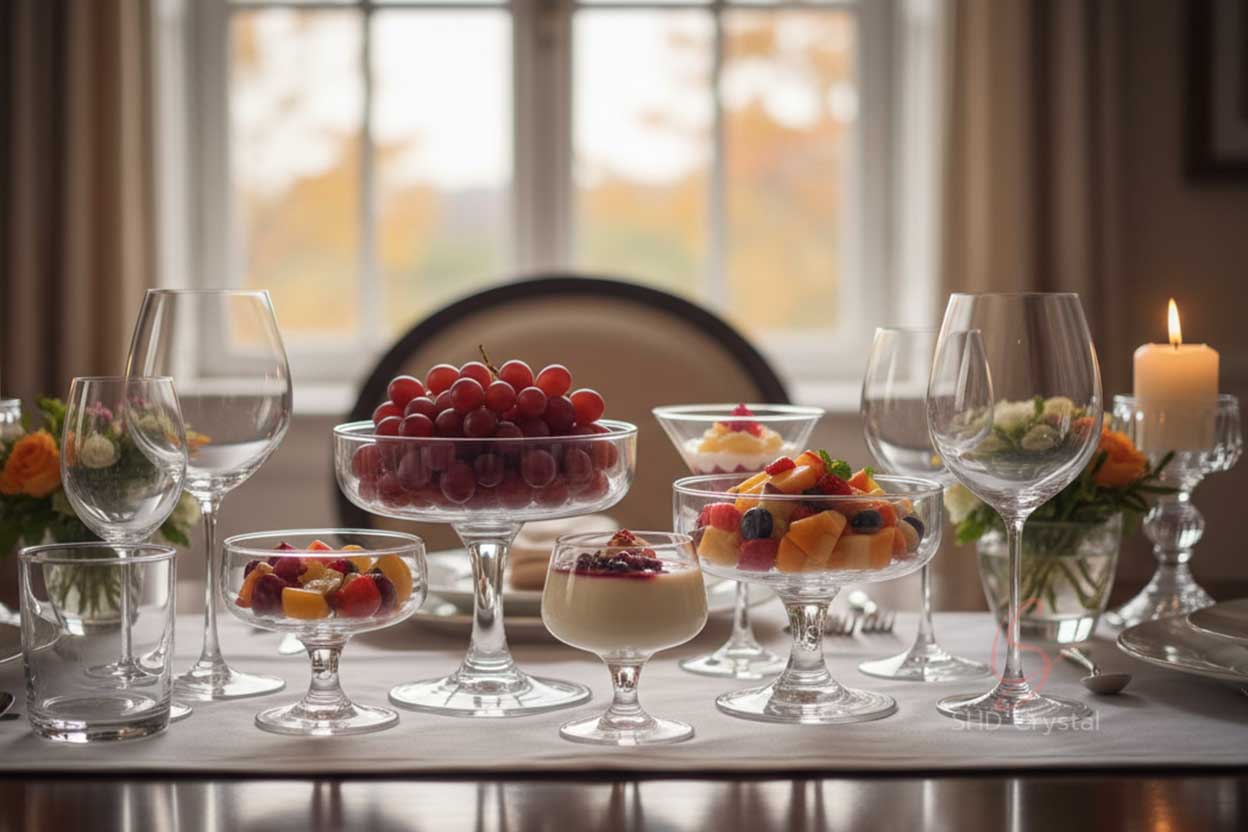
Unlike flat serving pieces, elevating the bowl changes how food is perceived. Transparent food bowls already allow visibility, but once lifted on a stem, the same content feels more deliberate, almost staged. In many projects, this shift is subtle, yet it changes the entire table composition.
Behind that shift is not just design, but custom fruit bowl development that translates visual intent into something stable, repeatable, and usable in real settings.
How Stemmed Crystal Tableware Emerges From Custom Fruit Bowl Development
The first prototype of stemmed crystal tableware rarely looks like the final product.
In early custom fruit bowl development, the challenge is not the bowl itself, but the relationship between the bowl and the stem. Too tall, and the piece becomes unstable. Too short, and the elevation effect disappears. The transition between these two parts determines whether the object feels intentional or awkward.
For transparent food bowls, this balance becomes even more visible. Because nothing hides the structure, every proportion is exposed. The thickness of the stem, the curvature of the bowl, and the weight of the base all interact visually and physically.
From an OEM perspective, this is where decisions start to layer. Increasing base thickness improves stability but adds visual weight. Reducing stem diameter enhances elegance but may affect durability. Custom fruit bowl development often moves through several iterations before these trade-offs settle into a usable form.
When Elevation Changes the Dining Experience
The first time stemmed crystal tableware is placed on a table, the effect is immediate but quiet.
Food is no longer sitting on the surface—it is slightly lifted into the visual field. Transparent food bowls amplify this effect by allowing light to pass through both the container and its contents. Fruits, desserts, or small plated items begin to interact with ambient light rather than absorbing it.
In hospitality settings, this creates a layered presentation. Multiple heights across a table introduce rhythm without adding more objects. Stemmed crystal tableware becomes part of the composition, not just a container.
During custom fruit bowl development, this effect is often tested under real lighting conditions. What looks balanced in a studio may behave differently under warm restaurant lighting or daylight environments.
The Moment Stability Becomes Visible
There is a point in every project where someone lifts the piece for the first time. That moment reveals whether the proportions work. Stemmed crystal tableware must feel stable even when held at an angle. The center of gravity needs to sit lower than expected, especially for transparent food bowls that may be filled unevenly. If the base is too light, the piece feels uncertain. If it is too heavy, it loses refinement.
This is why custom fruit bowl development often includes weight testing, not just visual evaluation. The goal is to ensure that the piece behaves naturally in use, without requiring the user to adjust how they hold it.
Where Craft Meets Repeatability
Once the form is finalized, the challenge shifts to consistency.
In stemmed crystal tableware production, maintaining uniform proportions across multiple units is more complex than it appears. Small deviations in stem alignment or bowl symmetry become noticeable when pieces are placed together.
For transparent food bowls, clarity adds another layer of difficulty. Any variation in thickness or polishing becomes visible immediately. Custom fruit bowl development must therefore integrate both forming control and finishing precision.
From an OEM perspective, this is where experience matters. The ability to reproduce the same visual and physical balance across batches determines whether the design can move beyond sampling into reliable production.
Conclusion
Stemmed crystal tableware is not defined by decoration, but by how it changes spatial perception and user interaction. Through careful custom fruit bowl development and the use of transparent food bowls, elevated glassware can transform simple serving into a more structured and intentional experience.
Developing Elevated Tableware With Lasting Usability
For brands and designers exploring new serving concepts, stemmed crystal tableware offers a way to introduce height, clarity, and refinement without adding visual complexity. At SHD Crystal, we approach transparent food bowls and custom fruit bowl development with a focus on proportion, stability, and production consistency, ensuring that each piece performs as well in use as it does in concept.