
Blogpost keywords: champagne glass factory, slender stemware structure, tall glass stability control
A champagne glass factory produces one of the most structurally sensitive forms in glassware manufacturing. Unlike low-profile drinkware, champagne glasses combine height, narrow geometry, and minimal material usage into a single vertical structure. This creates an inherently high center of gravity and places continuous stress on the stem and base connection.
Compared with tumblers or wide bowls, these glasses must maintain balance with less structural redundancy. The result is a product category where engineering discipline directly determines usability and reliability.
Champagne Glass Factory and Slender Stemware Structure Control
A professional champagne glass factory operates less as a decorative producer and more as a precision control system for slender stemware structure.
The challenge is not only to achieve a refined silhouette, but to ensure that every glass maintains stability under real-world conditions—placement, handling, and minor impact. This requires coordination between forming accuracy, material distribution, and alignment control.
Unlike thicker glassware, slender stem forms do not tolerate deviation. Even small inconsistencies can affect balance, tactile perception, and long-term durability.
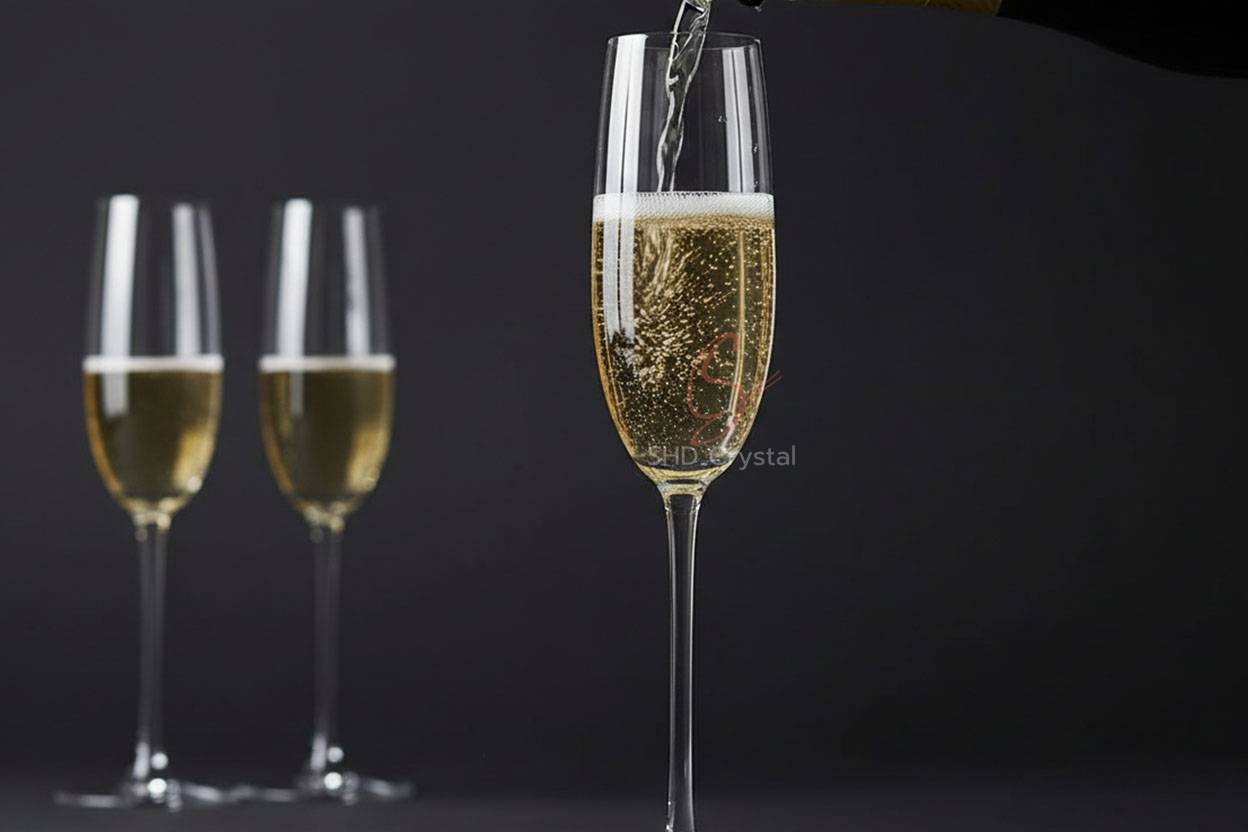
Controlling Height-to-Base Proportion
One of the primary variables in tall glass stability control is the relationship between total height and base diameter.
If the stem is extended without proportional base support, the glass becomes visually elegant but mechanically unstable. Conversely, increasing base width excessively compromises the intended slender aesthetic.
A capable champagne glass factory calibrates this ratio carefully, allowing the glass to retain visual lightness while maintaining a reliable center of gravity.
Maintaining Vertical Alignment in Slender Forms
Alignment is a critical but often overlooked aspect of slender stemware structure.
A slightly off-axis stem can shift the weight distribution enough to affect how the glass stands and feels. In tall profiles, even minimal deviation becomes visually amplified.
Through controlled forming and post-form inspection, a disciplined champagne glass factory ensures that the bowl, stem, and base remain on a consistent vertical axis, preserving equilibrium.
Material Distribution Along the Vertical Profile
Uniform material thickness is not suitable for tall glassware. Effective tall glass stability control requires strategic reinforcement.
The junction between bowl and stem, as well as the base transition, typically requires additional structural support. However, this must be achieved without visually thickening the glass.
An experienced champagne glass factory adjusts material distribution subtly, maintaining both strength and optical lightness.
Consistency Across Production Runs
In hospitality and retail environments, champagne glasses are rarely used individually—they are presented in sets. This makes consistency a visible quality indicator.
Variations in height, stem straightness, or base symmetry disrupt visual harmony. Maintaining consistent slender stemware structure across batches is therefore essential.
A controlled champagne glass factory standardizes forming parameters and inspection criteria to ensure that each production run aligns with the intended specification.
Where Structural Control Becomes Critical
The importance of tall glass stability control is most evident in environments where both aesthetics and functionality are required.
Hospitality venues, event service providers, and premium retail brands rely on tall stemware that can withstand frequent handling while maintaining a refined appearance.
In these contexts, the role of a champagne glass factory extends beyond production—it becomes a guarantee of performance consistency.
Conclusion
A reliable champagne glass factory is defined by its ability to manage vertical form, material distribution, and alignment with precision. Through disciplined control of slender stemware structure and effective tall glass stability control, production can achieve a balance between elegance and structural integrity.
This capability is what transforms a fragile-looking object into a dependable piece of functional design.
Supporting Stemware Programs Through Structural Control
For buyers developing stemware collections, collaboration with an experienced champagne glass factory ensures that design intent is matched by manufacturing precision.
From proportion calibration to alignment control, the ability to maintain stable slender stemware structure directly influences both product quality and user experience.
SHD Crystal Champagne Glass OEM Manufacturing Capability
For brands and distributors developing premium stemware collections, SHD Crystal provides specialized OEM manufacturing support for champagne glasses that require precise structural control.
Our production approach focuses on maintaining stable slender stemware structure through controlled forming, accurate stem alignment, and optimized material distribution. Each champagne glass is engineered to achieve consistent tall glass stability control, ensuring balance, durability, and visual refinement across production batches.
We support custom development based on design references, dimensional requirements, and target market positioning—whether for hospitality programs, private label retail, or high-end promotional collections. From proportion calibration to finishing consistency, SHD Crystal aligns manufacturing execution with design intent.
With scalable production capability and strict quality control standards, we help clients deliver champagne glass collections that combine elegance with structural reliability.