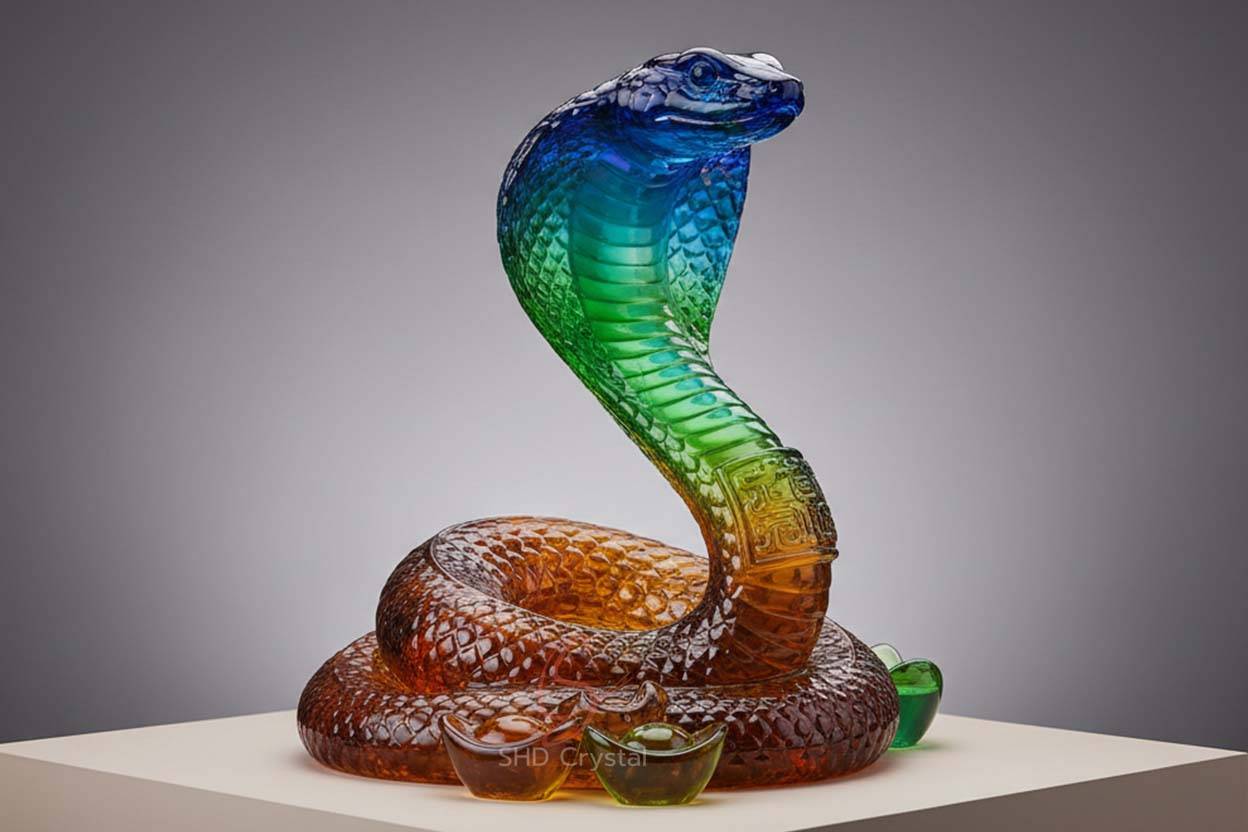
Blogpost keywords: crystal glass snake OEM, crystal snake figurine, glass snake sculpture
Crystal glass snake OEM production begins with more than form. Across different cultures, the snake carries layered meanings—transformation, renewal, protection, and wisdom. These symbolic associations give the snake a unique position in decorative art, where its shape is not only visual but also narrative.
When translated into sculpture, especially in glass, the snake becomes one of the most technically demanding and expressive forms. Its continuous curves, coiled motion, and fluid structure make it an ideal subject to explore both craftsmanship and artistic interpretation.
How Crystal Glass Snake OEM Translates Cultural Symbol into Sculptural Form
In many regions, the snake is associated with renewal due to its ability to shed skin. In others, it represents intelligence or spiritual protection. This symbolic flexibility allows the glass snake sculpture to be adapted across different markets—from collectible figurines to interior statement pieces.
However, translating this symbolism into a crystal snake figurine is not a simple design exercise. Unlike static geometric forms, the snake requires movement to feel authentic. The curve must appear natural, the proportions balanced, and the transitions between sections seamless.
This is where crystal glass snake OEM production becomes critical. It allows designers to refine proportions, posture, and surface details so that the final sculpture reflects both meaning and visual harmony.
Why Glass Makes Snake Sculpture More Complex
Compared to metal or resin, glass introduces a different level of complexity. A glass snake sculpture is not carved from a solid block but shaped through controlled forming and finishing processes.
The difficulty lies in the material behavior. Glass must maintain clarity while being shaped into curves that often change direction multiple times. Any imbalance in thickness can distort light or weaken structural stability.
For a crystal snake figurine, this becomes even more challenging. The body must appear fluid while remaining physically balanced. If the curvature is too aggressive, the piece may become unstable. If too rigid, it loses its sense of movement.
This balance between form and stability defines the technical depth of crystal glass snake OEM production.
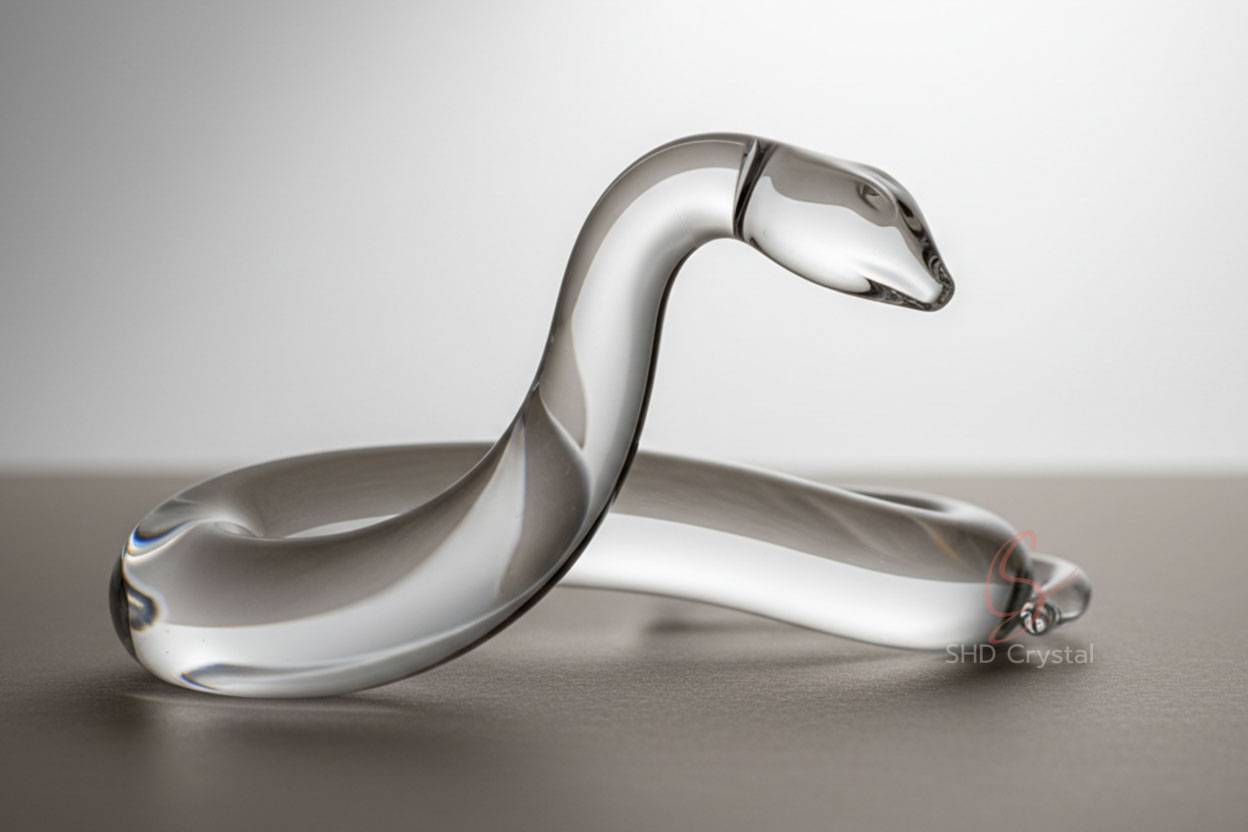
Sculpture Manufacturing Difficulty in Curved Glass Forms
Among decorative sculptures, the snake is one of the most difficult forms to produce consistently. The sculpture manufacturing difficulty comes from three main factors.
First is continuity. The entire form must flow as a single uninterrupted line. Any inconsistency breaks the visual rhythm.
Second is thickness control. In a glass snake sculpture, different sections of the body require subtle variation in thickness to maintain both strength and elegance.
Third is finishing. Polishing curved surfaces is significantly more complex than working on flat or symmetrical shapes. Each angle interacts with light differently, requiring careful refinement.
These factors mean that producing a high-quality crystal snake figurine is not only a matter of shaping but also of controlled execution across multiple stages.
Artistic Value Beyond Decoration
A common misconception is that animal sculptures are purely decorative. In reality, a well-executed glass snake sculpture functions as a study of movement and material.
The way light travels through a crystal snake figurine enhances its sense of motion. Reflections shift along the curves, creating a dynamic effect even when the object is stationary.
In interior design, this makes crystal glass snake OEM pieces particularly effective as focal elements. They introduce contrast into structured spaces, balancing straight architectural lines with organic form.
Practical Considerations for Designers and Brands
When developing a crystal glass snake OEM project, design intent must be aligned with production feasibility.
Proportions should be carefully evaluated to ensure stability. Surface finishing should enhance clarity without softening critical details. For larger pieces, base integration may be necessary to support balance.
Sampling is essential. Reviewing prototypes allows designers to assess how the glass snake sculpture performs visually and structurally before moving into production.
For brands, this process ensures that each crystal snake figurine maintains consistency while preserving artistic integrity.
Conclusion
Crystal glass snake OEM production represents a convergence of cultural symbolism, material control, and sculptural design. Through careful development of each glass snake sculpture, manufacturers transform a complex natural form into a refined decorative object that carries both meaning and craftsmanship.
For brands and designers, crystal glass snake OEM offers a pathway to create products that are both culturally meaningful and commercially viable.
At SHD Crystal, crystal snake figurine development combines advanced forming techniques with precise finishing processes to manage the inherent complexity of glass snake sculpture production. From initial concept to final polishing, each stage is controlled to ensure clarity, balance, and repeatable quality.
By aligning artistic intent with manufacturing expertise, SHD Crystal supports the creation of sculptural glass pieces that perform reliably across decorative, collectible, and interior applications.