
Blogpost keywords: gradient crystal glass sculpture, unique glass art, irregularly shaped glass
Color in glass is rarely accidental. In a gradient crystal glass sculpture, it is controlled, layered, and often the result of multiple processes working together. What appears as a smooth transition—from deep tone to near transparency—is in fact a carefully managed sequence of material behavior, surface treatment, and timing.
Unlike flat or uniform glass products, irregularly shaped glass introduces additional complexity. Curvature, thickness variation, and light refraction all affect how color is perceived. This is why gradient effects are most often associated with unique glass art, where visual expression and technical control must align.
Gradient Crystal Glass Sculpture and Color Application Strategies
Achieving a gradient effect in a gradient crystal glass sculpture can follow several technical paths, each with distinct characteristics.
One common method is surface coating through controlled spray application, often referred to as kiln-cured coating. In this process, color is applied externally and then fixed through heating. This allows smooth transitions across large surfaces, especially suitable for unique glass art pieces with open forms.
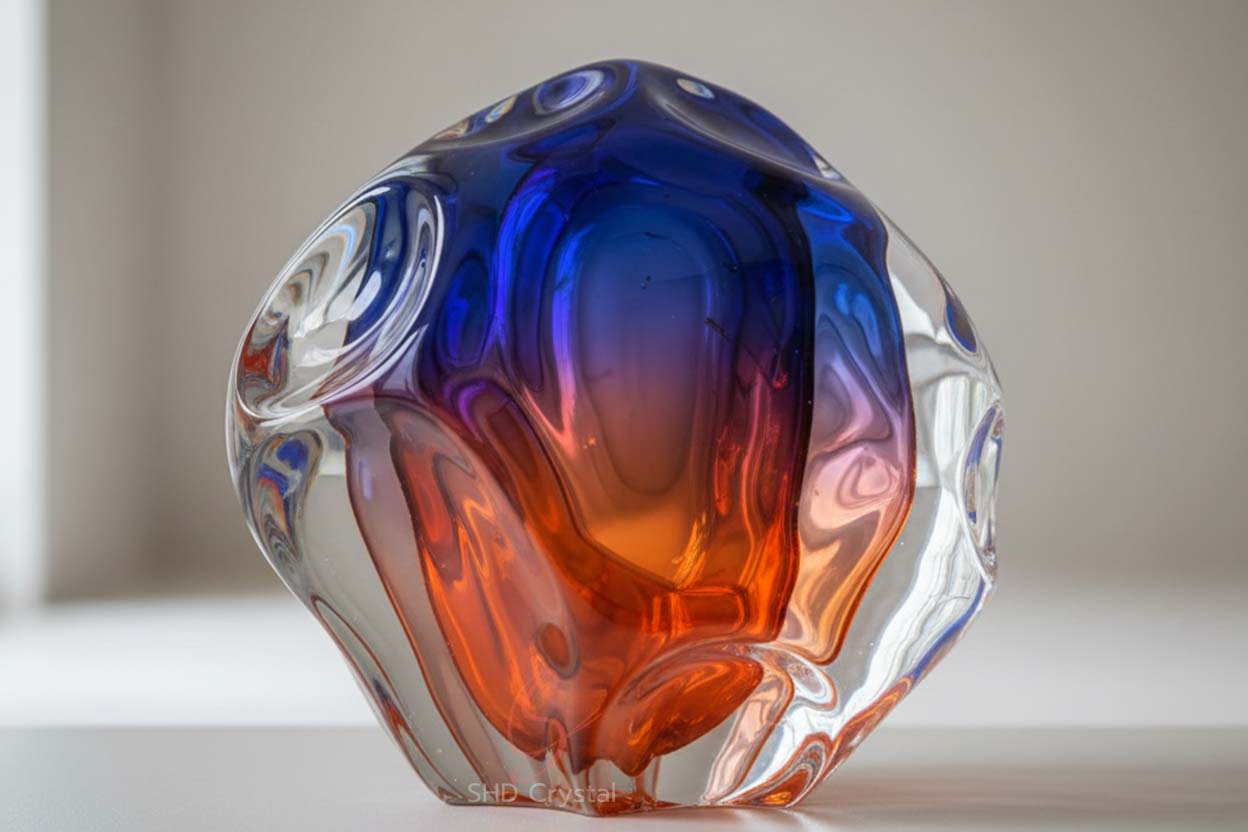
Hand-applied coloration is another approach. Pigments are layered manually, enabling more organic transitions. This technique is frequently used for irregularly shaped glass, where automated methods struggle to maintain even distribution across changing contours.
Integral coloration—where color is introduced during forming—is less common for gradient effects but can be used in combination with other methods. In such cases, base color is embedded in the material, while surface processes refine the gradient.
Each method produces a different visual depth. The choice depends on design intent, scale, and production feasibility.
The Challenge of Working with Irregularly Shaped Glass
Gradient application becomes significantly more complex when dealing with irregularly shaped glass.
Unlike flat panels, sculptural forms have varying angles and thicknesses. These variations affect how color settles and how light passes through the material. A gradient that appears smooth from one angle may look uneven from another.
For a gradient crystal glass sculpture, this means that application cannot rely on a single viewing perspective. The gradient must remain visually coherent across multiple angles, which requires careful control during both forming and finishing.
In unique glass art, this challenge is often addressed through iterative sampling. Multiple trials are used to calibrate color intensity, transition length, and surface response.
Interview Insight: Translating Design Into Gradient Glass
To better understand the process, we can consider insights from a production specialist working on gradient crystal glass sculpture projects:
“People often think gradient is just about spraying color, but that’s only part of it. On irregular forms, gravity becomes a factor. Color can accumulate in certain areas if the angle is not controlled.”
“For irregularly shaped glass, we sometimes rotate the piece during application to maintain even transitions. Even then, adjustments are needed after firing because the final tone changes slightly under heat.”
“In unique glass art, the goal is not perfect uniformity. It’s controlled variation. The gradient should feel natural, not mechanical.”
These observations highlight that gradient work is not a single-step process but a sequence of adjustments.
Process Control and Key Technical Considerations
Several factors determine whether a gradient crystal glass sculpture achieves a successful result.
Temperature control is critical. During firing, coatings or pigments may shift in tone. Without proper calibration, gradients can become patchy or overly saturated.
Surface preparation also matters. Clean, uniform surfaces allow color to adhere consistently. Any residue or micro-variation can disrupt the gradient.
Thickness variation is another factor. In irregularly shaped glass, thicker areas appear darker due to increased light absorption. This must be considered during design, especially in unique glass art where form and color interact closely.
Finally, process sequencing is essential. Applying color too early or too late in the production cycle can affect durability and visual stability.
Why Gradient Glass Remains a Specialized Craft
Despite advances in technology, gradient effects remain challenging.
The combination of material behavior, surface treatment, and optical perception means that no two pieces are identical. In gradient crystal glass sculpture, this variability is not a flaw—it is part of the aesthetic.
For unique glass art, this level of control distinguishes high-quality work from standard decorative products. The ability to manage color across irregularly shaped glass surfaces is what defines expertise in this field.
Conclusion
A gradient crystal glass sculpture is the result of layered processes rather than a single technique. Through methods such as coating, hand application, and controlled firing, manufacturers create transitions that respond to both form and light.
In unique glass art, these gradients enhance depth and perception, while in irregularly shaped glass, they demonstrate the balance between design ambition and technical execution.
For designers and developers working with gradient crystal glass sculpture, understanding how color interacts with form can open new possibilities in unique glass art. Careful coordination between design intent and production methods ensures that gradient effects remain both visually compelling and technically stable.
SHD Crystal Gradient Glass Art OEM Capability
In advanced glass art production, gradient effects require coordination between forming, surface finishing, and thermal processing. SHD Crystal supports gradient crystal glass sculpture development through controlled color application methods, including spray coating, hand-applied finishing, and kiln-fixed treatments.
Our experience with irregularly shaped glass allows us to manage color distribution across complex forms, ensuring that transitions remain visually consistent from multiple viewing angles. For unique glass art projects, this includes iterative sampling and process adjustment to align final results with design expectations.
By combining material control with finishing precision, SHD Crystal enables clients to develop gradient glass sculptures that maintain both artistic expression and production reliability.