
Blogpost keywords: colored glass lamp shades OEM, tinted lighting components, chromatic glass effects
In modern lighting development, color is no longer an accessory—it is a structural decision.
For clients building lighting collections, colored glass lamp shades OEM solutions allow the shade itself to define the atmosphere. Unlike coatings or external finishes, tinted lighting components embed color directly into the material, making the glass responsible for both visual identity and light modulation.
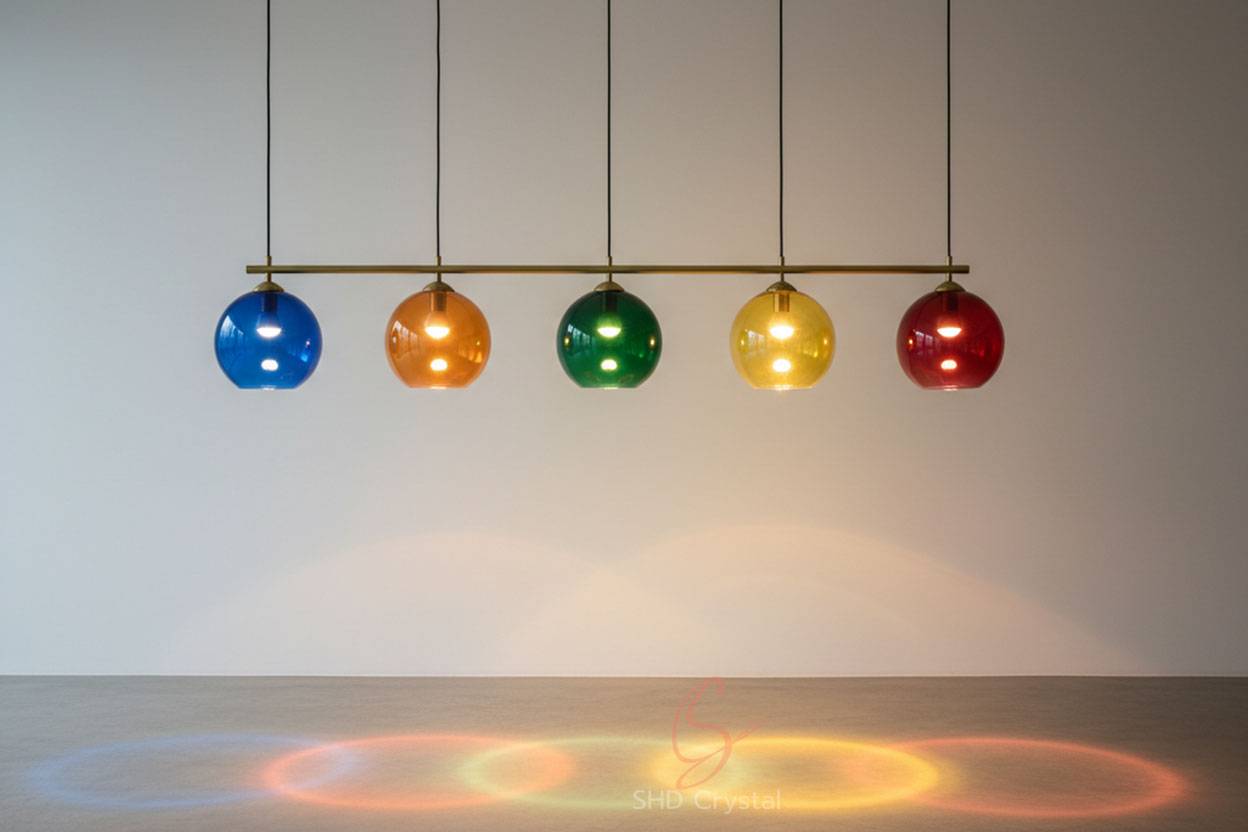
From a client perspective, this creates a dual requirement. The lamp must maintain a consistent appearance when unlit, and produce stable chromatic glass effects when illuminated. This expectation places the glass shade at the center of both design and performance.
Colored Glass Lamp Shades OEM and Unified Blown Glass Production
The primary manufacturing challenge lies in consistency.
In colored glass lamp shades OEM production, especially when multiple shades are used within one fixture or across a product line, all pieces must be formed through a unified blown process. This ensures that geometry, thickness, and optical behavior remain aligned.
Unlike press-molded glass, blown glass introduces variability. Each piece is shaped through controlled manual or semi-automated expansion, meaning that even slight differences in timing or temperature can affect the final form.
For tinted lighting components, this variability directly impacts how light passes through the glass. If wall thickness differs, chromatic glass effects will shift—darker in some areas, lighter in others.
Maintaining uniformity across batches therefore requires strict process control, not just design precision.
Color Integration and Optical Stability
Color in glass is not applied—it is formed. In colored glass lamp shades OEM manufacturing, pigments are integrated during melting. This allows tinted lighting components to maintain consistent coloration throughout the material, rather than relying on surface treatments that may degrade over time.
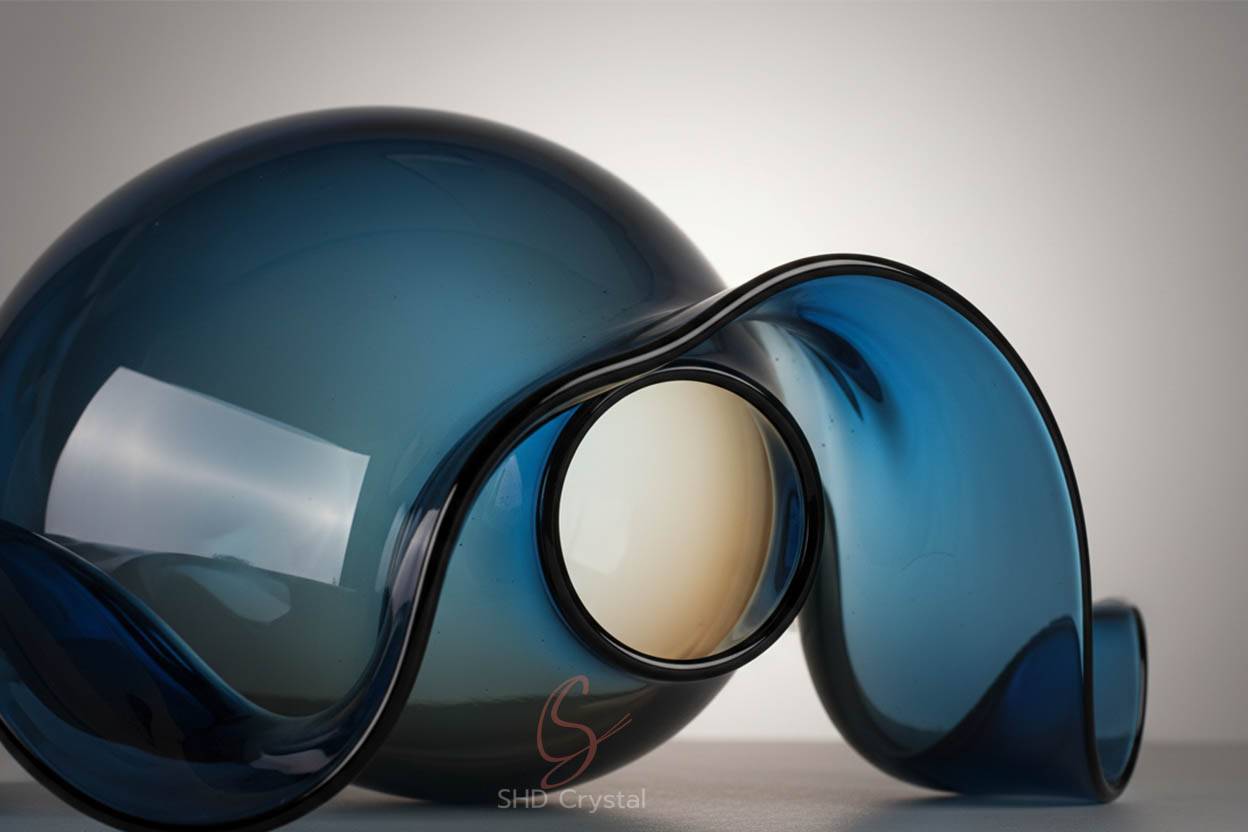
However, this also introduces complexity. The interaction between pigment concentration and glass thickness determines the final visual result. Too much concentration can reduce light transmission. Too little, and the intended chromatic glass effects become weak.
Manufacturers must therefore calibrate both formulation and forming simultaneously. The goal is not uniform color, but controlled optical response.
Dimensional Consistency and Fixture Integration
Beyond color, geometry must align precisely with fixture systems. Each colored glass lamp shades OEM component must match mounting specifications, opening diameters, and structural balance requirements. Even small deviations can lead to misalignment during assembly.
For tinted lighting components, dimensional consistency also affects light distribution. A slightly altered curvature can change how light spreads within the shade.
This is particularly critical in multi-light fixtures, where repeated units must appear visually identical. Consistent chromatic glass effects depend not only on color, but also on shape uniformity.
Production Difficulty and Process Control
From an OEM perspective, colored glass shades represent a compounded challenge:
- Material formulation must remain stable
- Blown shaping must be repeatable
- Cooling and annealing must prevent internal stress
- Optical performance must remain consistent
Each of these factors interacts.
In colored glass lamp shades OEM production, failure in one stage often becomes visible in the final product—whether through uneven tone, distortion, or inconsistent light behavior.
This is why experienced manufacturers rely on iterative sampling and controlled production environments when developing tinted lighting components for large-scale use.
Conclusion
Colored glass lamp shades OEM production is defined by its ability to align color, form, and optical performance through unified blown manufacturing. By controlling tinted lighting components and ensuring stable chromatic glass effects, manufacturers enable lighting designs that remain consistent across both visual and functional dimensions.
Developing Lighting Systems with Material Consistency
For lighting brands and designers, working with experienced colored glass lamp shades OEM partners ensures that tinted lighting components perform reliably across collections. Controlled production supports consistent chromatic glass effects, allowing design intent to translate accurately into final products.
SHD Crystal Colored Glass Lamp Shade OEM Capability
In colored lighting components, consistency is not achieved through design alone—it is established through controlled manufacturing.
SHD Crystal specializes in colored glass lamp shades OEM production with a focus on unified blown glass forming. By managing temperature, shaping timing, and wall thickness distribution, we ensure that each shade maintains consistent geometry and optical response.
For tinted lighting components, our process integrates pigment formulation directly into the glass melt, allowing stable chromatic glass effects across different batches and production cycles. This ensures that multiple units within a fixture—or across an entire collection—remain visually aligned.
Through controlled annealing and dimensional calibration, SHD Crystal enables lighting brands to achieve both aesthetic consistency and reliable performance in colored glass shade production.