
Blogpost keywords: decanter manufacturers, crystal carafes, luxury barware sets
Decanters are often judged by shape, but their performance and character are defined by how they are made. Behind every form—whether wide-based, elongated, or sculptural—lies a set of glass forming techniques that influence clarity, thickness, and usability.
For decanter manufacturers, production is not limited to shaping a vessel. It involves selecting how glass is formed, finished, and refined to achieve both functional performance and visual balance.
From crystal carafes to coordinated luxury barware sets, these decisions determine how decanters behave in real use.
Decanter Manufacturers and Blown Glass Forming
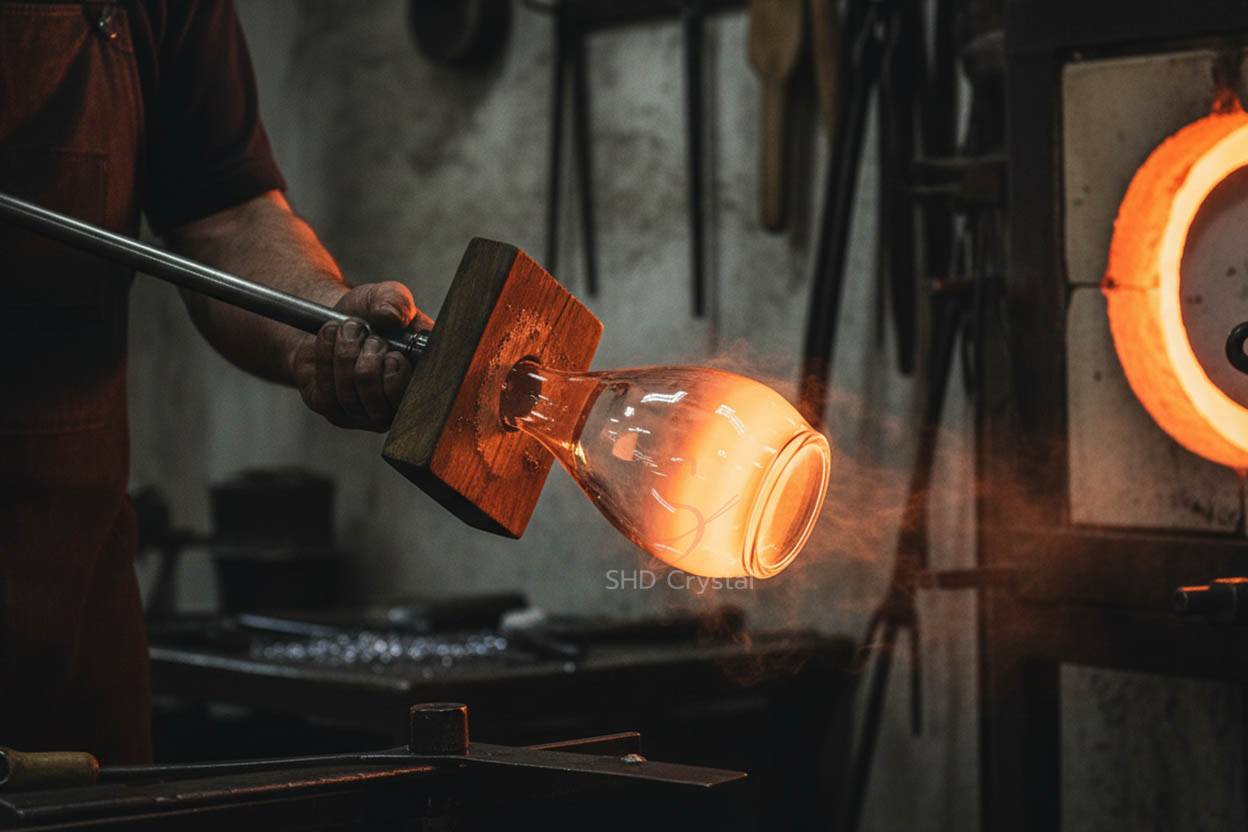
Blowing glass remains one of the most flexible methods in decanter production. In this process, molten glass is expanded using air pressure, allowing organic shapes to develop.
For decanter manufacturers, blown forms enable wide bases for aeration and smooth transitions between body and neck. Slight variations in curvature and thickness often occur, especially in hand-blown pieces, giving each decanter a subtle individuality.
In many crystal carafes, blowing glass supports fluid, continuous forms that cannot be easily replicated through rigid molds.
Pressed Glass and Structural Consistency
In contrast, pressing glass relies on molds to define shape. Molten glass is forced into a predefined cavity, producing consistent geometry across batches.
Decanter manufacturers often use pressing techniques for designs that require repeatability and structural uniformity. This is particularly relevant for luxury barware sets, where multiple pieces must match precisely.
Pressed decanters tend to have more defined edges and consistent wall thickness, making them suitable for standardized production environments.
Surface Engraving and Optical Interaction
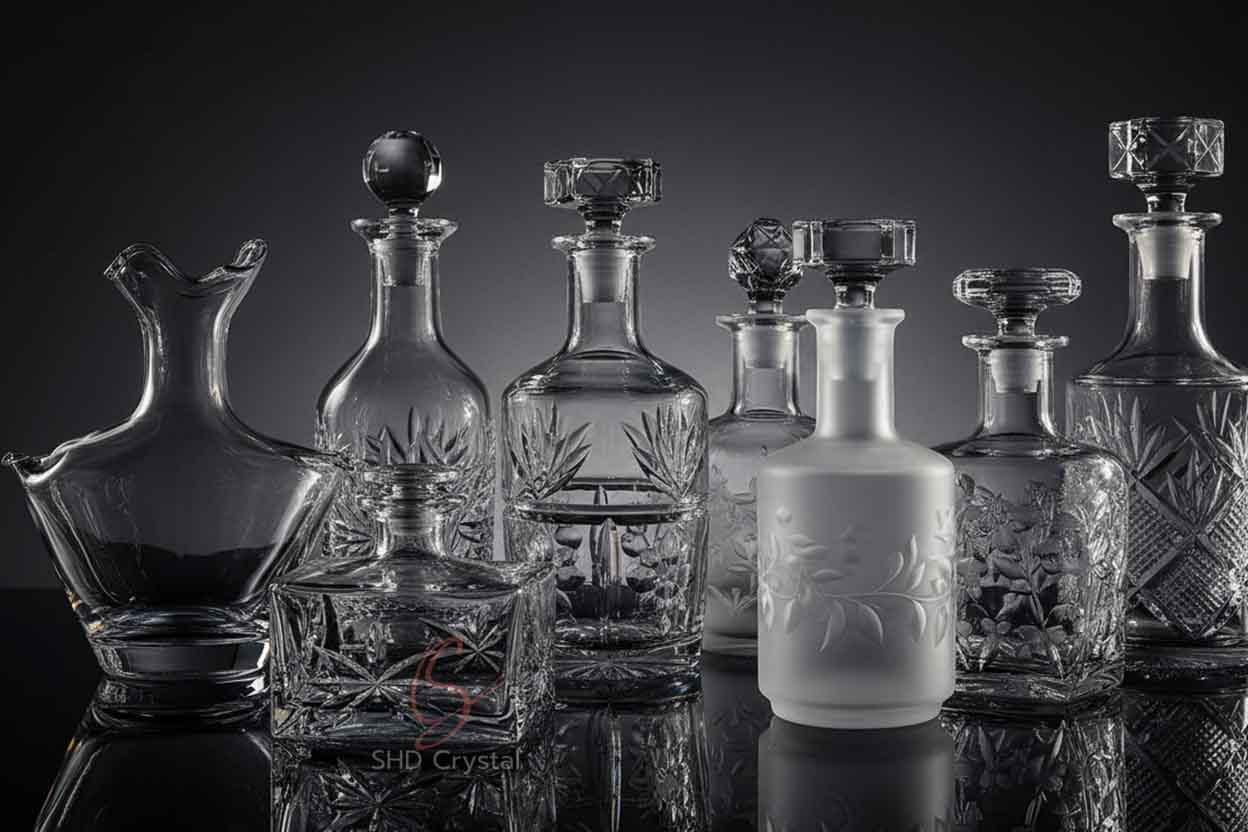
Engraving introduces texture without altering the overall structure. In crystal carafes, carved patterns interact with light, creating reflections and highlights that change depending on viewing angle.
For decanter manufacturers, engraving is not purely decorative. It modifies how light travels across the surface, adding depth to otherwise smooth glass.
Cut or engraved decanters often appear more dynamic, especially under directional lighting conditions.
Frosted Glass and Diffused Appearance
Frosted finishes create a different visual effect by scattering light across the surface. Instead of sharp reflections, the glass produces a softer, more diffused appearance.
Some luxury barware sets incorporate frosted decanters to reduce glare and create contrast when paired with clear glass elements. This variation adds balance within a collection.
For decanter manufacturers, frosted surfaces also introduce tactile differences, subtly changing how the object is handled.
Balancing Form, Function, and Technique
Each production method—blowing, pressing, engraving, and frosting—offers different advantages. The choice depends on how the decanter is intended to be used.
Blown glass emphasizes fluid form and aeration. Pressed glass ensures consistency. Engraving enhances light interaction. Frosting softens visual presence.
Experienced decanter manufacturers combine these techniques when necessary, creating crystal carafes that balance performance with visual clarity.
Conclusion
Decanters are not defined by shape alone, but by the processes used to create them. Through different forming and finishing techniques, decanter manufacturers produce crystal carafes and luxury barware sets that reflect both technical precision and material behavior.
Understanding these processes provides a clearer perspective on how glassware performs, rather than judging it solely by appearance.
Considering Technique When Evaluating Decanter Design
When selecting decanters for practical use or collection, examining the production method can be as important as evaluating shape.
Different forming techniques influence weight, balance, and light interaction. By recognizing how crystal decanter manufacturers apply these methods, it becomes easier to understand why certain crystal carafes feel more refined or why some luxury barware sets achieve better consistency across pieces.