
Blogpost keywords: conical glass lamp shades OEM, tapered lamp covers, controlled beam lighting
Conical glass lamp shades OEM production plays a defining role in lighting systems where geometry directly influences light behavior. Unlike spherical or cylindrical forms, a conical profile channels illumination into a focused direction, making it ideal for applications such as dining lighting, counters, and task-oriented spaces.
For lighting brands, sourcing conical glass lamp shades OEM components enables the integration of visual clarity with functional lighting performance. The tapered geometry does not only define the appearance of the fixture but also determines how light interacts with surrounding surfaces.
How Conical Glass Lamp Shades OEM Defines Tapered Lamp Covers
The structural identity of conical glass lamp shades OEM lies in the controlled transition from a narrow upper opening to a wider lower rim. This geometry must remain smooth and proportionally balanced to maintain both visual stability and functional alignment.
Manufacturers producing tapered lamp covers carefully control cone angles, wall thickness, and edge finishing. Even minor deviations in slope or proportion can alter the perceived balance of the fixture.
Through precision forming, the conical shape becomes a critical structural element that supports both design intent and installation stability.
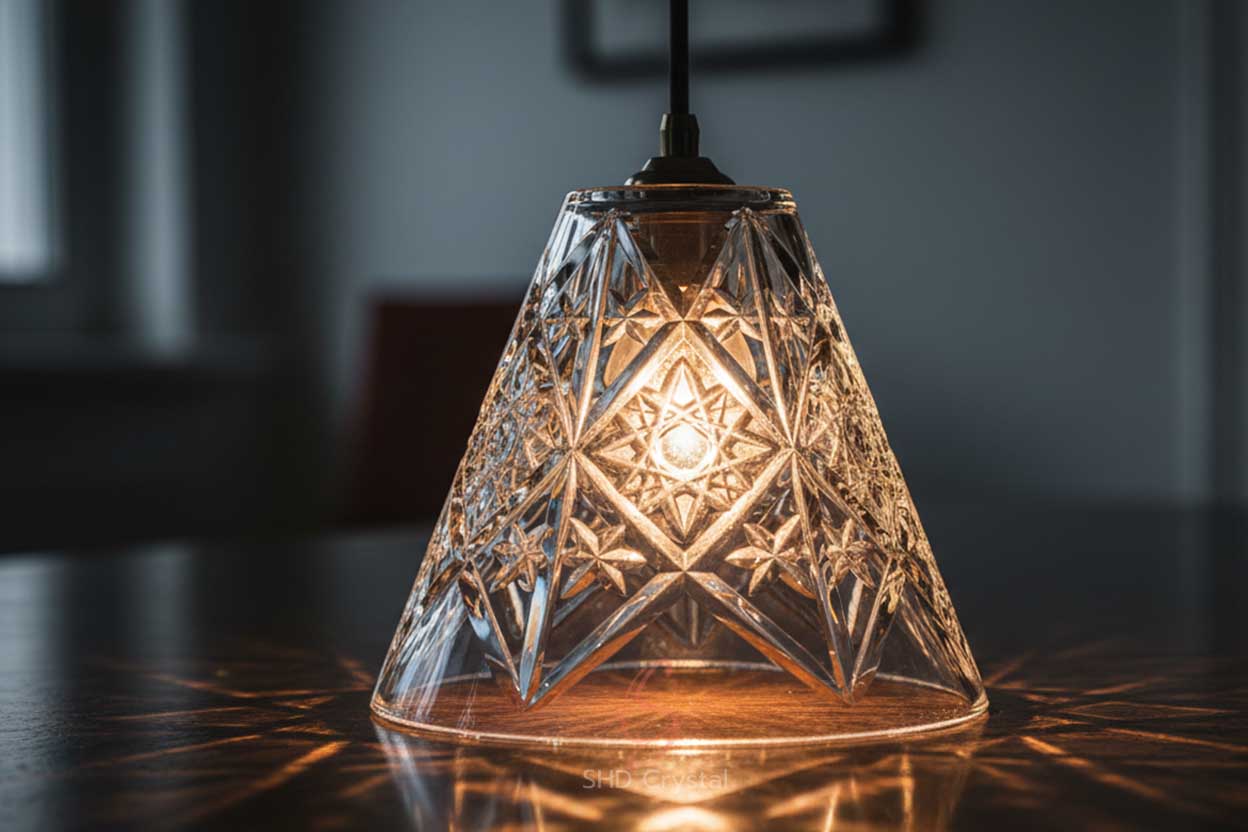
Controlled Beam Lighting Through Conical Glass Geometry
One of the primary advantages of conical glass lamp shades OEM production is its ability to guide light directionally. Unlike diffused globes, conical shades concentrate illumination toward a defined area.
Manufacturers adjust material transparency and surface treatments to refine controlled beam lighting. Clear glass allows stronger downward projection, while frosted or lightly textured finishes soften the light distribution.
This adaptability allows the same tapered lamp covers to serve different lighting purposes without changing the overall fixture design.
Integrating Tapered Lamp Covers With Fixture Systems
Conical shades are typically paired with exposed structural elements such as suspension rods, cords, or decorative holders. This makes alignment accuracy essential.
A professional conical glass lamp shades OEM supplier ensures that tapered lamp covers maintain consistent opening dimensions and edge precision. Proper integration ensures that the shade remains centered and stable once installed.
This level of compatibility is crucial for achieving a refined and professional lighting appearance.
Production Consistency Across Lighting Collections
Lighting brands often build product families around a shared shade geometry. Pendant lights, table lamps, and wall fixtures may all rely on the same conical form.
Experienced conical glass lamp shades OEM manufacturers maintain consistent geometry and surface finish across production batches. This ensures that tapered lamp covers retain identical proportions and visual characteristics.
Consistency supports brand identity while simplifying production and assembly processes.
Key Factors That Influence Shade Manufacturing Stability
- Glass thickness uniformity
- Cone angle precision
- Edge finishing quality
- Surface transparency control
- Batch consistency and annealing
These factors determine whether conical glass lamp shades OEM production can deliver stable and repeatable results.
Common Mistakes in Conical Glass Shade Development
One common issue is overlooking how geometry affects light behavior. Designers may focus on visual proportions without considering how the cone angle influences controlled beam lighting.
Another mistake is inconsistent manufacturing control, which leads to variations in tapered lamp covers across batches. Even slight dimensional differences can affect fixture alignment and overall product quality.
Some projects also underestimate the importance of edge finishing. Poorly finished rims can disrupt both visual refinement and installation stability.
Practical Considerations for Lighting Brands and Designers
When sourcing conical glass lamp shades OEM components, it is important to evaluate both design precision and production capability.
Brands should verify whether the supplier can maintain consistent tapered lamp covers across multiple batches. Reviewing samples under real lighting conditions also helps assess controlled beam lighting performance.
Early collaboration between design and manufacturing teams ensures that geometry, material selection, and production feasibility remain aligned throughout the project.
Applications in Modern Lighting Design
Conical glass shades are widely used in residential, hospitality, and commercial lighting systems.
In dining environments, they create focused illumination that enhances table settings. In retail spaces, controlled beam lighting highlights products effectively. In residential interiors, they contribute to both functional lighting and visual structure.
Through conical glass lamp shades OEM production, these applications achieve a balance between design consistency and lighting performance.
Conclusion
Conical glass lamp shades OEM manufacturing provides a reliable solution for lighting systems that require directional control. By combining tapered lamp covers with controlled beam lighting, manufacturers support the development of fixtures that are both visually refined and functionally precise.
The effectiveness of these products depends on consistent geometry, surface quality, and production stability.
From Geometry Control to Reliable Lighting OEM Production
At SHD Crystal, glass shade production is guided by precise forming logic and consistent process control.
We support conical glass lamp shades OEM projects by refining tapered lamp covers through controlled forming, edge finishing, and surface treatment. This ensures stable geometry and reliable integration with lighting fixtures.
Our team focuses on maintaining controlled beam lighting performance by aligning material selection and surface transparency with design requirements. From sampling to mass production, we ensure repeatable results across batches.
With flexible manufacturing capabilities and strict quality standards, SHD Crystal delivers glass lighting components designed for both aesthetic clarity and production reliability.