
Blogpost keywords: custom glass art, handcrafted glass art, bespoke glass sculptures
Custom glass art does not behave like decoration in the traditional sense. It operates closer to architecture than ornament. When introduced into a space, it does not simply sit within it—it changes how that space is read, how light travels, and how movement is perceived.
This is why custom glass art has become increasingly relevant in environments where identity matters. In hospitality, retail, and high-end residential design, materials are expected to communicate intent. Glass does this in a subtle but persistent way. It reflects, refracts, and responds, creating a presence that shifts with time rather than remaining static.
Where Custom Glass Art Interacts With Architecture
In architectural applications, custom glass art often performs beyond visual appeal. Large-scale installations can guide circulation, define zones, or soften transitions between structural elements.
Handcrafted glass art is particularly effective in these contexts because it introduces controlled irregularity. Unlike rigid materials such as stone or metal, glass can carry fluid transitions that visually connect otherwise separate elements.
Bespoke glass sculptures may appear as suspended installations, vertical panels, or integrated features within walls and partitions. Their transparency allows them to define space without enclosing it, which is especially valuable in open-plan environments.
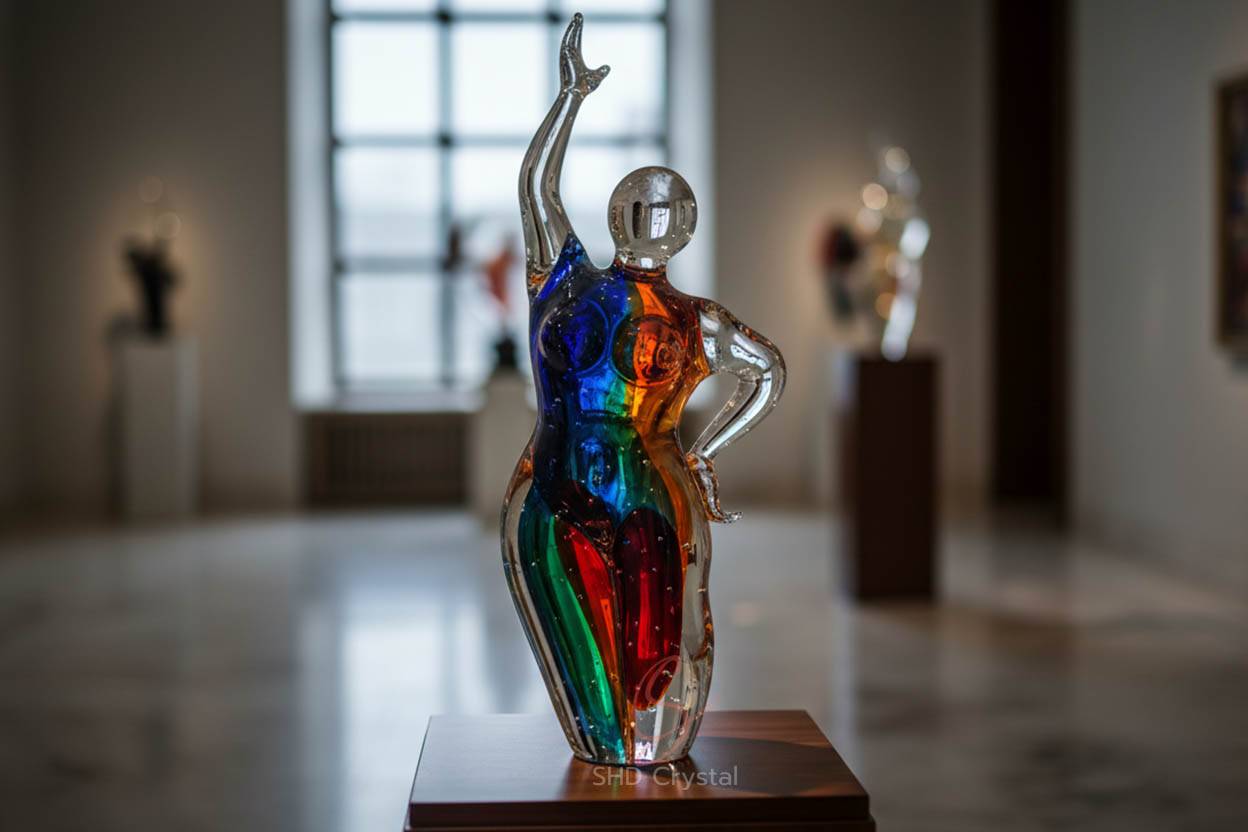
Material Behavior: Light as a Design Partner
One of the least discussed but most important aspects of custom glass art is how it behaves under changing light conditions.
A piece may appear almost invisible under diffused daylight, only to become highly defined under directional lighting. This duality allows handcrafted glass art to function differently depending on time of day or lighting design strategy.
Designers often use this property intentionally. In commercial spaces, glass installations can remain understated during operational hours and become visually prominent in evening environments. This dynamic quality is difficult to achieve with opaque materials.
Customization as a Design System, Not an Option
Customization in glass should not be treated as a decorative upgrade. It is a system-level decision.
Color, thickness, and form must be developed in relation to surrounding materials. A dense, saturated piece may anchor a space dominated by neutral tones, while a lighter, more transparent form can maintain openness in smaller environments.
Bespoke glass sculptures also allow repetition with variation. In large projects, this enables a consistent visual language while avoiding monotony. Each piece may differ slightly, yet still belong to the same system—something mass-produced decor cannot achieve.
Common Mistakes in Using Custom Glass Art
A common misjudgment is treating glass as interchangeable with other materials. Without considering lighting, even well-crafted pieces can appear flat or underwhelming.
Another issue is expecting exact duplication in handcrafted glass art. This often leads to unnecessary revisions and misaligned expectations. Slight variation is not a flaw—it is part of the material language.
Scale misalignment is also frequent. Oversized bespoke glass sculptures can overwhelm a space, while undersized pieces may lose presence entirely. These issues are rarely about craftsmanship, but about planning.
Practical Considerations for Long-Term Performance
Custom glass art is often assumed to be fragile, but properly produced glass undergoes controlled annealing to reduce internal stress. This makes it suitable for long-term installation in both residential and commercial environments.
Maintenance is typically minimal. Smooth or lightly textured surfaces can be cleaned with non-abrasive materials, and installations are usually positioned to minimize direct handling.
More importantly, early-stage coordination—between designer, manufacturer, and installer—ensures that bespoke glass sculptures are not only visually successful but also structurally reliable.
Conclusion
Custom glass art stands at the intersection of material expression and spatial strategy. Through the flexibility of handcrafted glass art and the adaptability of bespoke glass sculptures, it offers designers a medium that is both visually dynamic and structurally relevant.
Its strength lies not in uniform perfection, but in controlled variation and its ability to engage with light, scale, and environment over time.
From Artistic Vision to Manufacturable Glass Systems
At SHD Crystal, custom glass art is developed as a balance between artistic intent and production feasibility.
We support projects that require handcrafted glass art with consistent design language across multiple units or installations. By controlling forming techniques, surface finishing, and dimensional alignment, we ensure that bespoke glass sculptures retain their expressive qualities while meeting project-level requirements.
This approach allows glass to function not only as an artistic element, but as a reliable component within architectural and commercial design systems.