
Blogpost keywords: square glass lamp shades factory, etched glass panels, prism glass lighting elements
When clients come to us as a square glass lamp shades factory, they are usually not just looking for glass components—they are trying to solve a design problem. Square lighting elements are chosen when a project requires alignment, structure, and visual order.
From our perspective, square glass is not simply a shape. It is a commitment to precision. Every edge, every corner, and every surface becomes visible once installed in a lighting fixture. That is why producing etched glass panels and prism glass lighting elements for square designs requires a different level of control compared to curved or rounded forms.
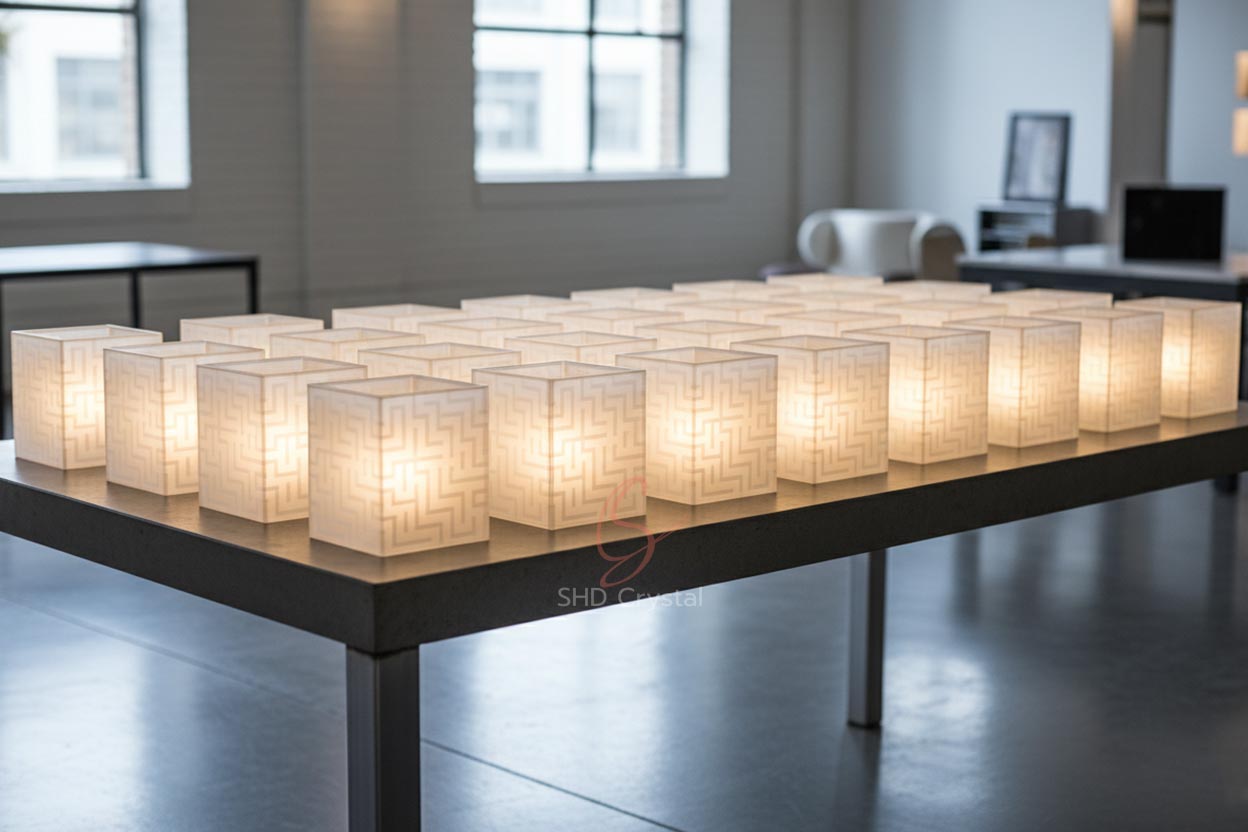
Why Square Glass Design Matters In A Square Glass Lamp Shades Factory
In many projects, as a square glass lamp shades factory, we see designers move toward square forms when they want lighting to integrate with architectural lines. Straight edges connect naturally with ceilings, walls, and furniture layouts.
Unlike curved glass, which softens transitions, square glass defines boundaries. When we produce etched glass panels, the goal is not only to diffuse light, but to maintain the clarity of the form. The etched surface must soften brightness without weakening the geometry.
For prism glass lighting elements, the role becomes more dynamic. Instead of simply diffusing light, these surfaces interact with light—breaking it into controlled reflections while still respecting the structured outline of the piece.
How We Approach Forming Square Glass Components
From a manufacturing standpoint, square glass is less forgiving than it appears. During production, molten glass does not naturally prefer sharp corners or flat planes. It must be guided carefully into shape.
In our factory, forming square glass requires controlled mold design and precise temperature management. The glass must flow evenly into each corner, otherwise slight deviations become visible after cooling.
When producing etched glass panels, we also pay attention to how the surface will behave after forming. Any inconsistency in thickness can affect both the etching result and the way light passes through the panel.
For prism glass lighting elements, shaping is only part of the process. The geometry must align with how light will interact with the surface later, which requires coordination between forming and finishing stages.
What Makes Square Glass Difficult To Get Right
From experience, the biggest challenge is not creating the shape—it is maintaining consistency.
A single panel may look acceptable on its own, but once installed in a fixture with multiple components, even small variations become noticeable. This is especially true for etched glass panels, where uneven surface treatment can disrupt light diffusion.
With prism glass lighting elements, alignment becomes even more critical. If angles are slightly off, reflections will not behave consistently across different units.
This is why, as a square glass lamp shades factory, we focus heavily on repeatability. The goal is not just to produce one correct piece, but to ensure that every piece performs the same way in real installations.
Where Square Glass Lighting Performs Best
In our projects, square glass components are most effective in environments where structure matters.
We often see etched glass panels used in pendant lighting over kitchen islands, reception counters, or long tables—places where alignment and symmetry enhance the space.
Prism glass lighting elements are frequently applied in wall lighting or corridor systems, where controlled reflections can add depth without disrupting the overall layout.
Because of their defined geometry, these components work particularly well in modular lighting systems, where multiple units must align visually across a larger area.
What Clients Often Overlook
One of the most common issues we encounter is designs that look precise on paper but do not fully consider production behavior.
Square glass requires allowance for material movement during forming. Without this, edges may not meet expectations after cooling.
We also see cases where surface treatments are treated as purely visual decisions. In reality, for etched glass panels, the depth and consistency of etching directly affect light diffusion.
Similarly, for prism glass lighting elements, the interaction between surface geometry and light source positioning is often underestimated.
As a manufacturer, our role is to identify these gaps early and adjust the design so it performs correctly in both production and application.
Conclusion
Working as a square glass lamp shades factory means more than producing geometric forms. It requires aligning design intent, material behavior, and production control to achieve consistent results.
Through careful handling of etched glass panels and precision execution of prism glass lighting elements, it becomes possible to deliver lighting components that support both architectural structure and functional illumination.
Supporting Lighting Design With Controlled Glass Production
At SHD Crystal, we approach square glass lighting components as a combination of forming accuracy and finishing control. Our team integrates glass shaping, surface processing, and detailed inspection into a unified workflow, ensuring that each component meets both visual and structural expectations.
With experience in producing etched glass panels and prism glass lighting elements, along with a skilled team in glass forming and finishing, we support lighting brands in developing structured designs that can be reliably produced at scale.