
Blogpost keywords: art of glassblowing, glassblowing techniques, hand blown glass craftsmanship
The art of glassblowing is a highly controlled process that transforms molten material into expressive forms through heat, motion, and timing. Unlike automated production, this craft relies on continuous adjustment by the artisan, where every movement directly influences structure, thickness, and visual character.
Art Of Glassblowing As A Controlled Forming Process
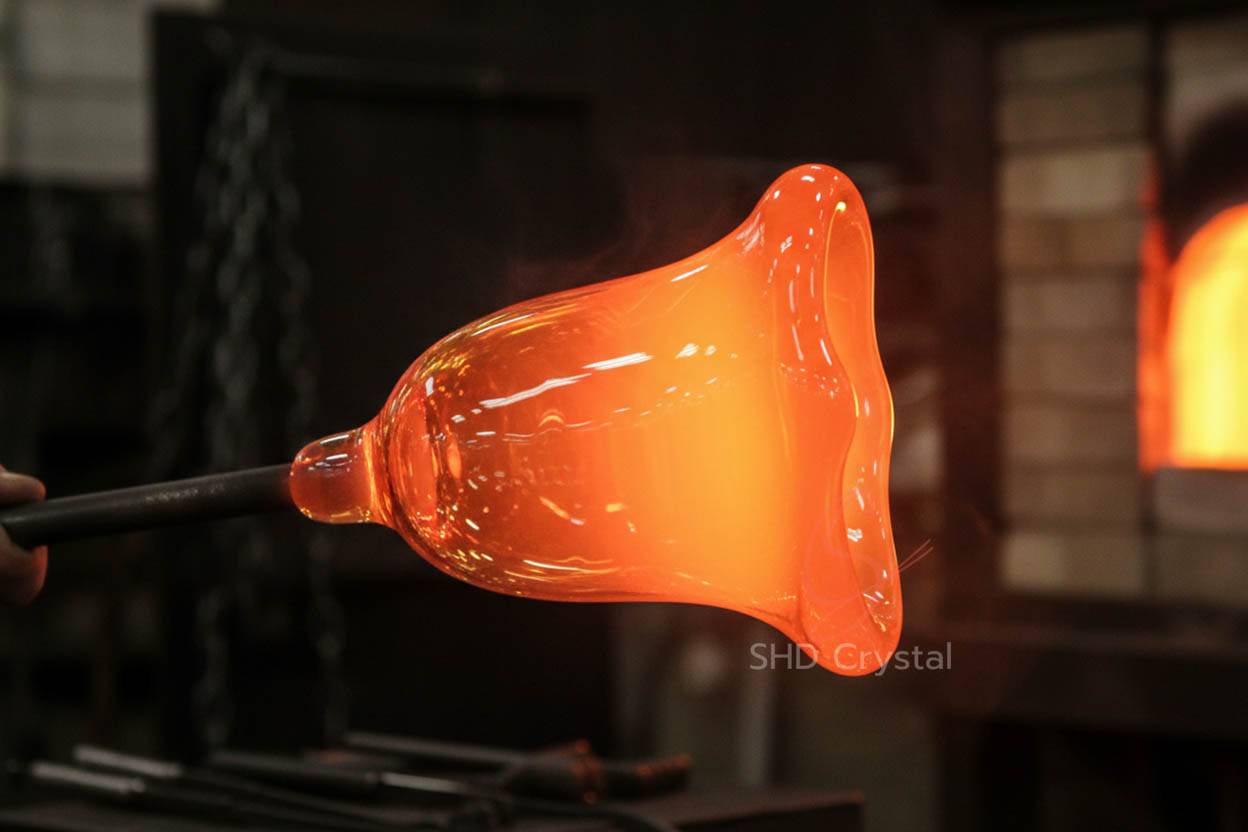
The art of glassblowing begins with gathering molten glass from a furnace, typically at temperatures above 1000°C. At this stage, the material behaves like a viscous liquid, allowing it to be shaped through rotation, gravity, and controlled airflow.
Glassblowing techniques are defined by how the artisan manages temperature and movement simultaneously. If the material cools too quickly, it loses flexibility. If it remains too hot, it becomes unstable and difficult to control. This balance is the foundation of hand blown glass craftsmanship.
Unlike rigid mold-based systems, glassblowing allows continuous reshaping during the forming process, making each piece slightly unique in form and internal structure.
Material Behavior And Thermal Control
Understanding how glass responds to heat is essential in the art of glassblowing. The material transitions through different states as temperature changes, from highly fluid to gradually rigid.
Glassblowing techniques rely on precise reheating cycles. The artisan repeatedly returns the piece to the furnace to maintain workability while shaping it incrementally. This cycle prevents cracking and ensures uniform wall thickness.
Hand blown glass craftsmanship also involves controlling internal air pressure. The expansion of air inside the glass determines the final volume and symmetry, requiring steady and consistent breath control.
Forming Techniques And Structural Balance
Several glassblowing techniques are used to achieve different forms, including free blowing, mold-assisted shaping, and stretching. Each method produces distinct structural and visual characteristics.
Free blowing allows organic, slightly irregular shapes that reflect the artisan’s hand movements. Mold-assisted methods introduce controlled geometry while still preserving aspects of hand blown glass craftsmanship.
During forming, the artisan must balance gravity and centrifugal force. Rotation keeps the glass centered, while controlled stretching creates elongated or curved profiles. Any imbalance can lead to uneven thickness or distortion.
Surface Detail And Artistic Expression
The art of glassblowing extends beyond shaping into surface treatment and visual refinement. Techniques such as engraving, cutting, and texturing can be applied after forming to enhance depth and light interaction.
Hand blown glass craftsmanship often embraces subtle irregularities, including faint ripples, thickness variations, and optical distortions. These features are not defects but indicators of manual control and authenticity.
Color can also be introduced during the process through layering or fusing techniques, resulting in gradient tones or embedded patterns that shift under light.
Common Misconceptions In Glassblowing
One common misconception is that glassblowing produces perfectly uniform objects. In reality, slight variations are inherent to the process and contribute to its artistic value.
Another misunderstanding is that glassblowing is purely decorative. In practice, many glassblowing techniques are applied in functional objects where balance, durability, and usability must be maintained alongside aesthetics.
Recognizing these factors helps distinguish hand blown glass craftsmanship from mass-produced alternatives.
Where Craftsmanship And Function Meet
The art of glassblowing is widely used in both artistic and functional contexts. From sculptural pieces to everyday objects, the same principles of thermal control and forming precision apply.
In professional environments, artisans refine glassblowing techniques to achieve repeatable results while preserving handcrafted qualities. This balance allows the production of objects that are both visually distinctive and structurally reliable.
Conclusion
The art of glassblowing combines material behavior, thermal control, and skilled manipulation to create forms that reflect both precision and individuality. Through refined glassblowing techniques and consistent hand blown glass craftsmanship, this process continues to define the relationship between functional design and artistic expression.
For projects that require refined execution of the art of glassblowing, working with experienced teams such as SHD Crystal supports the integration of advanced glassblowing techniques and hand blown glass craftsmanship into scalable OEM production while maintaining artistic integrity and structural consistency.