
Blogpost keywords: colored glass lamp shades factory, tinted decorative glass, stained glass lamp bodies
A colored glass lamp shades factory does more than produce decorative components. It shapes how light is experienced.
Unlike clear materials, glass with color actively transforms illumination. The light passing through it is no longer neutral. It carries tone, atmosphere, and visual intention. This is why tinted decorative glass and carefully crafted stained glass lamp bodies are widely used in lighting collections where mood matters as much as brightness.
In practice, achieving this effect consistently is not simple. Color must behave predictably across batches, forms, and lighting conditions.
Colored Glass Lamp Shades Factory and the Control of Visual Consistency
In production, color is not only about pigment. It is about repeatability.
A professional colored glass lamp shades factory focuses on ensuring that each shade within a product line delivers the same visual output. Even small deviations in tone can disrupt the identity of a lighting collection, especially in hospitality or retail environments where multiple fixtures are installed together.
This is where tinted decorative glass requires disciplined process control. Material composition, melting temperature, and forming conditions all influence the final color.
At the same time, stained glass lamp bodies introduce additional complexity. Layering or tonal variation must be controlled so that visual richness does not become inconsistency.
How Color Interacts With Interior Lighting
Color in glass is not static. It changes with light intensity, angle, and surrounding materials.
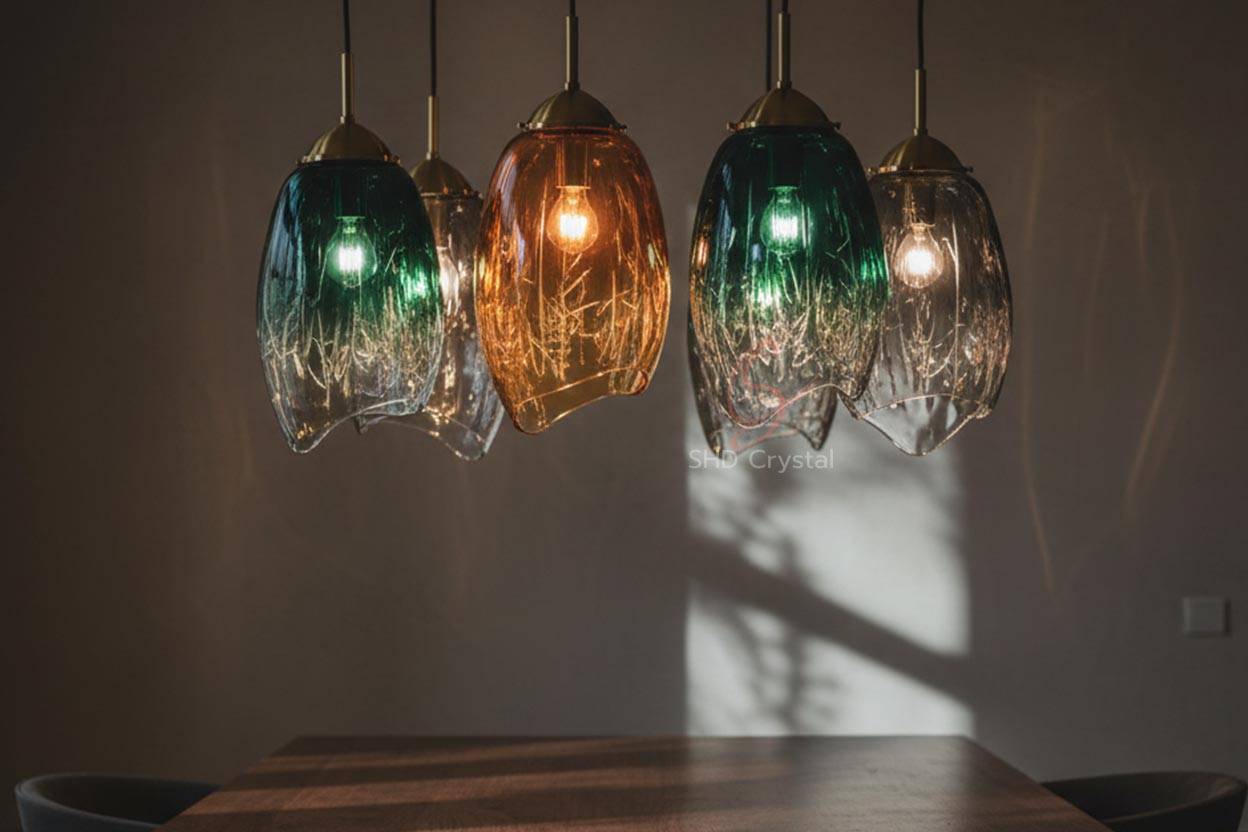
Warm tones such as amber tend to soften illumination, creating a more intimate environment. Cooler tones like green or blue shift perception toward calmness or modernity. Designers use tinted decorative glass in spaces where lighting is part of the atmosphere rather than just functional output.
In more expressive applications, stained glass lamp bodies introduce depth through layered coloration. When illuminated, these layers create subtle gradients and visual movement.
A capable colored glass lamp shades factory understands that the same glass may look different under various lighting conditions. Production decisions must account for this variability.
Key Factors That Define Color Stability
To maintain consistency, manufacturers rely on a combination of material and process control.
- Controlled raw material composition to ensure repeatable base glass quality
- Precise measurement of additives used in tinted decorative glass
- Stable forming temperatures to prevent uneven color distribution
- Standardized annealing cycles to preserve color characteristics
- Inspection under controlled lighting to verify appearance consistency
For stained glass lamp bodies, additional attention is required to maintain balance between layered tones and overall light transmission.
These factors are not always visible in the final product, but they determine whether color remains stable across production runs.
Common Mistakes in Colored Glass Production
One common misunderstanding is that color is determined only by additives. In reality, process variation can alter the final appearance even when the same formula is used.
Another issue occurs when designers prioritize strong color saturation without considering light transmission. Excessive pigmentation may reduce brightness, making the fixture less functional.
In some cases, insufficient coordination between design and manufacturing leads to inconsistency between samples and bulk production. A colored glass lamp shades factory that lacks structured control may deliver acceptable prototypes but unstable batch results.
Practical Considerations for Reliable Manufacturing
For brands and designers, evaluating production capability goes beyond reviewing a single sample.
Testing multiple batches of tinted decorative glass provides a clearer picture of consistency. Differences in tone, transparency, or surface quality often appear only when comparing pieces side by side.
It is also useful to confirm how stained glass lamp bodies behave under real lighting conditions. Observing the glass both illuminated and unlit helps identify whether color remains balanced.
Clear communication between design teams and the colored glass lamp shades factory further reduces risk. Defined tolerances, reference samples, and production guidelines support more predictable outcomes.
Where Colored Glass Performs Best
Colored glass shades are most effective in environments where lighting contributes to spatial identity.
Pendant lighting with tinted decorative glass is often used in dining or hospitality spaces to soften illumination while adding visual character. Decorative fixtures featuring stained glass lamp bodies are commonly placed in boutique interiors where craftsmanship becomes part of the design narrative.
In these contexts, consistency matters as much as creativity. Variations in color or finish can disrupt the intended atmosphere.
Conclusion
A colored glass lamp shades factory combines material engineering and controlled production to ensure that color remains stable, expressive, and consistent. Through careful handling of tinted decorative glass and precise development of stained glass lamp bodies, manufacturers enable lighting designs where color becomes an integral part of illumination rather than a decorative afterthought.
Developing Stable Colored Glass for Lighting Projects
For lighting brands, early collaboration with a colored glass lamp shades factory improves both design clarity and production reliability.
At SHD Crystal, colored glass development is approached as a balance between visual intent and manufacturing control. Through precise formulation, controlled forming conditions, and structured inspection, the team supports consistent tinted decorative glass output across multiple production cycles.
For more complex designs, including layered or expressive stained glass lamp bodies, SHD Crystal integrates process stability with refined finishing techniques, ensuring that each piece maintains both color accuracy and material clarity in large-scale OEM production.