
Blogpost keywords: purple glass washbasins, hue layering precision, surface hardness control
Purple glass washbasins are often perceived as purely aesthetic choices, yet in manufacturing terms, they represent one of the most demanding categories in colored glass production. Unlike neutral or single-tone materials, purple exists within a narrow balance between red and blue spectra, making it highly sensitive to processing conditions.
In practice, achieving stable color depth requires more than pigment selection. It depends on how hue layering precision is controlled throughout forming and cooling, and how surface hardness control ensures that the final basin maintains both visual integrity and durability.
How Purple Glass Washbasins Achieve Stable Color Through Precise Control
Not all colors behave equally in glass. Purple, in particular, tends to shift depending on temperature, thickness, and light interaction.
In purple glass washbasins, even slight variation during production can result in inconsistent tone—ranging from overly dark to unevenly tinted surfaces. This is why hue layering precision becomes critical. It allows manufacturers to control how color distributes within the glass rather than appearing as a flat overlay.
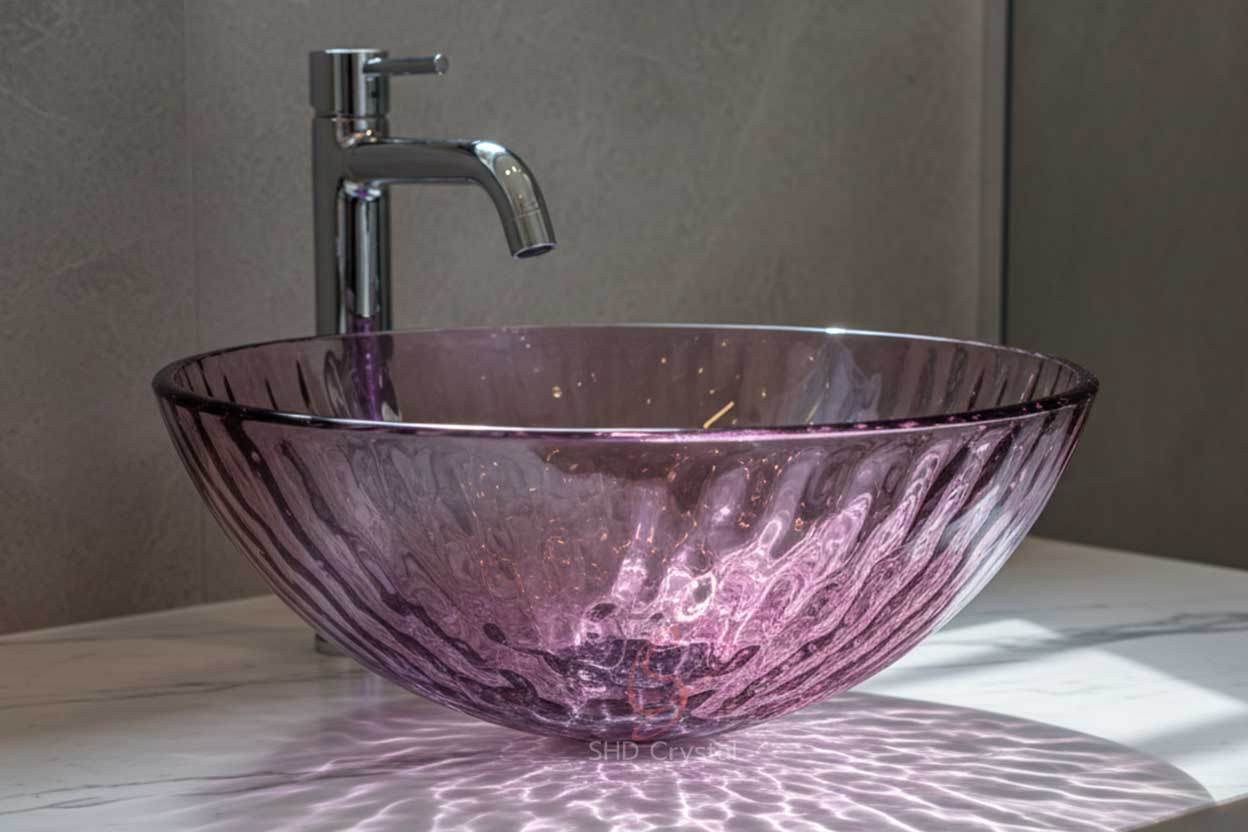
At the same time, maintaining surface hardness control ensures that the finished basin resists scratches, preventing surface wear from distorting perceived color over time.
How Color Depth Is Built Through Layering
The visual richness of purple glass washbasins does not come from a single application of color. Instead, it is developed through controlled layering within the material.
Through hue layering precision, manufacturers adjust density, transparency, and tonal variation across the basin. This creates depth that changes under different lighting conditions, rather than a static color appearance.
Without this level of control, purple glass often appears flat or inconsistent, reducing its impact within a designed space.
Key Factors That Define Color Stability And Durability
- Consistency of pigment distribution within glass layers
- Controlled thickness to maintain uniform tone
- Precision in cooling cycles to avoid color distortion
- Surface finishing that protects clarity and reflection
- Structural reinforcement through surface hardness control
These factors determine whether purple glass washbasins maintain their intended appearance over time. In high-end production, hue layering precision and surface hardness control are not optional—they define product reliability.
The Interaction Between Light And Surface
One of the defining characteristics of purple glass washbasins is how they respond to light. Unlike opaque materials, glass allows light to pass through and reflect simultaneously, amplifying tonal variation.
Through hue layering precision, this interaction can be calibrated to create subtle gradients and visual depth. Meanwhile, surface hardness control ensures that the surface remains smooth and resistant to micro-damage, preserving reflective quality.
This combination allows the basin to appear dynamic rather than static, enhancing its role within interior design.
Common Misunderstandings About Colored Glass Basins
A common assumption is that colored glass is simply tinted material. In reality, producing purple glass washbasins involves controlling multiple variables simultaneously, including temperature, thickness, and cooling speed.
Another misconception is that color alone defines quality. In practice, without proper surface hardness control, even well-colored basins can lose clarity due to surface wear.
Similarly, insufficient hue layering precision often results in uneven tones that become more visible under lighting.
Practical Applications In High-End Interiors
In design applications, purple glass washbasins are rarely used casually. They are typically introduced as focal elements within carefully controlled environments.
Residential projects use them to introduce depth without overwhelming the space, while hospitality settings rely on hue layering precision to maintain consistency across multiple units.
At the same time, surface hardness control ensures that these basins remain suitable for long-term use, even in high-traffic environments where durability is essential.
Where Craftsmanship Meets Color Engineering
Behind the visual complexity of purple glass washbasins lies a combination of material expertise and process control. At SHD Crystal, color development is managed through calibrated forming conditions and controlled cooling cycles, ensuring stable hue layering precision across production batches.
At the same time, advanced finishing processes support consistent surface hardness control, allowing each basin to retain both clarity and resistance to wear. This integration of craftsmanship and engineering ensures that expressive color does not compromise performance.
Conclusion
Purple glass washbasins demonstrate how color, material, and process must work together to achieve both visual depth and durability. Through controlled production, purple glass washbasins can deliver stable color expression while meeting the practical demands of modern interiors.
Choosing purple glass washbasins allows designers to introduce complexity without sacrificing precision. With the support of manufacturers capable of hue layering precision and surface hardness control, color becomes a controlled design element rather than an unpredictable variable.