
Blogpost keywords: sculpture in clear glass, fine glass engraving, hand-sculpted glass
A sculpture in clear glass is never only about form. It is about how light travels through form, how edges dissolve into transparency, and how material becomes a quiet record of the maker’ s hand. In crystal glass, this effect is intensified: clarity is not emptiness, but a stage where reflection, refraction, and shadow perform together.
Unlike opaque sculpture, where volume dominates perception, a sculpture in clear glass exists between presence and absence. It is shaped not only by what is carved or formed, but also by what is intentionally left untouched. This duality is why artists and collectors increasingly turn to crystal as a medium capable of holding both structure and atmosphere.
Where Sculpture in Clear Glass Begins: Form Before Perfection
The earliest stage of hand-sculpted glass is not about refinement—it is about movement. Molten crystal, gathered and shaped, resists strict geometry. It stretches, bends, and responds to gravity in ways that no rigid material can replicate.
In hand-sculpted glass, these initial gestures are not erased; they are preserved. Slight asymmetries, subtle distortions, and organic transitions become part of the final expression. This is where a sculpture in clear glass gains its authenticity—through the visible evidence of making.
Rather than pursuing mechanical perfection, the process embraces controlled irregularity. The result is a form that feels alive, as if it has paused mid-motion.
Fine Glass Engraving as Narrative, Not Decoration
Once the form stabilizes, the surface becomes a second language. Fine glass engraving is not merely ornamental; it introduces depth, rhythm, and direction into the object.
Through engraving, light is interrupted, redirected, and scattered. A smooth surface reflects broadly, but an engraved surface fractures light into finer patterns. This creates contrast within transparency—an essential characteristic of sculpture in clear glass.
In high-end crystal work, engraving is often layered. Some cuts are deep and structural, while others are shallow and almost imperceptible. Together, they form a visual hierarchy that reveals itself gradually as the viewer moves around the piece.
Case Share: Capturing Motion in Crystal
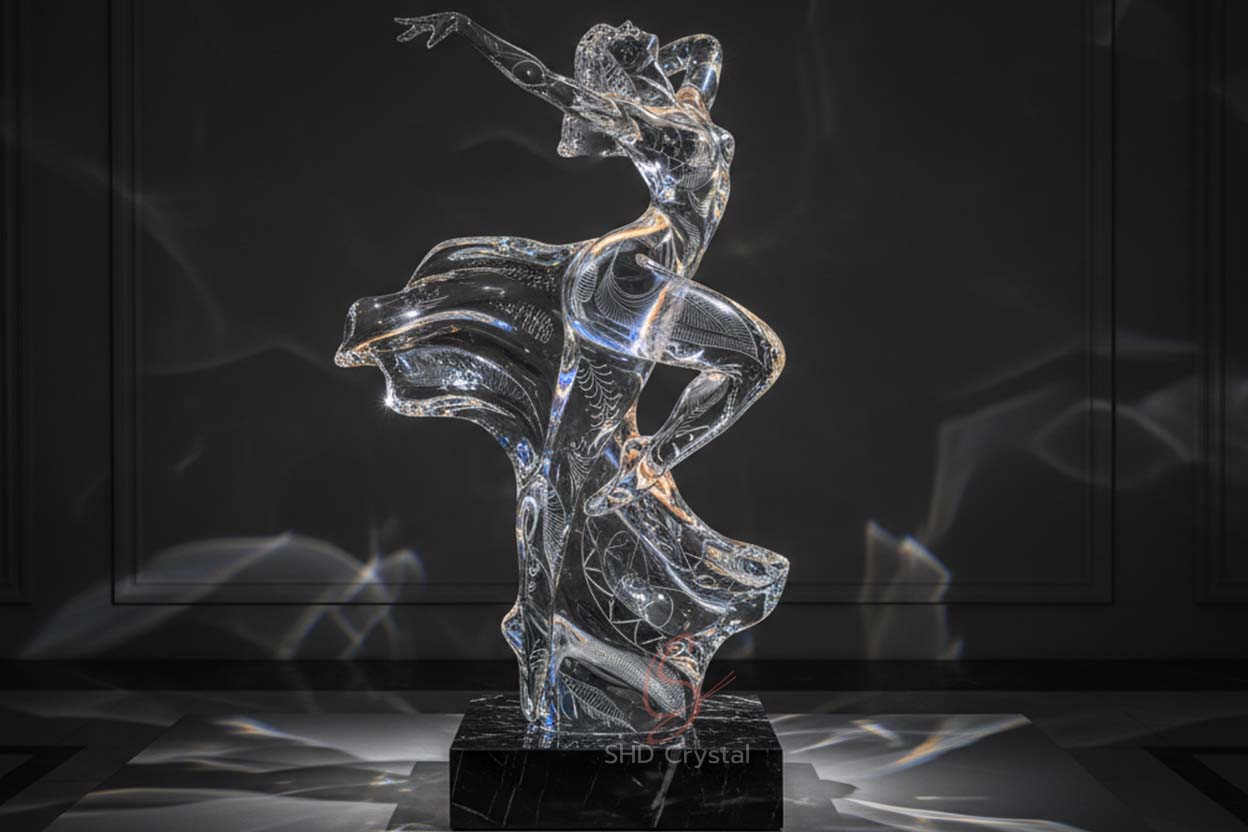
A design studio once approached us with a challenge: to create a sculpture in clear glass inspired by a contemporary dancer mid-performance. The reference images showed a figure twisting through space, one arm extended, the body suspended in an almost impossible balance.
The difficulty was not in reproducing anatomy, but in translating motion into a static medium. A purely smooth surface made the form feel frozen, lifeless.
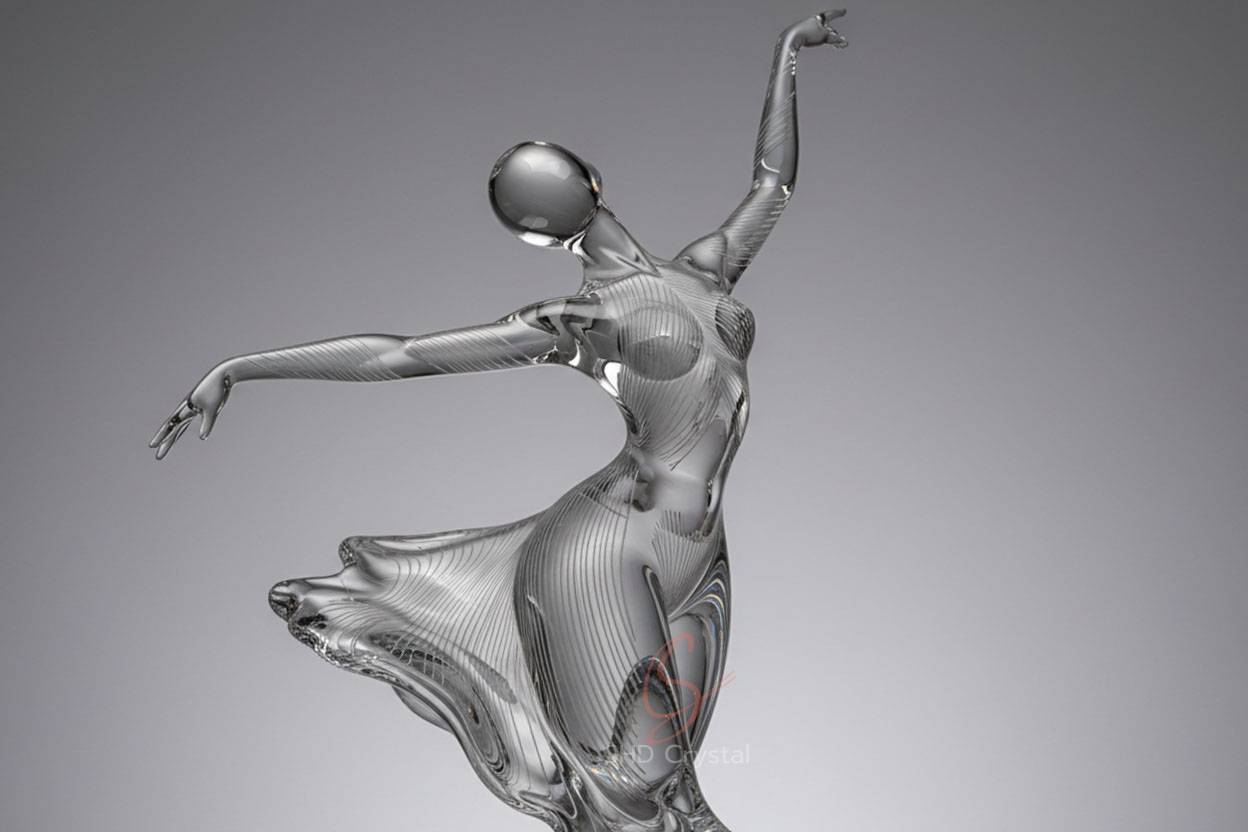
The solution emerged through the combination of hand-sculpted glass and fine glass engraving. The primary form was shaped with slight elongations and softened edges to suggest fluidity. Then, engraving lines were introduced along the direction of movement—subtle, almost like traces of air displaced by the dancer’ s motion.
When light passed through the finished piece, these engraved paths caught and scattered it, creating the illusion that the figure was still moving. The sculpture did not depict motion; it generated it.
Why Crystal Glass Elevates Sculptural Expression
Not all glass behaves the same way. Crystal glass, with its higher clarity and density, allows for sharper edges and deeper engraving without compromising structural integrity.
This makes it particularly suited for sculpture in clear glass, where both form and surface detail must coexist. Fine glass engraving can achieve greater precision, and hand-sculpted glass forms retain their definition even in complex geometries.
More importantly, crystal amplifies light interaction. Edges glow, surfaces shimmer, and internal reflections create layers that give the sculpture a sense of depth beyond its physical dimensions.
The Subtle Discipline Behind “Handmade“
The phrase hand-sculpted glass often suggests spontaneity, but in practice it requires strict control. Temperature, timing, and tool interaction must all be precisely managed. A moment too long in heat, and the form collapses; too little, and the material resists shaping.
Similarly, fine glass engraving demands patience and consistency. Each cut must align with the overall composition. Unlike other materials, mistakes in clear glass cannot be hidden—they become part of the visual field.
This discipline is what transforms craftsmanship into artistry. A successful sculpture in clear glass is not only expressive but also technically resolved.
Conclusion
A sculpture in clear glass represents a balance between material control and artistic intuition. Through the integration of hand-sculpted glass forming and fine glass engraving, crystal becomes a medium capable of holding both structure and movement.
What defines these works is not only their transparency, but the way they interact with light and space—turning still objects into dynamic visual experiences.
Where Craft Meets Controlled Production in Crystal Sculpture
At SHD Crystal, the creation of sculpture in clear glass is approached as both an artistic and technical process.
We support projects that require hand-sculpted glass forming combined with fine glass engraving, ensuring that each piece maintains its expressive character while meeting structural and production requirements. From concept development to finishing, our team focuses on preserving the integrity of handcrafted details within a controlled manufacturing environment.
By balancing artisan techniques with process stability, SHD Crystal enables designers, artists, and brands to realize crystal sculptures that are not only visually compelling but also consistently achievable at scale.