
Blogpost keywords: Murano art glass vases, multicolor layering, hand-blown flower vase
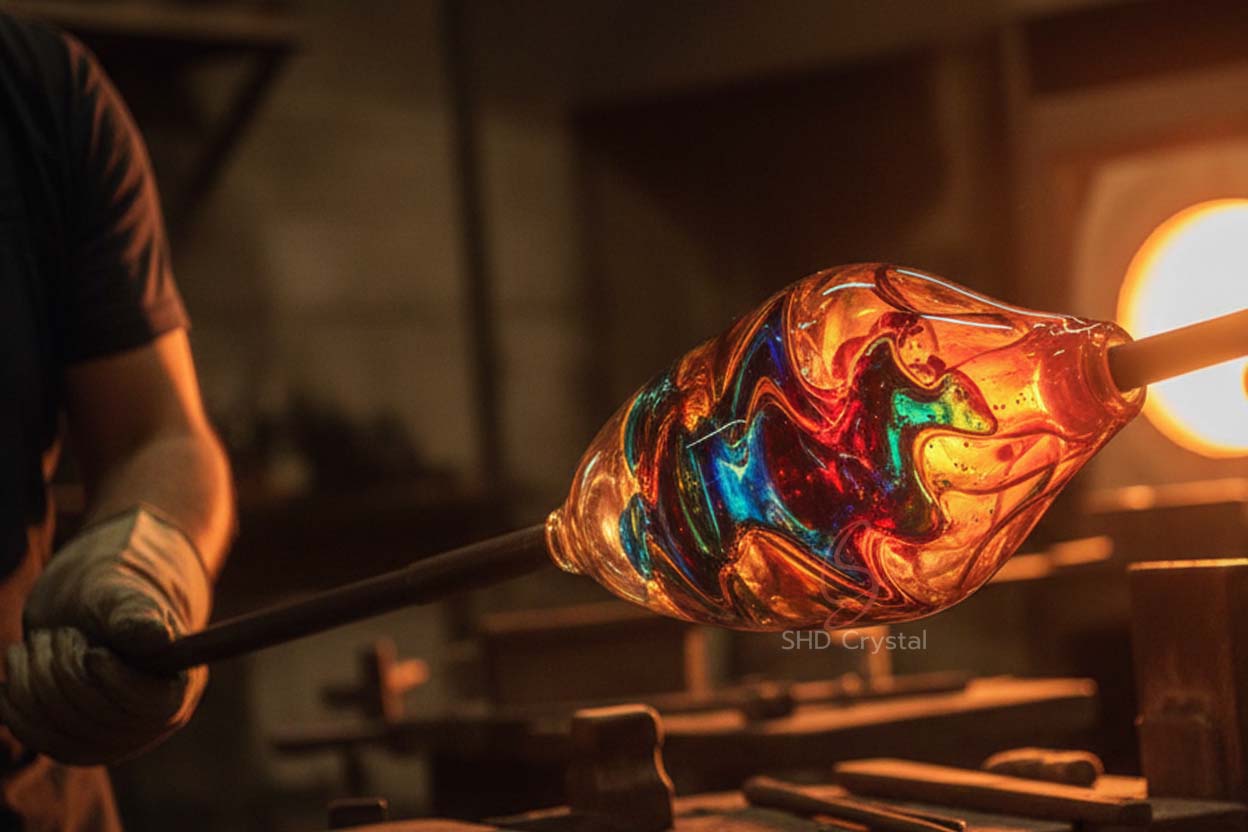
Murano art glass vases are not simply decorative objects—they are records of controlled chaos. In the furnaces of Murano, glass has long been treated not as a passive material but as something alive, something that must be guided rather than forced. Each vase begins as a glowing gather, but what defines it is not the initial shape. It is the way color moves, settles, and transforms during the process.
This is where multicolor layering becomes more than a technique. It becomes a language. A Murano-style piece does not present color as a surface finish; instead, color exists within the body of the glass, suspended like motion that has been frozen at just the right moment.
The Handmade Logic Behind Murano Form
To understand Murano art glass vases, one must first understand that symmetry is not the goal—balance is. A hand-blown flower vase often carries slight variations in thickness, curvature, or contour. These are not flaws; they are the signature of the maker’s timing and control.
In Murano workshops, artisans rely on breath, rotation, and gravity to shape the glass. The result is a form that feels stable yet subtly dynamic. No two pieces behave identically under heat, and that unpredictability is precisely what gives Murano art glass vases their character.
A perfectly uniform vase may be technically impressive, but a handmade one carries tension. It feels as though it could still be moving.
Multicolor Layering as a Controlled Interaction
The visual richness of Murano art glass vases comes largely from multicolor layering. Unlike painted or coated finishes, these colors are introduced during the molten stage, layered, stretched, and sometimes intentionally disrupted.
In many traditional pieces, color appears in gradients, fragments, or clustered patterns. These are not random. They are the result of deliberate timing—when to introduce pigment, how long to reheat, when to stretch or compress the form.
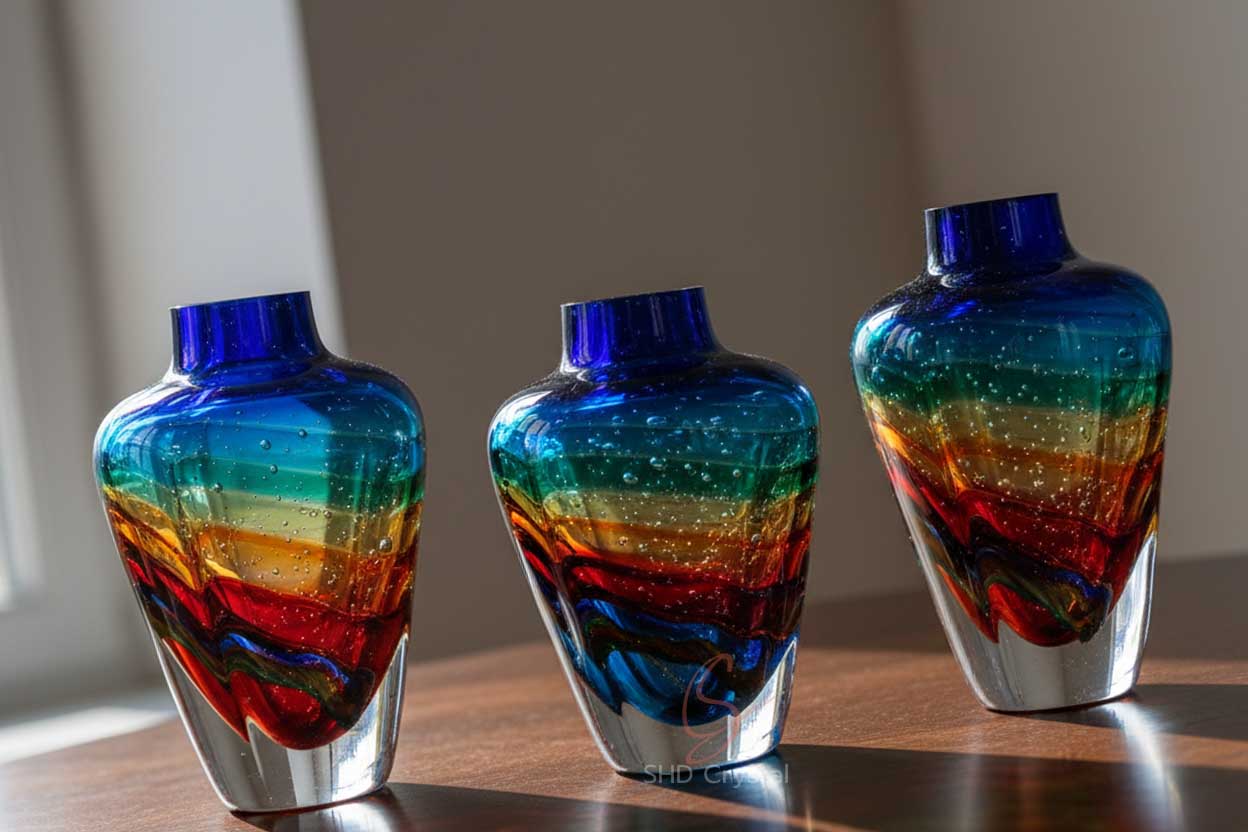
This is why a hand-blown flower vase in the Murano tradition often reveals different tones from different angles. Light does not simply reflect off the surface; it travels through layers, refracting and blending in ways that give the piece depth beyond its physical thickness.
A Story of Color in Motion
A collector once described choosing a Murano-style vase not by shape, but by how it behaved in changing light. In the morning, the piece appeared cool and restrained, dominated by blues and soft greens. By late afternoon, warmer tones emerged—amber, coral, and hints of red that had seemed almost invisible before.
What the collector had unknowingly selected was a vase with complex multicolor layering, where pigments were embedded at different depths. As sunlight shifted, so did the visual hierarchy of those layers.
This is the quiet power of Murano art glass vases. They are not static objects. They respond, subtly but continuously, to their environment.
Why Hand-Blown Flower Vase Craft Still Matters
In an age of automated production, the persistence of the hand-blown flower vase may seem almost unnecessary. Yet this is precisely why it endures. Machines can replicate form, but they struggle to replicate controlled irregularity—the slight variations that give glass its vitality.
Murano art glass vases depend on this balance between control and unpredictability. The artisan must understand not only the material, but also the moment. When to stop shaping is as important as how to shape.
This sensitivity is what separates a handmade piece from a mass-produced one. It is not about imperfection; it is about presence.
Conclusion
Murano art glass vases represent a tradition where material, color, and movement are inseparable. Through multicolor layering and hand-blown flower vase techniques, these pieces capture a fleeting state of transformation and preserve it in solid form.
Their value lies not only in their appearance, but in the process they embody—a process that continues to influence contemporary glassmaking far beyond Murano itself.
Reinterpreting Murano Craft Through Modern Production
At SHD Crystal, we approach Murano-inspired production with both respect for tradition and a focus on manufacturability.
Our team specializes in hand-blown glass processes that recreate the visual depth of multicolor layering while maintaining consistency across production. By controlling color integration, reheating cycles, and forming techniques, we are able to produce Murano-style art glass vases that retain the expressive qualities of handmade work.
For clients seeking a hand-blown flower vase with Murano aesthetics—whether for decorative collections, retail lines, or interior projects—SHD Crystal provides a balance between artisan character and scalable production capability.