
Blogpost keywords: mold assisted glass forming, glass molding process, glass appearance molding
Mold assisted glass forming is a critical method within the modern glass molding process, allowing manufacturers to achieve controlled shapes while maintaining the fluid characteristics of hot glass. Compared to fully free-form techniques, this approach provides structural guidance during shaping without eliminating the handcrafted nature of the material.
By integrating glass appearance molding into early forming stages, manufacturers can create repeatable textures and patterns that serve as the foundation for further refinement.
How Mold Assisted Glass Forming Works in Practice
In a typical glass molding process, molten glass is first gathered from the furnace and shaped into an initial form. At this stage, the material remains highly responsive to gravity and temperature.
The glass is then introduced into a segmented mold, where mold assisted glass forming begins to guide the external geometry. Unlike rigid casting methods, this process does not fully constrain the material. Instead, it allows controlled expansion within the mold structure.
During glass appearance molding, the material is pressed or expanded against patterned mold surfaces, forming ribbed, faceted, or petal-like structures. These textures are not final shapes but serve as controlled surface frameworks for later stages.
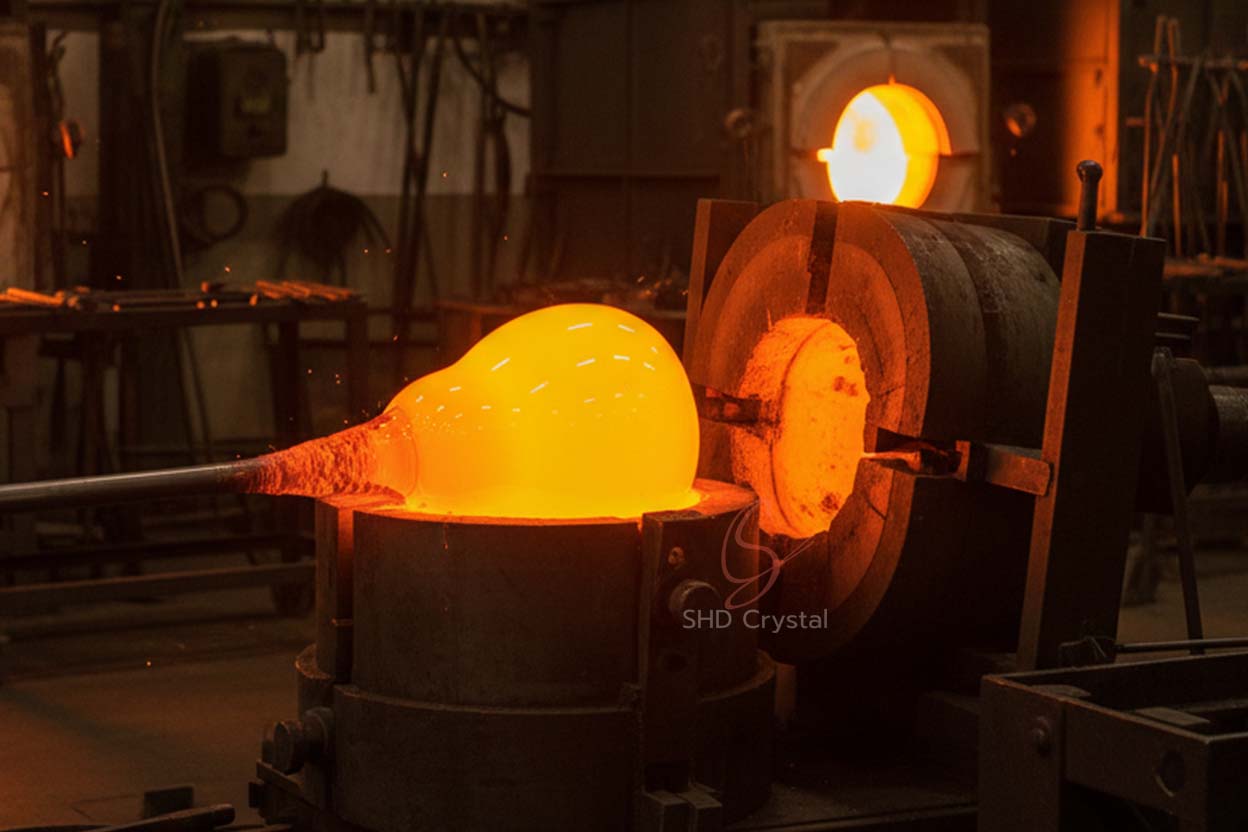
Transition from Mold Structure to Final Form
After the initial shaping, the glass is removed from the mold and returned to open-air forming. This step distinguishes mold assisted glass forming from purely mechanical processes.
At this stage:
- The structured patterns are softened and refined
- Edges created during glass appearance molding are blended
- The overall silhouette is adjusted for proportion and balance
This transition allows the glass molding process to retain both structural consistency and organic visual flow.
Key Advantages of Mold Assisted Glass Forming
The glass molding process benefits significantly from mold assisted glass forming, especially in applications requiring both repeatability and aesthetic control.
- Controlled Repeatability
Surface textures created through glass appearance molding can be reproduced across multiple pieces while maintaining consistency.
- Enhanced Surface Definition
Molds introduce structured detail that would be difficult to achieve through free-form shaping alone.
- Structural Stability
Early-stage guidance reduces deformation risk and helps maintain symmetry.
- Process Flexibility
Mold assisted glass forming can be combined with other glass molding process techniques such as reheating, stretching, or trimming.
Common Misconceptions About Glass Molding
A common misconception is that mold use eliminates craftsmanship. In reality, mold assisted glass forming still depends heavily on timing, temperature control, and manual skill.
Another misunderstanding is that all glass molding process methods produce identical results. Even within structured molds, variations occur due to heat distribution and material movement, preserving the individuality of each piece.
Practical Applications in Production
Mold assisted glass forming is widely used across different categories of the glass molding process, including:
- Decorative glass vessels
- Lighting components such as lamp shades
- Textured glassware
- Architectural glass elements
By incorporating glass appearance molding, manufacturers can achieve distinctive surface designs while maintaining production efficiency.
Conclusion
Mold assisted glass forming represents a balance between control and material expression within the glass molding process. Through the integration of glass appearance molding, manufacturers can guide form development while preserving the dynamic qualities of molten glass.
Advancing Glass Molding Through Controlled Techniques
For designers and manufacturers, understanding mold assisted glass forming provides a foundation for achieving consistent and visually refined outcomes.
By combining structured glass appearance molding with flexible shaping methods, the glass molding process can deliver both repeatable results and expressive design.