
Blogpost keywords: rhombus-faceted crystal vase, cutting craftsmanship, artistic decorative vase
When clients ask us at SHD Crystal to develop a rhombus-faceted crystal vase, they are rarely just asking for a container. What they are really looking for is a surface that can hold light, shift it, and return it with character.
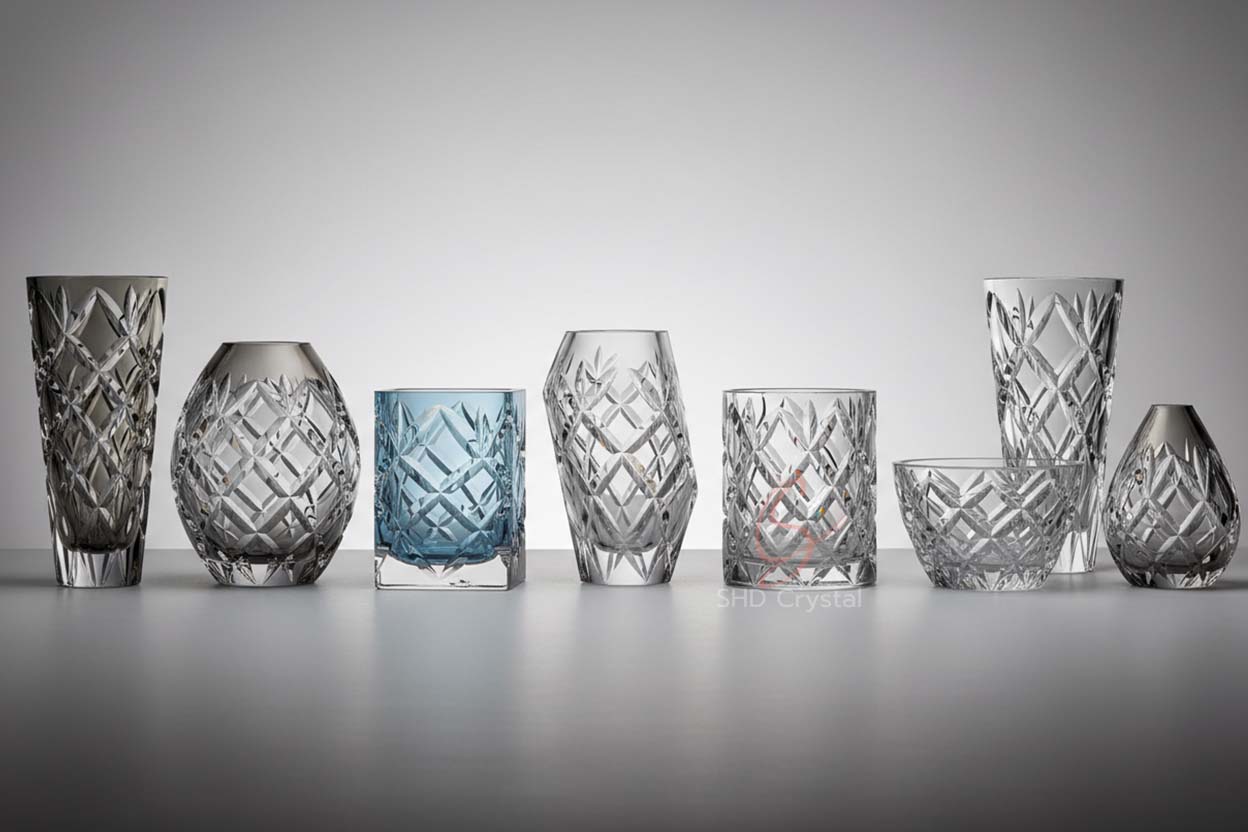
Among many cut patterns, the rhombus facet stands out because it introduces direction. Unlike round or uniform cuts, this geometry creates angled planes that guide reflections across the body of the vase. That is why a rhombus-faceted crystal vase is often chosen as an artistic decorative vase—not only for its form, but for how it behaves under light.
From our perspective, the challenge is not in achieving sharp facets, but in ensuring that every cut contributes to a consistent visual rhythm across the entire piece.
Why This Facet Pattern Changes The Way A Vase Is Perceived
In practice, we see designers choose rhombus faceting when they want movement without distortion. The angled surfaces create a shifting effect as the viewing angle changes, giving the vase a dynamic presence even when it is static.
For a rhombus-faceted crystal vase, this effect becomes more pronounced when placed near natural or directional lighting. Each facet acts as a controlled reflector, creating layered highlights rather than a single uniform shine.
This is where the difference between standard cutting and advanced cutting craftsmanship becomes visible. The pattern must remain coherent across the entire surface, otherwise the visual flow breaks.
As an artistic decorative vase, the piece is expected to perform consistently from every angle, not just from a single viewpoint.
How We Approach Cutting Craftsmanship In Production
At SHD Crystal, we do not treat cutting as a finishing step—it is a structural process. For a rhombus-faceted crystal vase, the base form must be prepared with precision before any cutting begins.
Each facet is then introduced through controlled grinding and polishing stages. The depth, angle, and spacing must remain consistent, otherwise the light interaction becomes uneven.
In our experience, cutting craftsmanship is not only about sharpness. It is about alignment. Every facet must relate to the next, forming a continuous surface language.
This is particularly important for an artistic decorative vase, where the visual effect depends on how light travels across multiple planes rather than isolated cuts.
What Makes Rhombus Faceting Difficult To Execute
From a manufacturing perspective, the difficulty lies in maintaining uniformity across a three-dimensional form.
A rhombus-faceted crystal vase is not flat. As the surface curves, each facet must adjust slightly while maintaining consistency to the eye. This requires coordination between shaping and cutting stages.
We often see designs where the pattern looks correct in concept, but becomes inconsistent when applied to a real object. Without proper control, some facets may appear deeper, while others lose definition.
This is why experienced cutting craftsmanship involves continuous adjustment during production, not just predefined measurements.
Where These Vases Create The Strongest Visual Impact
In interior applications, we see rhombus-faceted crystal vases used as focal points rather than supporting elements.
Placed on a dining table, console, or display shelf, the vase interacts with surrounding light sources and nearby materials. The faceted surface reflects not only light, but also colors and textures from the environment.
As an artistic decorative vase, it does not rely on additional decoration. The surface itself carries enough visual complexity.
This makes the rhombus-faceted crystal vase particularly effective in spaces where minimal objects are used to create a strong visual impression.
What Clients Often Overlook In Faceted Designs
One common issue we encounter is treating the pattern as purely decorative. In reality, the success of a rhombus-faceted crystal vase depends on how the pattern integrates with the form.
Another oversight is ignoring how the vase will be viewed in real environments. Lighting conditions vary, and poorly executed cutting craftsmanship can result in inconsistent reflections or dull surfaces.
We also see cases where excessive cutting reduces structural balance. An artistic decorative vase must maintain both visual sharpness and physical stability.
Our role is to guide these decisions so the final product performs as intended, both visually and functionally.
Conclusion
At SHD Crystal, producing a rhombus-faceted crystal vase means aligning form, surface, and light into a unified result. Through controlled cutting craftsmanship and careful shaping, we create artistic decorative vase pieces that maintain visual consistency and structural reliability.
Turning Faceted Design Into Scalable Craft
For brands and designers working with rhombus-faceted crystal vase concepts, the key is transforming a visual idea into a repeatable process.
At SHD Crystal, our team combines glass forming expertise with advanced cutting craftsmanship to ensure that each artistic decorative vase maintains the same level of precision across production. From shaping to finishing, every stage is coordinated to support both design intent and manufacturing consistency.