
Blogpost keywords: blown glass factory, visual volume illusion, hollow glass presence
Objects produced in a blown glass factory often create a subtle contradiction: they appear heavy, yet feel unexpectedly light when handled. This is not accidental. It is the result of controlled forming decisions that shape how volume is perceived rather than how much material is used.
In practice, visual volume illusion becomes a design tool. By relying on hollow structures, glassmakers create forms that occupy space visually while maintaining manageable weight—an essential quality in both decorative and functional applications.
How a Blown Glass Factory Engineers Hollow Glass Presence
From a manufacturing perspective, blown glass is less about shaping material and more about shaping perception.
A skilled blown glass factory does not simply produce hollow objects; it calibrates how those objects are read in space. Through controlled expansion and internal air distribution, hollow glass presence is established—allowing pieces to feel substantial without being physically dense.
This is particularly important in large decorative forms, where weight directly affects usability and installation.
Where Thickness Creates the Illusion of Weight
One of the most effective techniques used in a blown glass factory is selective thickness distribution.
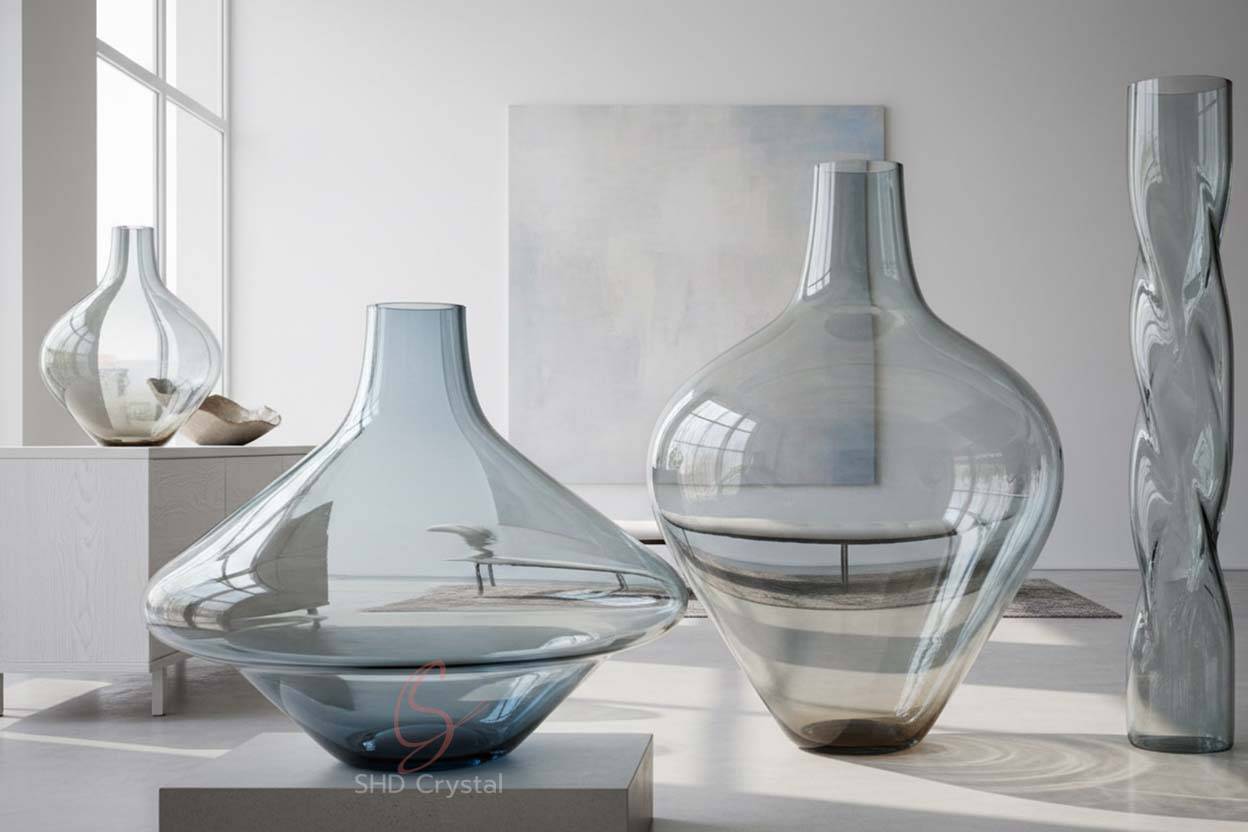
Heavier rims or reinforced bases create visual anchors, giving the impression that the entire object carries mass. In reality, the body remains largely hollow. This contrast is a core mechanism behind visual volume illusion.
When executed correctly, hollow glass presence feels natural rather than deceptive, reinforcing stability without adding unnecessary weight.
How Shape Defines Spatial Authority
Silhouette plays an equally important role. Expanded curves, wide profiles, and controlled proportions allow objects from a blown glass factory to command space without increasing material usage. These forms influence how the eye measures volume.
Through visual volume illusion, even lightweight pieces can appear dominant within a setting. Maintaining consistent hollow glass presence across different shapes ensures that collections remain visually balanced.
Key Factors That Control Perceived Mass in Blown Glass
In practice, perceived weight is not created by adding material, but by redistributing it. A blown glass factory achieves this by carefully adjusting thickness across different parts of the form. Slight reinforcement at the rim or base gives the object a visual anchor, while the body remains light and hollow.
At the same time, expansion during forming must remain controlled. If the internal volume is not evenly distributed, the object may appear distorted or unstable, even if structurally sound. This is why proportion becomes critical—silhouette determines how the eye interprets scale long before weight is felt.
Material behavior adds another layer to this perception. Clear glass tends to reduce visual density, while subtle tinting can increase presence without adding mass. The balance between these factors is what defines visual volume illusion in practical production.
Consistency is the final test. It is relatively easy to achieve this effect in a single piece, but much harder to maintain across a series. Only when multiple forms share the same visual logic does hollow glass presence feel intentional rather than incidental.
For a blown glass factory, this is not about exaggerating form, but about controlling how form is read. The success of visual volume illusion depends on precision in these small decisions, not on dramatic design moves.
Why Transparency Changes How Weight Is Perceived
Glass interacts with light in a way that directly affects perceived density. Clear glass tends to reduce visual weight, while subtle coloration increases perceived presence. A capable blown glass factory adjusts transparency levels to control this effect.
By combining material clarity with structural form, visual volume illusion becomes more nuanced. At the same time, stable hollow glass presence ensures that objects remain practical despite their visual scale.
Where This Capability Becomes Critical
This approach matters most in applications where size and weight must be balanced. In interior design, large glass pieces need to feel substantial without overwhelming the space or adding structural load. In lighting, oversized forms must remain manageable for installation.
A reliable blown glass factory understands that hollow glass presence is not just an aesthetic feature—it is a functional requirement supported by visual volume illusion.
Where Craft Meets Controlled Production
At SHD Crystal, blown glass production is approached as a system of controlled perception.
Each piece is developed through calibrated forming techniques that manage internal air volume, thickness distribution, and shape stability. This allows the blown glass factory process to consistently achieve strong visual volume illusion while maintaining reliable hollow glass presence across production batches.
The result is not just lightweight glass, but glass that feels intentionally proportioned in space.
Conclusion
A blown glass factory does more than shape objects—it shapes how those objects are perceived. By controlling visual volume illusion and hollow glass presence, a blown glass factory creates forms that balance scale, presence, and usability.
Designing With Lightness And Presence
Working with an experienced blown glass factory allows designers to achieve large-scale visual impact without the constraints of material weight. Through controlled visual volume illusion, glass objects can remain expressive, practical, and structurally efficient at the same time.