
Blogpost Keywords: crystal glass champagne flute factory, luxury champagne flutes, premium crystal champagne glasses
A champagne flute moves from a four-degree refrigerator to a twenty-two-degree dining room, then contacts eight-degree champagne. Each transition creates thermal stress within the glass structure. A crystal glass champagne flute factory that engineers for thermal shock resistance ensures that luxury champagne flutes survive hundreds of these transitions without micro-fracture accumulation or catastrophic failure.
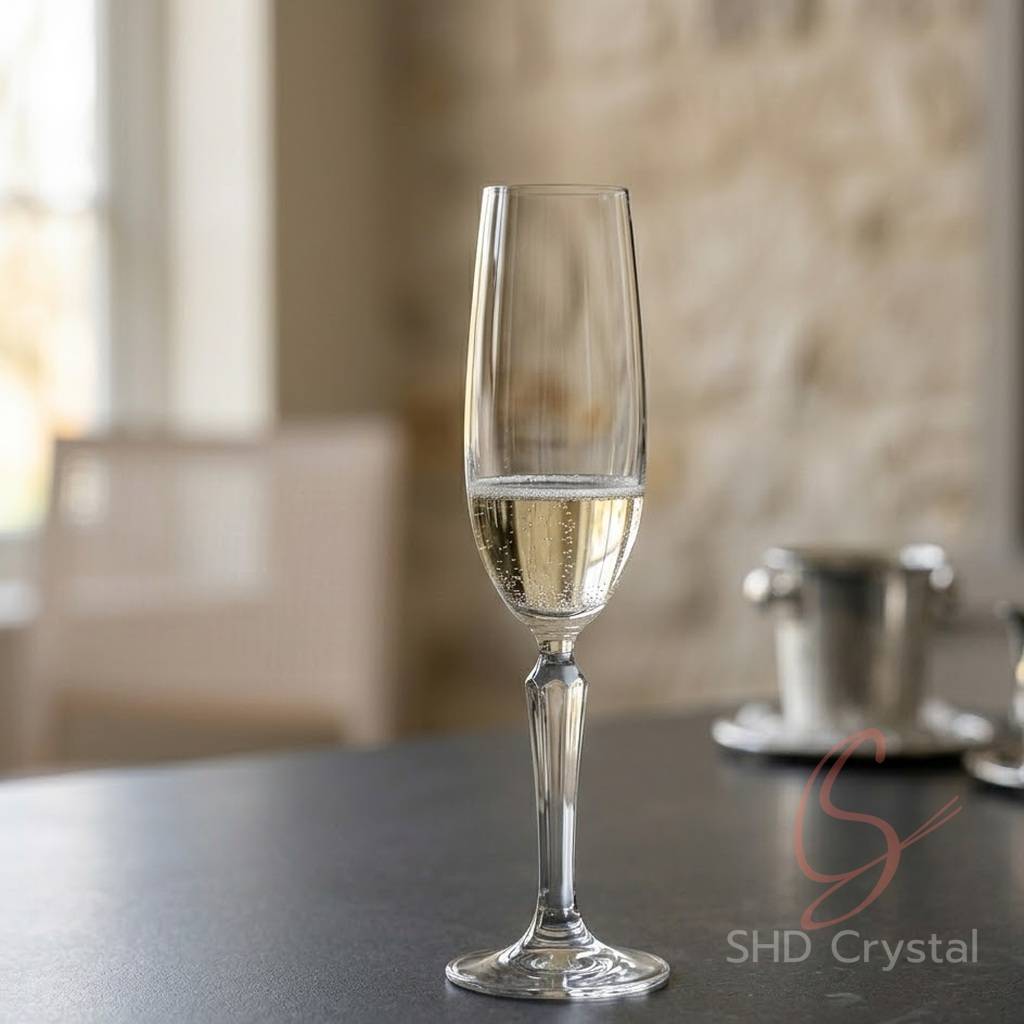
The thermal resilience of premium crystal champagne glasses is not an accident of material — it is a designed property, controlled through composition, annealing protocol, and wall thickness distribution. This article examines how thermal engineering shapes the production process from raw batch to finished glass.
Thermal Stress Fundamentals in Glass coefficient of Thermal Expansion and Glass Composition
Every glass formulation has a coefficient of thermal expansion (CTE) that determines how much it expands and contracts with temperature change. A crystal glass champagne flute factory that selects compositions with low CTE values — below 90 times ten to the minus seven per degree Celsius — produces premium crystal champagne glasses that tolerate temperature differentials of up to sixty degrees without cracking.
Luxury champagne flutes made from borosilicate-enhanced crystal achieve CTE values around 55 times ten to the minus seven, significantly more resistant to thermal shock than standard soda-lime alternatives at 90. The trade-off is a slightly higher melting temperature during production, which the crystal glass champagne flute factory manages through specialized furnace configurations.
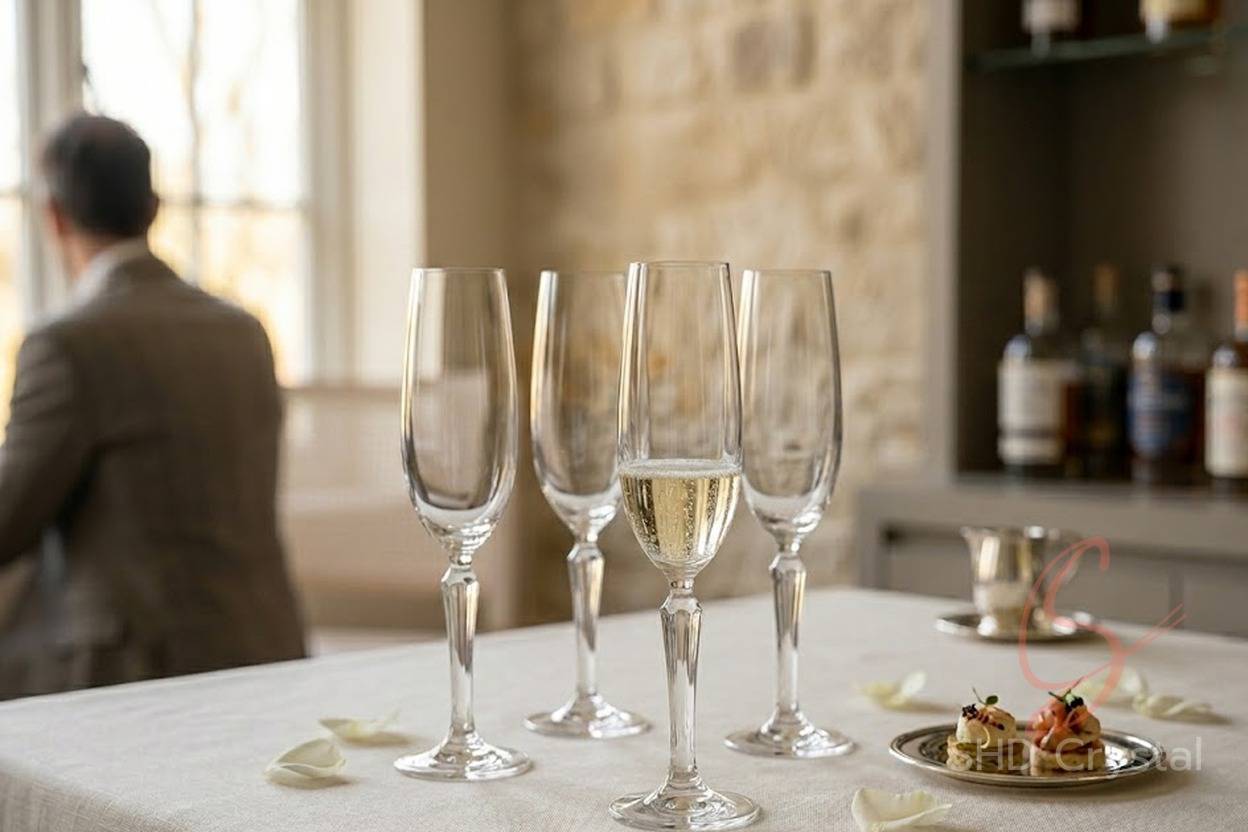
The crystal composition also affects how thermal stress distributes within the glass wall. Premium crystal champagne glasses formulated with balanced alkaline earth oxides distribute stress more evenly, reducing the concentration points where micro-fractures initiate.
Thermal Gradient and Wall Thickness
When cold champagne enters a room-temperature flute, the inner wall cools faster than the outer wall, creating a thermal gradient across the glass thickness. A crystal glass champagne flute factory that controls wall thickness to between 1.0 and 1.5 millimeters limits this gradient to a range that the material can accommodate without internal stress exceeding its fracture threshold.
Luxury champagne flutes with walls thicker than two millimeters are more vulnerable to thermal shock, not less, because the temperature differential across the wall generates proportionally higher stress. Premium crystal champagne glasses optimized for thermal resistance maintain thin, uniform walls that equalize temperature quickly.
Annealing and Stress Relief controlled Cooling Rate and Residual Stress
The annealing lehr is where residual thermal stress from the forming process is eliminated. A crystal glass champagne flute factory that controls the cooling rate at between two and four degrees Celsius per minute through the annealing point — the temperature at which internal stress relaxes within minutes — ensures that luxury champagne flutes leave the production line with near-zero residual stress.
Rapid cooling through the annealing zone traps internal stress that will later manifest as spontaneous breakage during normal use. Premium crystal champagne glasses from factories with properly calibrated annealing cycles demonstrate breakage rates below two percent during commercial service, compared to eight to twelve percent for insufficiently annealed alternatives.
The annealing temperature profile must be specific to the crystal composition in use. A crystal glass champagne flute factory producing multiple formulations maintains separate annealing programs for each, as the annealing point can vary by twenty degrees Celsius between compositions.
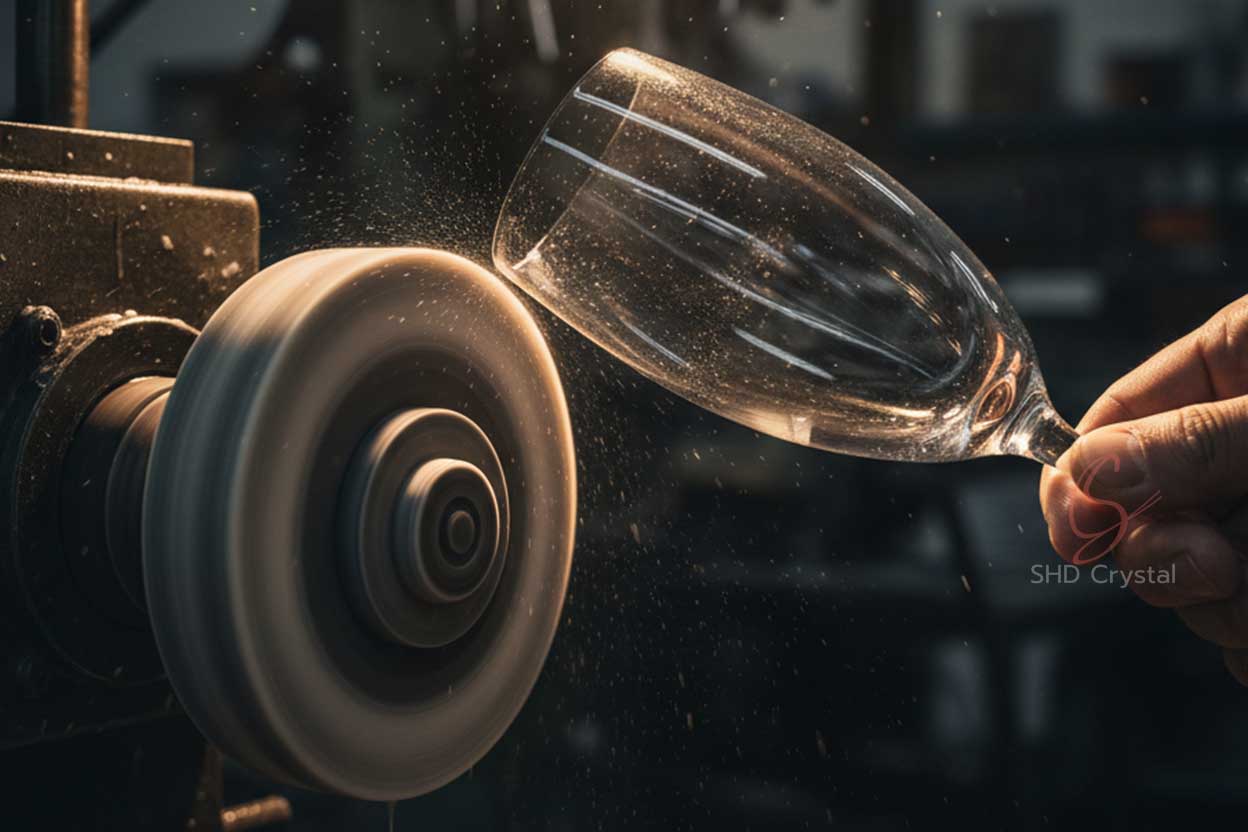
Stress Polarization Testing
After annealing, each batch of luxury champagne flutes undergoes stress polarization testing — a process where the glass is viewed between crossed polarizing filters to reveal any remaining internal stress patterns. Premium crystal champagne glasses that pass this test show uniform darkness under polarization, indicating the absence of stress concentration zones.
A crystal glass champagne flute factory with in-house polarization testing can identify and reject stressed pieces before they ship, reducing the customer’s breakage rate and protecting the brand’s quality reputation.
Thermal Performance Validation thermal Shock Testing Protocol
Before a production run of premium crystal champagne glasses is approved, samples undergo thermal shock testing: glasses are chilled to negative ten degrees Celsius for thirty minutes, then immediately immersed in sixty-degree water. A crystal glass champagne flute factory that requires zero failures from a sample of twenty glasses under these conditions ensures that luxury champagne flutes can withstand any realistic service temperature transition.
This test exceeds normal use conditions by a factor of two to three, providing a safety margin that accounts for extreme scenarios — such as a glass being moved from a walk-in freezer to a hot dishwasher rinse cycle. The crystal glass champagne flute factory that validates thermal performance at these levels delivers products that survive the realities of commercial hospitality.
Thermal engineering is invisible to the guest but fundamental to the longevity of luxury champagne flutes in service. A crystal glass champagne flute factory that treats thermal shock resistance as a primary design parameter rather than an incidental material property produces premium crystal champagne glasses that maintain their beauty and integrity through years of temperature cycling.
The most reliable crystal glass champagne flute factories publish thermal performance specifications alongside their dimensional and aesthetic data — transparently communicating the engineering depth that separates their luxury champagne flutes from visually similar but thermally fragile alternatives.