Blogpost keywords: custom tulip glass lamp shades, floral lamp diffusers, vintage-inspired lighting parts
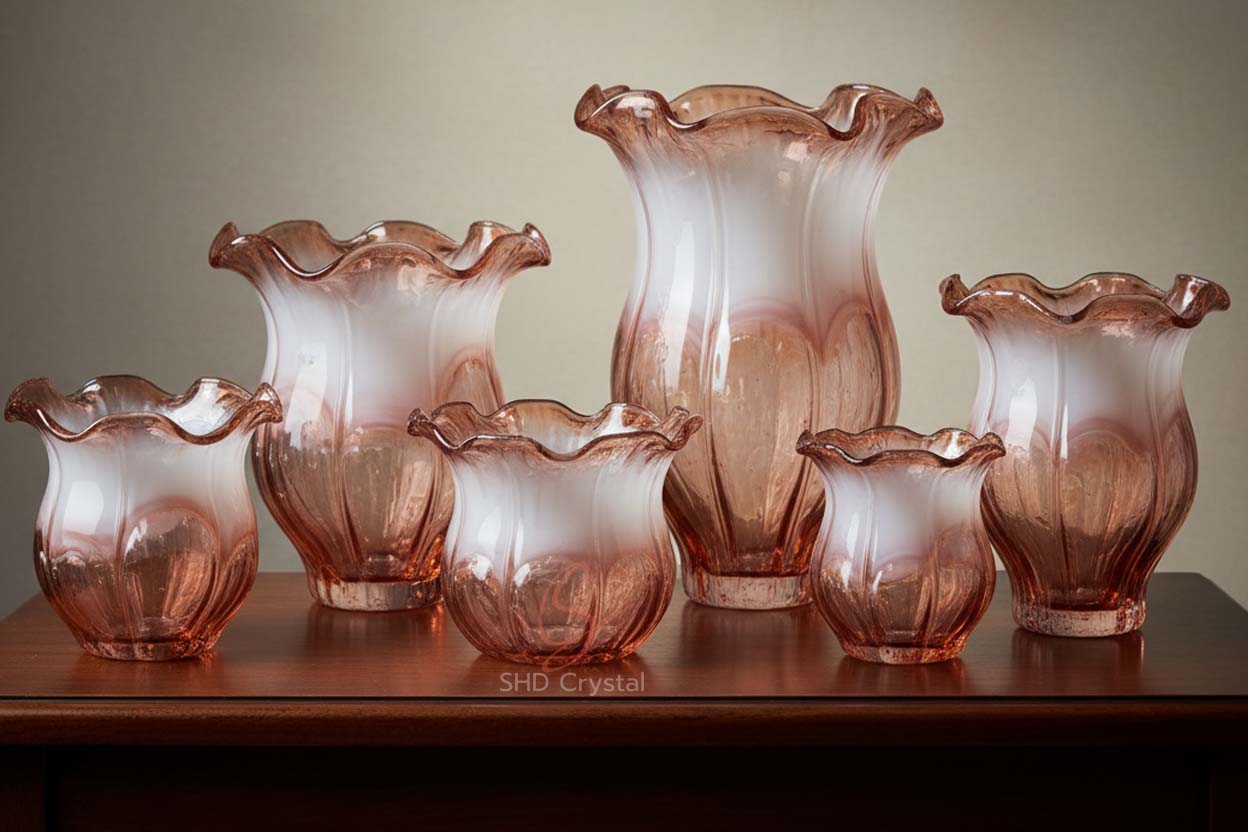
Among decorative lighting components, custom tulip glass lamp shades are often underestimated in production complexity. Their floral silhouette appears soft and natural, yet recreating that form consistently in glass requires far more control than standard cylindrical or conical shades.
Unlike simpler profiles, tulip shapes combine flare, curvature, asymmetry, and thin petal-like edges within a single piece. This makes them one of the more demanding categories of floral lamp diffusers in glass blowing.
For manufacturers, the challenge is not merely achieving the outline once—but repeating it consistently across production while maintaining proportion, symmetry, and optical quality.
How Custom Tulip Glass Lamp Shades Challenge The Glass Blowing Process
The primary difficulty in producing custom tulip glass lamp shades lies in the transition from the neck to the flared petal opening.
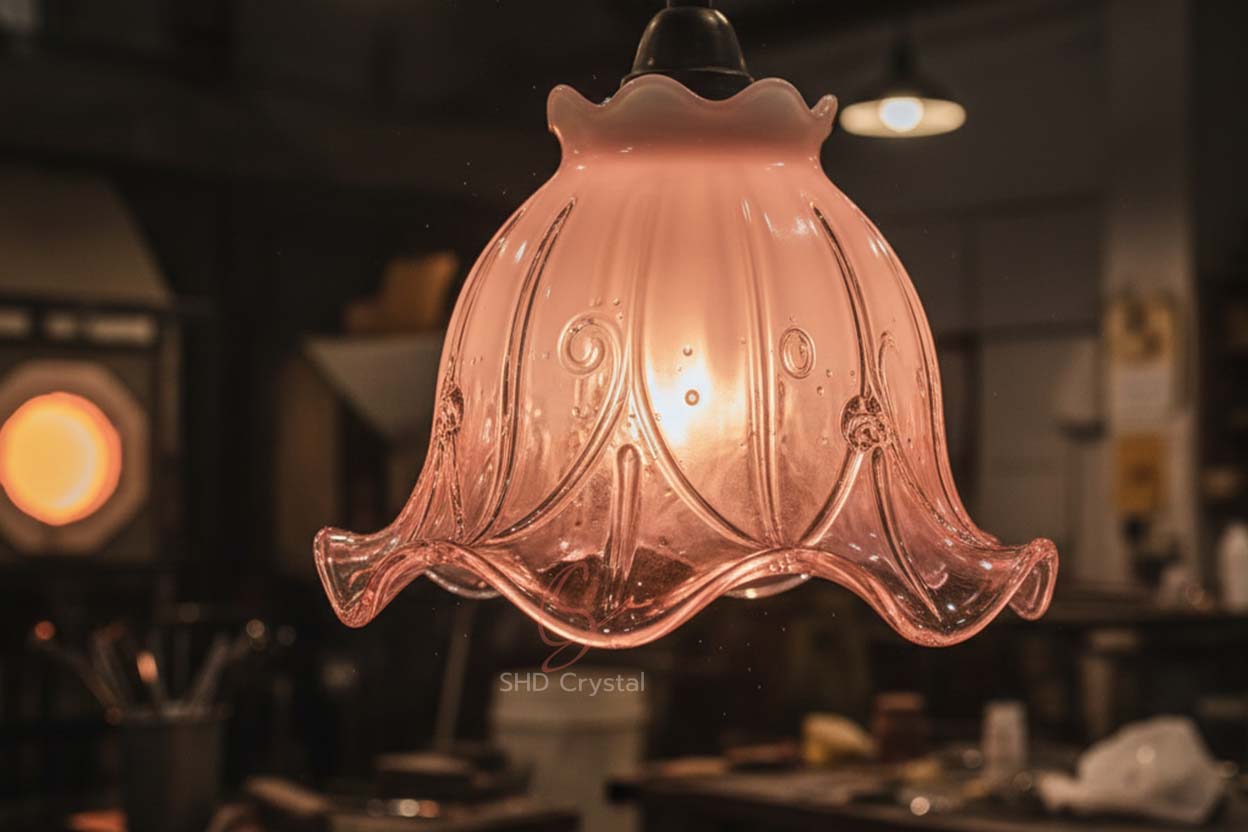
As molten glass expands, the upper edge must be opened outward while remaining thin and elegant. At the same time, the lower body must retain enough structural thickness to support the form. This creates a delicate balance in the blowing process. If the flare opens too early, the profile loses tension. If the edge remains too thick, the shade appears heavy and unnatural.
Compared with standard vintage-inspired lighting parts, tulip forms require significantly tighter control over heat distribution and timing.
Why Petal Geometry Is Harder Than It Looks
A tulip-shaped outline is not a simple flare. Most successful custom tulip glass lamp shades include subtle asymmetry, petal variation, or directional curvature to mimic natural floral movement. These features must be introduced while the glass remains hot and responsive. Even slight inconsistency can make one unit appear elegant while another looks rigid or collapsed. This is why many lower-end floral lamp diffusers fail to capture the softness associated with true tulip forms.
In production, achieving natural-looking petal geometry requires the artisan to shape the glass beyond basic symmetry into controlled organic movement.
Why Edge Thickness Defines Quality Perception
One of the clearest indicators of quality in custom tulip glass lamp shades is edge treatment. Thin, refined petal edges make the shade appear lighter and more realistic. However, reducing thickness at the flare increases the difficulty of maintaining structural stability. If cooled too quickly, the edge may crack. If left too thick, the lamp loses its floral delicacy.
For premium vintage-inspired lighting parts, this edge refinement often determines whether the final piece feels handcrafted and elegant—or merely decorative.
How Surface Decoration Adds Another Layer Of Difficulty
When decorative texturing or carving is introduced, the complexity increases further. A patterned custom tulip glass lamp shades design requires the underlying blown form to remain consistent enough for surface detailing to align properly.
For engraved or molded textures, the petal contours must remain stable throughout shaping, otherwise the pattern will distort. This is why textured floral lamp diffusers often demand stronger production control than smooth-surface versions.
Why Tulip Shades Remain Popular Despite Production Difficulty
Despite their complexity, custom tulip glass lamp shades remain commercially relevant because the shape offers something standard shades cannot—movement.
The form softens lighting fixtures visually and creates a more expressive silhouette. This is particularly valuable in decorative wall lamps, table lamps, and heritage-style fixtures using vintage-inspired lighting parts.
For many buyers, the added production difficulty is justified by the stronger visual identity the tulip form provides.
Conclusion
Custom tulip glass lamp shades represent one of the more technically demanding forms in decorative lighting glass. Their success depends on precise blowing control, refined edge shaping, and consistent handling of organic petal geometry. When executed well, they offer floral lamp diffusers and vintage-inspired lighting parts a level of softness and craftsmanship that simpler glass forms cannot replicate.
Why Skilled Production Matters In Tulip Shade Development
For buyers developing custom tulip glass lamp shades, manufacturing capability directly affects product quality.
The complexity of tulip forms requires experienced control over blowing, shaping, and finishing—particularly when thin petal edges, organic flare, or decorative textures are involved. Reliable production of floral lamp diffusers and vintage-inspired lighting parts depends not only on tooling, but on the glass craftsmanship behind each forming stage.