
Blogpost keywords: purple wash basin, hue transition balancing, water flow stabilization
Purple wash basin developed with hue transition balancing and water flow stabilization for refined appearance and controlled daily performance.
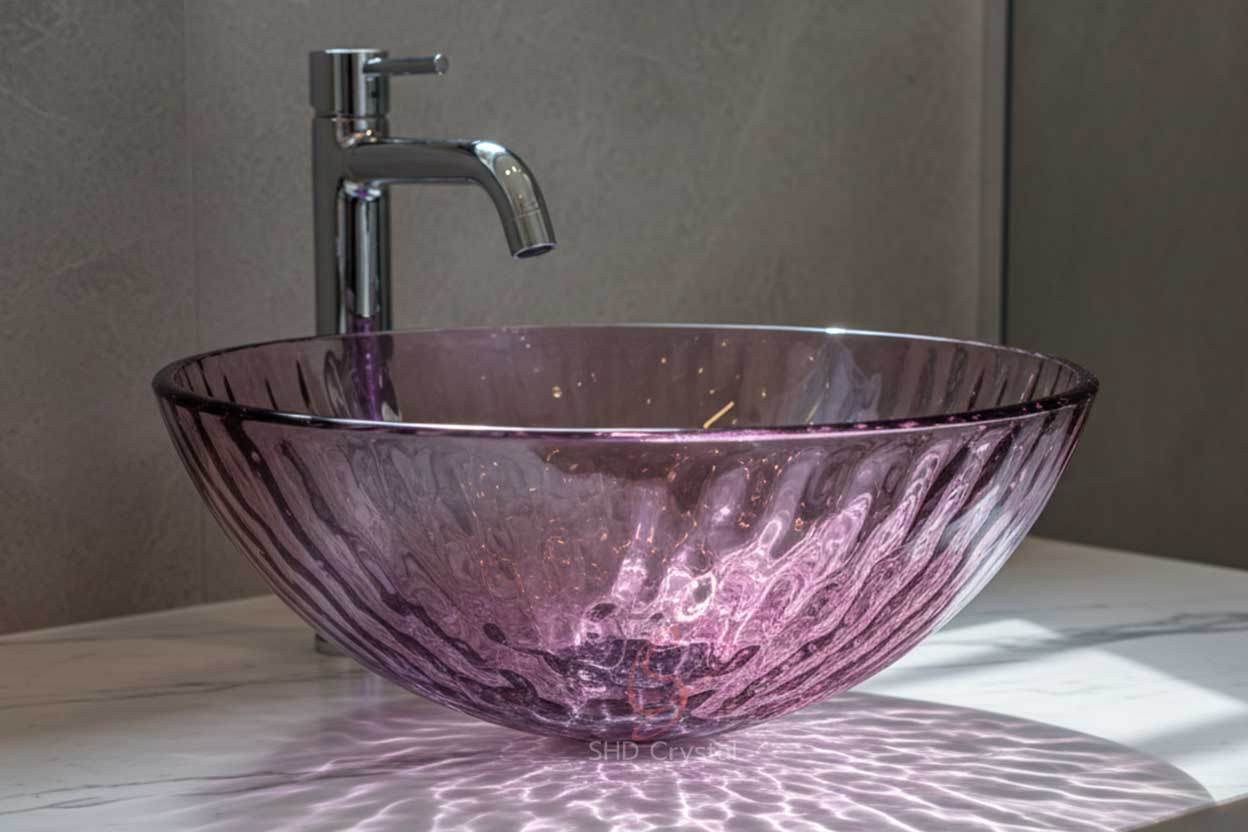
Purple Wash Basin as a Study of Tone Transition
Purple wash basin design stands at the intersection of warm and cool color behavior, making it one of the most complex tones to manage in glass. Unlike single-direction colors, purple shifts depending on lighting, thickness, and viewing angle, requiring a more controlled approach to both material and form.
In modern interiors, a purple wash basin often serves as a subtle statement—distinct but not overpowering. Manufacturers that apply hue transition balancing and precise water flow stabilization can produce basins that maintain visual consistency while delivering reliable functionality.
This approach treats color as a dynamic variable rather than a fixed attribute.
Balancing Dual-Tone Characteristics
Purple is inherently a combination of contrasting color influences. In a purple wash basin, this creates the potential for uneven visual behavior if not properly managed.
Through hue transition balancing, manufacturers control how the tone shifts across different areas of the basin. Thicker sections may lean toward deeper violet, while thinner edges may reveal lighter undertones.
Balancing these transitions ensures that the basin appears cohesive rather than fragmented.
This is particularly important in glass, where transparency amplifies even subtle variations.
Structuring Form for Visual Stability
Because of its tonal complexity, a purple wash basin relies heavily on form to maintain visual clarity. Curves, edges, and proportions all influence how the color is perceived.
Through hue transition balancing, manufacturers ensure that the basin’s geometry supports a smooth visual gradient rather than abrupt changes.
At the same time, water flow stabilization ensures that internal shaping supports functional performance without disrupting the external appearance.
This coordination allows the basin to feel both structured and fluid.
Managing Water Behavior in Daily Use
Functionality remains essential in any basin design. In a purple wash basin, water interaction becomes more visible due to the depth of color.
With water flow stabilization, manufacturers refine internal contours to guide water smoothly toward the drain. This reduces splashing and improves usability.
The design considers not only the direction of flow but also how water spreads and settles within the basin.
Meanwhile, hue transition balancing ensures that these internal adjustments do not affect the overall color consistency.
Light Interaction and Depth Perception
One of the defining features of a purple wash basin is how it interacts with light. Depending on lighting conditions, the basin may appear warmer or cooler.
Through hue transition balancing, manufacturers maintain a controlled response to light, preventing the basin from shifting too dramatically in appearance.
At the same time, water flow stabilization ensures that reflections created by moving water remain subtle and controlled.
This balance enhances both visual depth and usability.
Addressing Production Complexity
Purple glass is sensitive to variations in both color composition and thickness. In purple wash basin manufacturing, controlling these variables is essential.
Without proper hue transition balancing, inconsistencies may lead to uneven color distribution.
Without effective water flow stabilization, internal geometry may not perform as intended, affecting user experience.
Maintaining consistency requires precise process control throughout production.
Application in Contemporary Interiors
Purple wash basin products are often used in interiors that aim for a balance between individuality and refinement.
In residential spaces, they can provide a distinctive focal point without overwhelming the overall design.
In hospitality environments, purple tones can introduce a sense of sophistication and depth.
Through controlled hue transition balancing, manufacturers ensure consistent visual behavior, while water flow stabilization guarantees practical performance.
This makes the basin suitable for a wide range of design applications.
Conclusion
Purple wash basin design is defined by its ability to manage tonal complexity and functional performance simultaneously. By applying precise hue transition balancing and effective water flow stabilization, manufacturers can produce basins that maintain both visual harmony and everyday usability. This approach ensures consistent quality while supporting modern design expectations.
Planning a Purple Wash Basin Project
When developing a purple wash basin, it is important to collaborate with manufacturers experienced in both color management and structural design. Suppliers capable of implementing hue transition balancing and stable water flow stabilization can support design validation, sampling, and production scaling. This ensures that the final product aligns with both aesthetic goals and functional requirements.