
Crystal glass frosting techniques alter the outer surface of transparent glass so that it scatters more light and develops a translucent, matte appearance. The two most common routes are chemical etching and abrasive blasting. Both can create an attractive frosted effect, but they do not produce identical texture, optical behavior, edge definition, or production requirements. Selecting a method therefore depends on the glass composition, product geometry, intended handling, decoration layout, order volume, and acceptable variation.
How Crystal Glass Frosting Techniques Change the Glass Surface
Frosting works by creating microscopic irregularities that interrupt direct reflection and transmission. A smooth transparent surface allows light to pass with relatively little scattering; a treated surface redirects that light in many directions and appears softer or more opaque. The size, depth, and distribution of those irregularities determine whether the finish looks like a fine satin haze or a stronger chalky frost.
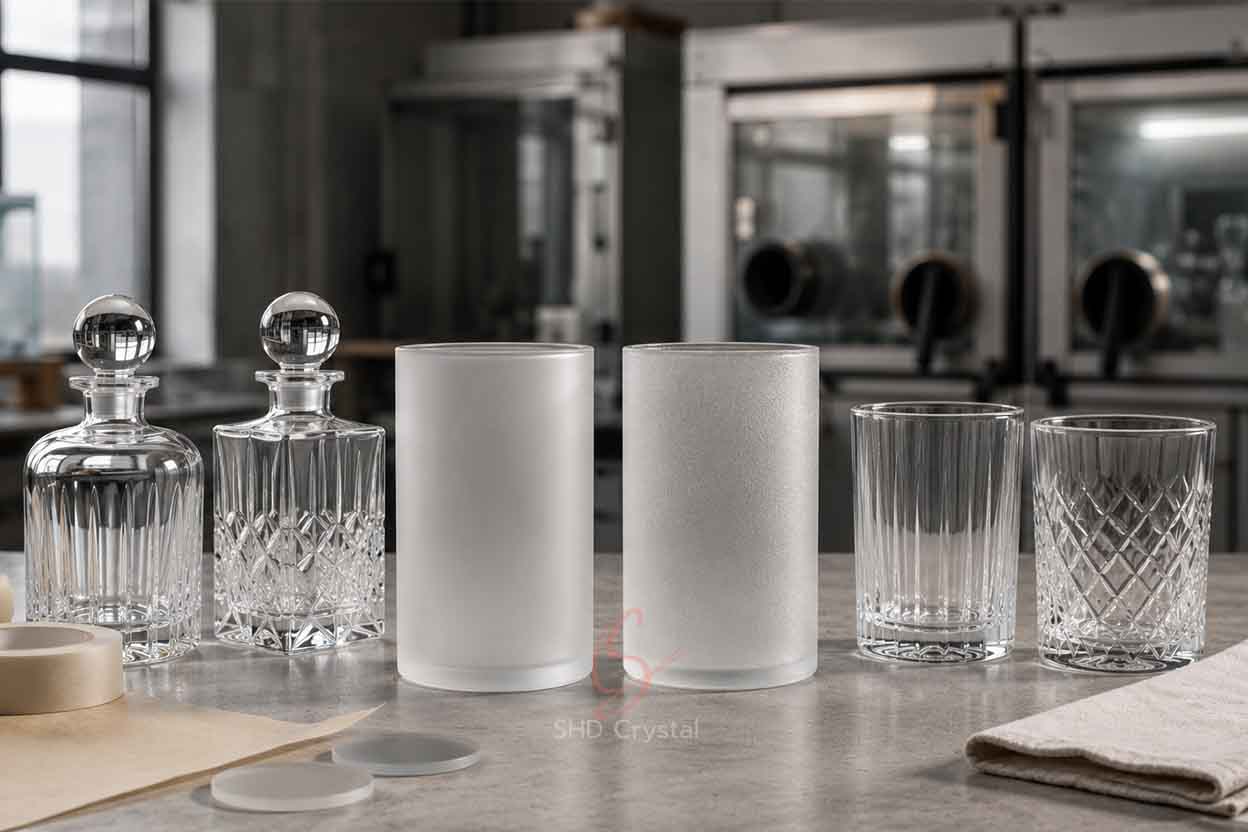
Chemical and mechanical processes create those irregularities in different ways. Chemical etching removes material through a controlled reaction. Sandblasting strikes the surface with abrasive media and creates small impact features. Research on glass erosion confirms that abrasive impact changes surface roughness and optical transmission, while studies of chemical etching show that concentration, temperature, time, initial defects, and glass composition influence surface evolution.
Acid Etching Produces a Chemically Developed Frost
Industrial acid frosting uses fluoride-based chemistry to react with the glass surface. On multicomponent crystal glass, the process is more complex than dissolving a single material because different glass constituents and reaction products influence the effective removal rate. This is why one recipe cannot be assumed to behave identically on lead crystal, lead-free crystal, or soda-lime glass.
When well controlled, glass surface etching can create a fine, comparatively uniform satin appearance across suitable shapes. The result depends on the starting surface, glass formulation, exposure conditions, bath condition, rinsing, masking, and post-process cleaning. Existing scratches or forming defects may remain visible or become easier to notice after the reflective surface has been replaced by a diffuse finish.
Acid frosting also introduces a major workplace-safety requirement. Hydrofluoric acid is used to etch, polish, and frost glass, but NIOSH describes it as extremely harmful because it can penetrate tissue and cause systemic exposure. The method belongs in properly engineered industrial facilities with trained personnel, containment, ventilation, emergency procedures, and appropriate chemical controls. It is not a workshop process to reproduce casually.
Sandblasting Creates Frost Through Abrasive Impact
Sandblasting, more accurately described as abrasive blasting, propels selected media against the glass. Particle type, particle condition, air pressure, nozzle angle, working distance, travel speed, masking quality, and repeated passes all affect the finish. A finer and more evenly controlled treatment can produce a soft matte texture, while stronger treatment generally increases opacity and tactile roughness.
The process is flexible for prototypes, small batches, selective patterns, irregular objects, and areas that are easier to reach with a nozzle than to immerse in a chemical bath. It can also produce a visibly handcrafted or strongly textured result that suits decorative objects.
That flexibility does not mean the process is automatically simple. Abrasive impact changes surface morphology and can introduce or enlarge surface flaws when it is too aggressive. Dust and rebound media also require enclosed equipment, exhaust ventilation, suitable cleanup methods, and worker protection. OSHA identifies containment and ventilation as primary controls for abrasive-blasting exposure.
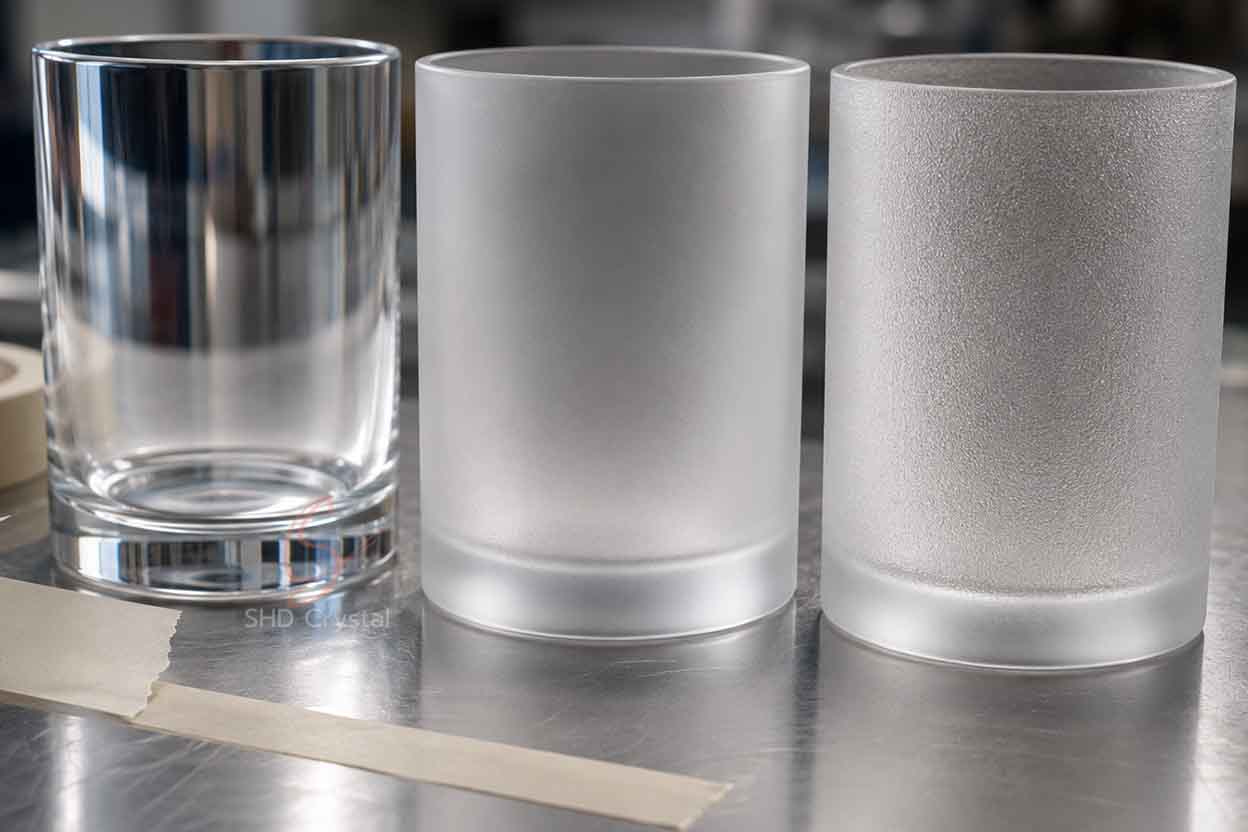
Acid Etching and Sandblasting Do Not Have One Universal Winner
The practical difference is not that one method is always premium and the other is always economical. Each offers a different balance.
Acid etching is often considered when a project requires a fine, continuous satin character across a larger surface. It may support repeatable full-body frosting when the glass composition, bath control, masking, and rinsing are stable. The trade-off is the need for highly controlled chemical handling, wastewater management, process calibration, and compatibility testing.
Sandblasting is useful when the design needs localized frosting, stronger opacity, flexible masking, or a more tactile surface. It can be efficient for development work and lower quantities, but manual nozzle movement may introduce variation unless fixtures or automated paths are used. A rougher result can also interact differently with coatings, printing, handling marks, and cleaning.
Finishing decisions should therefore be based on approved physical samples rather than visual renderings. Lighting conditions, bottle color, wall thickness, and the liquid or object behind the glass can all change how the same frost appears.
Product Geometry Changes the Finishing Result
Flat panels are easier to treat uniformly than narrow necks, deep recesses, sharp shoulders, heavy bases, or complex sculptural curves. Chemical immersion can reach broad exposed surfaces, but trapped air, drainage, masking edges, or uneven rinsing may affect difficult geometry. Abrasive blasting can target specific zones, although the nozzle angle and distance change continuously around curved forms.
Raised logos, cut patterns, seams, and polished edges require special attention. Frosting may soften the visual contrast of molded details, expose defects around seams, or create visible transitions where masks begin and end. Selective frosting also needs sufficient space for reliable masking. Extremely fine lines that look precise in artwork may not remain equally sharp after production handling.
For custom projects, frosting requirements should be discussed before molds and decoration layouts are finalized. A small change to the logo panel, shoulder radius, or frost boundary may improve masking accuracy and reduce visible inconsistency without changing the product concept.
Strength and Durability Claims Need Careful Language
Any process that removes material or creates surface damage can influence glass strength, but the outcome cannot be predicted from the method name alone. Initial surface condition, treatment intensity, flaw population, geometry, thickness, and later handling all matter. Research shows that chemical etching can expose and alter microcracks as the surface evolves, while abrasive erosion increases roughness and changes optical properties. These findings support testing rather than universal claims that one treatment always strengthens or weakens every product.
This is particularly important for rims, stems, thin corners, and high-contact areas. Full frosting may be appropriate for a decorative bottle body but unnecessary on a drinking rim or a precision closure interface. Functional zones can be masked or finished separately when surface texture would interfere with sealing, comfort, assembly, or inspection.
What Buyers Should Confirm Before Production
A useful finishing brief should identify:
–The exact glass composition or approved base sample
–Full-body or selective frosting
–Target opacity and tactile character
–Areas that must remain clear or polished
–Logo, label, coating, and printing requirements
–Acceptable masking-edge variation
–Cleaning and handling expectations
–Packaging protection for the treated surface
–Approval lighting and sample comparison method
–Order quantity and repeat-order requirements
Buyers should request samples representing the real glass, geometry, and intended secondary decoration. A flat reference plate cannot fully predict the result on a curved bottle or handmade object. Several pieces should be reviewed for patchiness, color consistency, masking alignment, seam visibility, surface marks, and variation between production positions.
Packaging also matters. Frosted surfaces can show rubbing or contamination differently from polished glass. Dividers, trays, films, and gift-box interiors should be checked against the actual finish, not selected only from dimensions.
Conclusion
Crystal glass frosting techniques create different visual and tactile results because acid etching and sandblasting modify the surface through different mechanisms. Successful selection requires more than comparing appearance or unit cost. Glass composition, geometry, masking, process control, worker safety, secondary decoration, packaging, and batch consistency all influence the result. Glass surface etching may suit a fine chemical frost, while abrasive methods may offer greater flexibility for localized or stronger textures. The most reliable decorative glass finishing decision is made through representative samples and clearly defined acceptance standards.
Evaluating a Frosted Finish for Custom Glass Products
SHD Crystal supports crystal glass frosting techniques through product-shape review, finish sampling, selective-frosting planning, decoration coordination, inspection, and export packaging evaluation. Sharing the base glass, target texture, clear zones, artwork, order quantity, and handling requirements allows the team to compare chemical etching with abrasive decorative glass finishing and recommend a practical route for trial production.
Exclusive Release by SHD Crystal
Custom Crystal Glass OEM Manufacturer
This article is originally published by SHD Crystal. Original Link: https://shdcrystal.com/blogs/crystal-glass-frosting-techniques/