
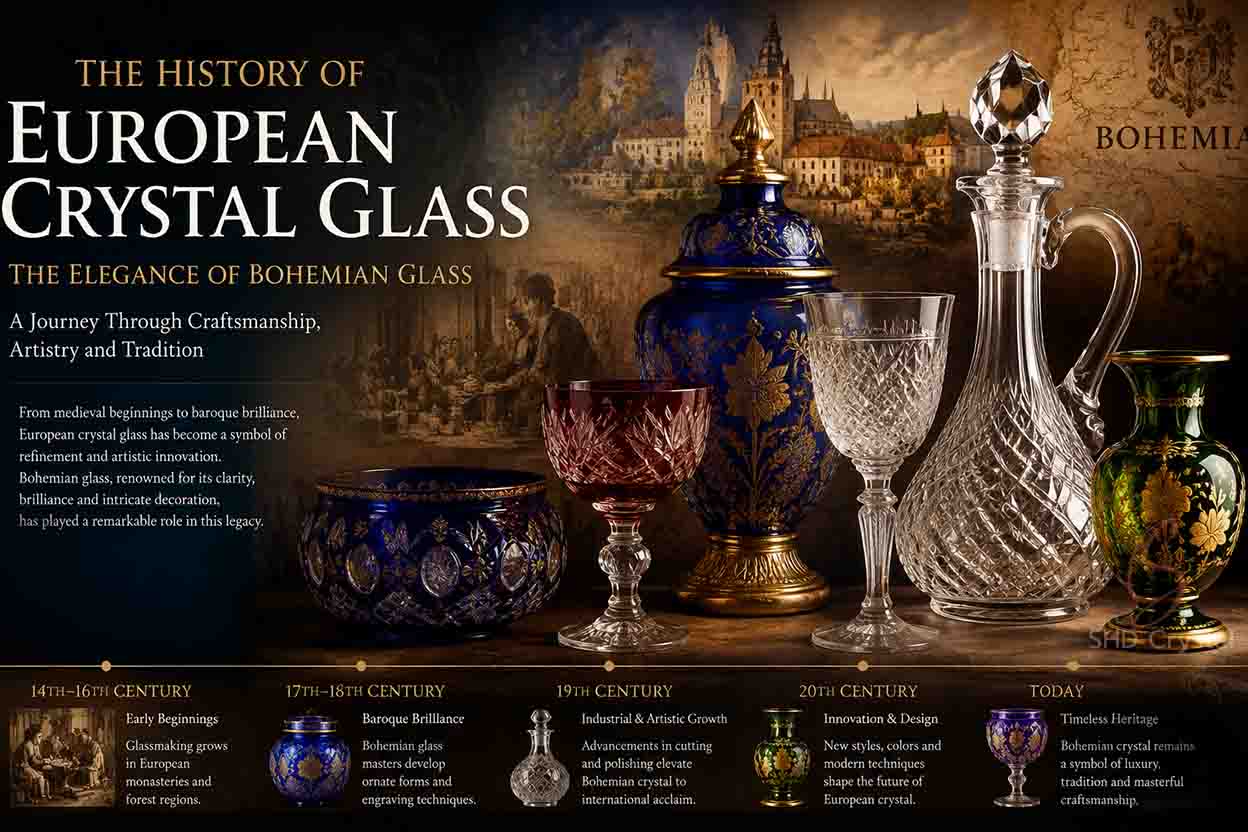
European crystal history begins long before a finished goblet catches the light. It begins with heat that cannot be paused, raw materials that do not always behave exactly as expected, and craftspeople who must make decisions while the glass is still moving. Long before digital temperature controls and standardized inspection sheets, quality depended on the ability to read a furnace, judge viscosity, control cooling, and recognize when a piece was ready for cutting.
The result was not simply decorative tableware. It was a new way of understanding glass as both a working material and a social object.
European Crystal History Was Written In Heat, Weight, And Timing
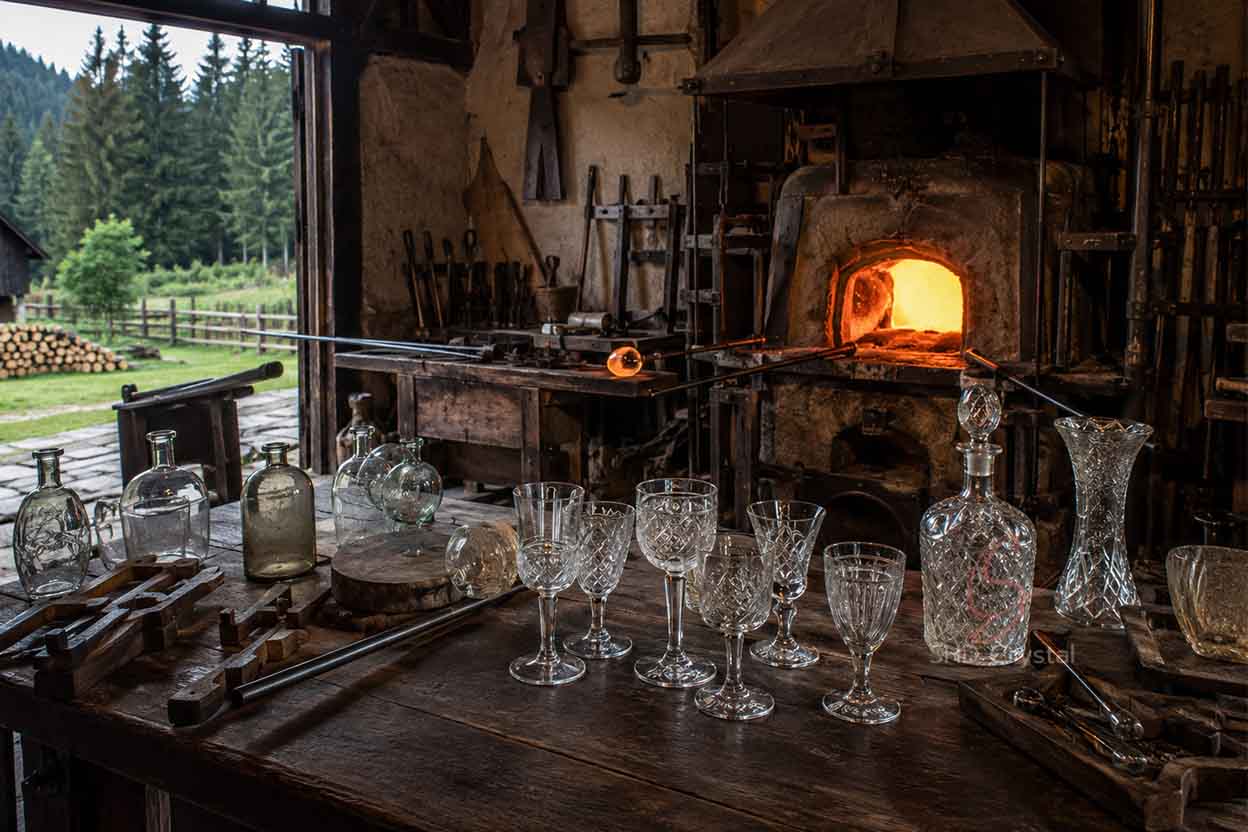
Imagine a glasshouse at the end of a long working day. The furnace is still active. A gather of molten glass is lifted, turned, shaped, reheated, and shaped again. There is little room for hesitation. Too cool, and the glass resists the tool. Too hot, and the form loses control.
This physical reality sits behind the European glassmaking tradition. Early workshops did not separate design from material behavior. The intended shape had to respect what the glass could do at a particular temperature, how quickly it cooled, and where its weight collected during forming.
A bowl that appeared balanced depended on even glass distribution. A stem needed enough strength without becoming visually heavy. A foot needed to sit flat after cooling. These were not abstract artistic preferences. They were practical achievements.
Modern buyers still judge these same qualities, even when they do not know their historical origin. They lift a wine glass and notice the balance. They run a finger near the rim. They look through the bowl and instinctively search for clarity, symmetry, and control.
When Clearer Glass Changed What Decoration Could Become
European glass did not develop through one uninterrupted tradition. Different regions produced different materials, techniques, and decorative languages.
In late 17th-century England, lead-containing glass compositions became associated with higher refractive brilliance and a material that responded well to cutting. Around the same period, Bohemian workshops became known for a clear, high-lustre potash-lime glass that could also be cut and engraved with considerable precision.
These were not identical materials, but both helped transform surface decoration. Before a cutter could create deep facets, the blank itself needed sufficient thickness and structural consistency. Before an engraver could build a detailed scene, the wall needed to survive controlled material removal. Clarity mattered, but so did hardness, softness, weight, and resistance beneath the wheel.
Bohemian crystal glassware became especially recognizable through this union of material and decoration. Floral engraving, geometric cutting, faceted surfaces, colored overlays, gilding, and scenic imagery turned vessels into objects that rewarded close viewing.
Yet the beauty was never produced by sparkle alone. Every cut removed material. Every engraved line required pressure control. Every polished surface depended on the previous stage being completed correctly.
The Object Passed Through More Than One Pair Of Hands
A historical crystal vessel was rarely the expression of a single isolated craft. One worker might form the body. Another might cut the facets. An engraver could add imagery or ornament. A polisher would bring clarity back to surfaces dulled by grinding. A decorator might apply enamel, staining, or gilding. The finished piece carried the accumulated decisions of several specialists.
This division of skill is one of the most important lessons within the European glassmaking tradition. Quality was not created in one dramatic moment. It emerged through a chain of controlled stages.
A poorly formed blank limited the cutter. Uneven wall thickness restricted engraving depth. Excessive polishing could soften sharp details. Inadequate annealing could leave invisible internal stress beneath an otherwise beautiful surface.
The sequence mattered. That same logic applies to contemporary crystal production. Forming, annealing, cutting, engraving, polishing, inspection, and packing cannot be evaluated independently. A defect introduced early may only become visible much later.
Bohemian Crystal Glassware Was Not Always Heavy And Ornate
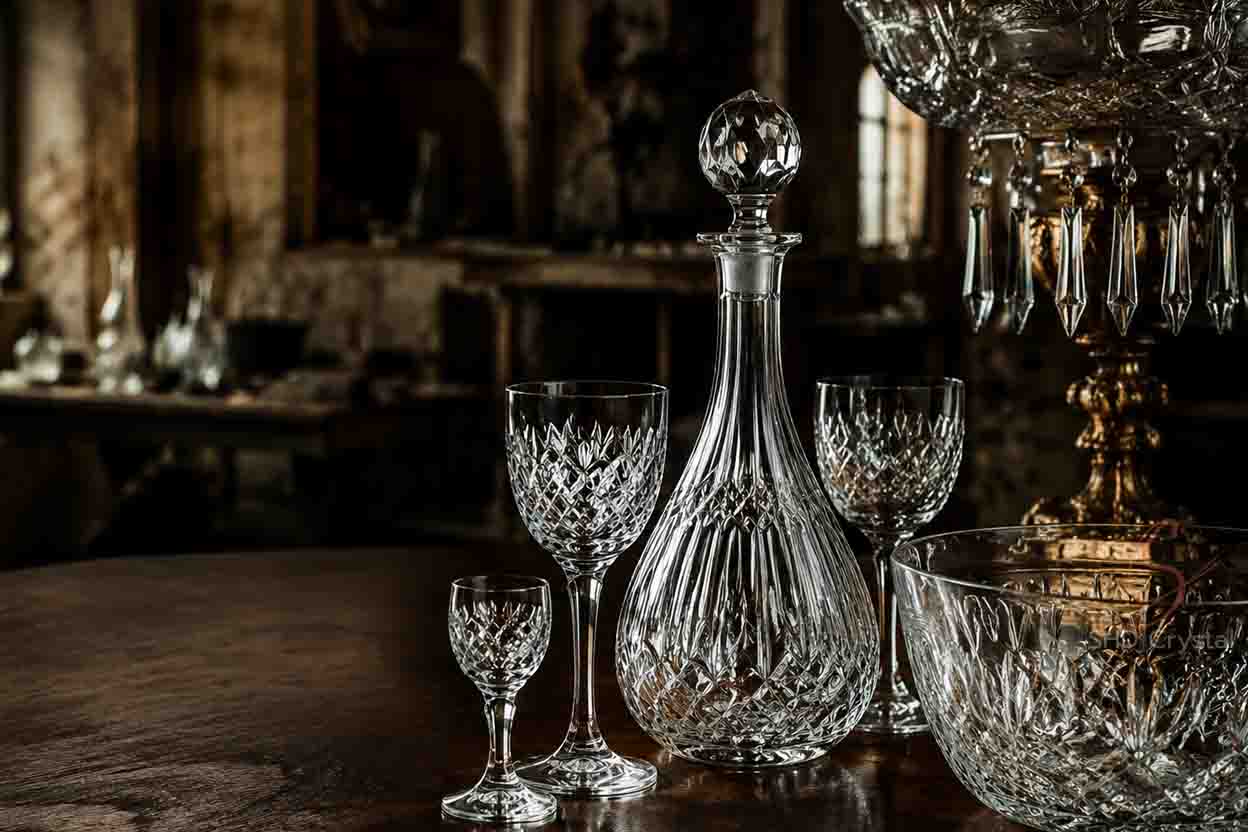
Historical crystal is often imagined as dense, formal, and covered in decoration. That image represents only part of the story. Bohemian crystal glassware included elaborate ceremonial pieces, but it also included drinking vessels, serving objects, spa beakers, household glass, colored wares, and forms shaped by changing markets. Some pieces relied on deep cutting. Others used delicate engraving, colored layers, painted details, or relatively restrained silhouettes.
This range matters because it challenges a common modern assumption: that historical influence must result in excessive ornament. A contemporary designer may borrow the rhythm of a faceted pattern without reproducing it completely. A hotel collection may use a classical bowl proportion with a simpler stem. A modern decanter may keep the visual weight of traditional crystal while removing most surface decoration.
Historical reference works best when its logic is understood. The purpose is not to copy an old object. It is to identify why its proportion, reflection, balance, or ornament feels deliberate.
Material Choice Changed The Character Of Crystal
Material developments also changed the appearance and handling of glass. Traditional lead crystal became valued for weight, brilliance, refractive behavior, and suitability for cutting. Those characteristics supported the dramatic optical effects associated with many historical table and decorative objects.
Modern lead-free crystal follows a different material route. Depending on the formulation and intended use, it may provide clarity, lower weight, or a more suitable position for certain hospitality, retail, and export programs. The comparison should not be reduced to one material being universally superior. Material choice affects forming behavior, cutting response, product weight, compliance considerations, handling expectations, and cost.
European crystal history shows that material innovation has always changed design. When a clearer or more workable glass became available, decoration changed with it. When production methods changed, proportions and markets changed too.
A material is not simply poured into a historical design. It helps determine which design is realistic.
From Dining Rooms To Modern Quality Standards
Crystal objects also evolved alongside the places where they were used. A ceremonial covered goblet did not answer the same need as a daily drinking glass. A decorative centerpiece could accept more weight than a stemmed glass carried repeatedly by hotel staff. A cabinet piece could prioritize visual complexity. A restaurant glass needed comfort, replacement practicality, and stable dimensions.
This is where history becomes commercially relevant. The intended setting influences rim thickness, base weight, decoration depth, overall scale, and packaging. A deep-cut tumbler may suit a gift collection but create unnecessary weight for high-volume hospitality use. A thin-stem glass may look elegant but require tighter handling and packaging controls. A sculptural bowl may tolerate small handmade differences that would appear unacceptable in a uniform boxed set. The strongest historical objects were appropriate to their role. Modern products should be judged in the same way.
The Invisible Craft Still Matters Most
A buyer can see brilliance, cutting, color, and shape. Other quality factors remain hidden. Annealing reduces internal stress after forming. Wall thickness transition influences cooling behavior. Polishing pressure affects edge quality. Mold tolerance influences repeatability. Inspection determines which variations are acceptable. Packaging decides whether all that work survives transportation.
These invisible controls explain why one sample cannot represent an entire production order. A single piece may be exceptionally balanced or carefully selected. Batch quality asks a harder question: can the same proportion, finish, rim quality, and decoration be maintained again and again?
That question may sound modern, but it carries one of the oldest lessons in European crystal history. Craft is not only the ability to make one beautiful object. It is the discipline required to control material through every stage of its transformation.
Heritage Becomes Useful When It Guides Better Questions
Historical knowledge should not encourage buyers to request more cutting, more weight, or more decoration without purpose. It should help them ask better questions.
-Which visual feature creates the desired character?
-Does the brilliance come from the material, the cut pattern, or both?
-Will the product be displayed, gifted, or used every day?
-How much handmade variation suits the collection?
-Can the wall support the intended cutting depth?
-Does the packaging protect the stem, rim, and decorated surfaces?
When these questions are clear, Bohemian crystal glassware becomes more than an aesthetic reference. It becomes a way to study the relationship between silhouette, surface, material, and use.
What European Crystal History Leaves Behind
European crystal history matters because it records generations of problem solving disguised as beauty. Glassmakers learned to control heat. Cutters learned how far a wall could be reduced. Engravers discovered how light could reveal an image. Polishers restored transparency after abrasion. Users gave each object a place at the table, in the home, or in ceremony.
The surviving lesson is not that modern glassware should look old. It is that every visible detail should be supported by an invisible reason. Weight should serve balance. Decoration should respect structure. Material should suit the intended use. Craft should remain connected to function.
Carrying The Story Into Modern Glassware
The European glassmaking tradition continues whenever a new glass object is developed with the same attention to proportion, material behavior, surface control, and purpose. A modern tumbler, decanter, stem glass, bowl, or centerpiece may look entirely contemporary while still carrying principles refined over centuries.
For anyone using historical references in a new project, the most useful starting point is not a request to copy a period style. It is a clear explanation of what the reference communicates: brilliance, cutting rhythm, visual weight, engraved detail, stem proportion, or ceremonial presence.
That is how european crystal history remains alive. Not as a fixed catalogue of old designs, but as a continuing conversation between material, maker, object, and use.
Read the original full version:
https://shdcrystal.com/blogs/european-crystal-history/