
Airtight glass container testing is an important step in product validation because a lid that feels tight does not always create a reliable seal. A container may look well assembled, resist movement when closed, or create a firm closing sensation, but small gaps, uneven compression, or material differences can still allow air to enter or escape.
For glass storage jars, candle vessels, beverage containers, and other closure-based products, sealing performance should be evaluated through functional testing rather than visual inspection alone. A secure fit may suggest good assembly, but it does not prove airtight performance under real use conditions.
Why Airtight Glass Container Testing Matters Before Production
The purpose of airtight glass container testing is to verify whether the complete sealing system performs consistently under defined conditions. In most cases, sealing depends on more than the glass body itself. Lid structure, gasket material, contact surface condition, dimensional tolerance, compression level, and assembly repeatability all influence the final result.
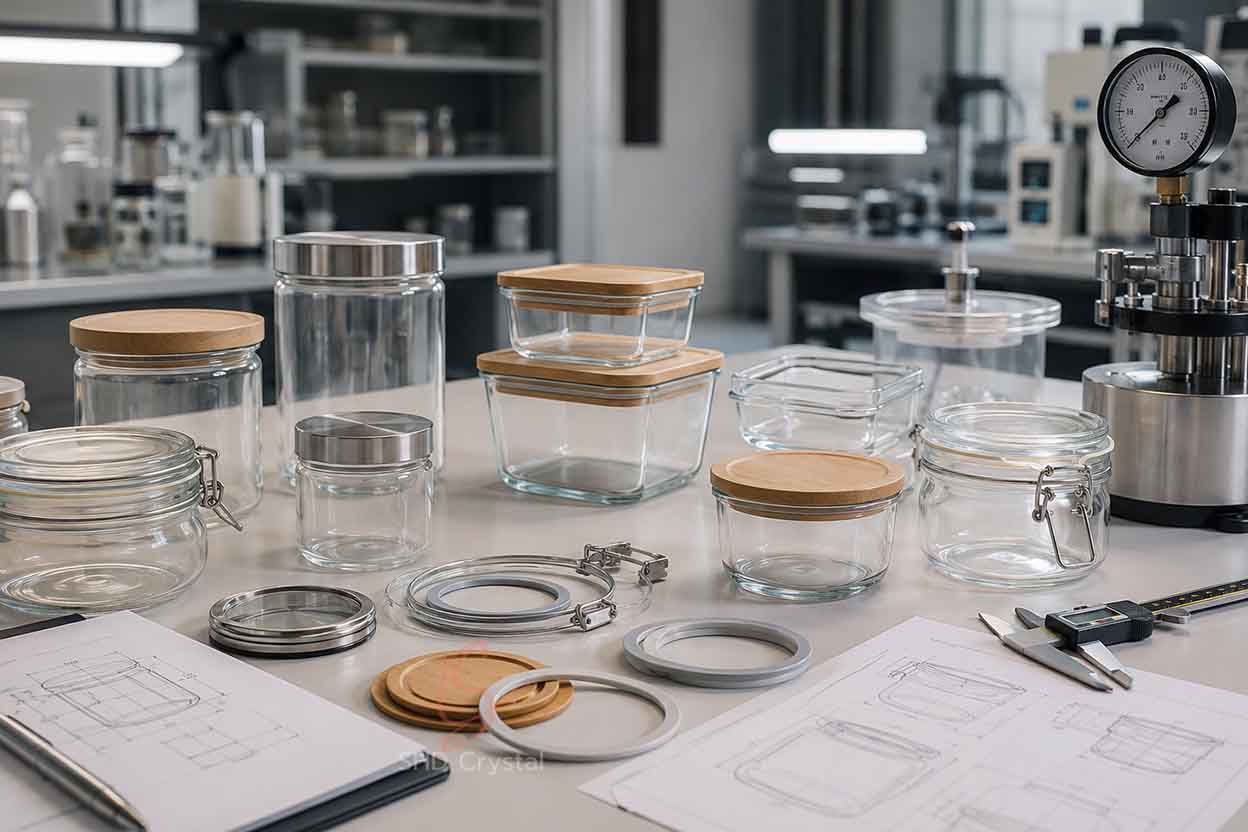
From a product development perspective, this matters because a successful sample does not always guarantee stable production performance. A prototype may pass an initial check, but batch production can introduce variation in glass dimensions, lid fit, gasket placement, or closure pressure. If these factors are not evaluated early, sealing issues may only appear after tooling, production, or customer use.
This is why container leak testing should be treated as part of product validation, not as a final visual check.
Secure Fit And Airtight Performance Are Different
One common misunderstanding is that a tight lid automatically means an airtight seal. In reality, a tight-fitting closure and a functional airtight seal are not the same. A lid may feel firm because of friction, thread resistance, or mechanical pressure, while the sealing surface still has small air pathways. On the other hand, a lid that opens smoothly may still perform well if the gasket is compressed evenly and the contact area is properly controlled.
This makes closure fit evaluation especially important. Fit evaluation should confirm whether the lid matches the container correctly, but it should also consider how the gasket or sealing surface behaves after assembly. The goal is not only to make the lid stay in place, but to ensure that the sealing structure works as intended.
Testing The Complete Sealing System
Effective airtight glass container testing usually evaluates the assembled product rather than each component separately. A high-quality glass body, a precise lid, or a good gasket may still fail if the parts do not work well together.
Depending on the product design and intended use, validation may involve vacuum-based testing, pressure-based testing, controlled leak observation, compression checks, repeated opening and closing cycles, or storage simulation. These methods do not all measure the same type of performance, so the testing approach should be selected according to the product’s actual sealing requirement. For example, a reusable storage jar may need repeated-use testing because consumers open and close the lid many times. A decorative candle vessel with a lid may require a different evaluation focus. Beverage or food-related containers may need additional validation depending on their material system, storage conditions, and market requirements.
The term “airtight” should therefore be used carefully. A product should not be described as airtight only because the lid feels secure. The claim should match the validation method, test condition, and intended application.
Material And Production Factors That Affect Sealing
Many airtight container designs combine glass with other materials such as silicone, wood, stainless steel, plastic, or cork. Each material can respond differently to compression, humidity, temperature, handling, and repeated use.
Wood may expand or contract with environmental changes. Silicone may compress differently over time. Metal or plastic parts may introduce variation in alignment or assembly. Because of these differences, container leak testing should focus on how the complete structure performs, not only whether individual parts appear acceptable.
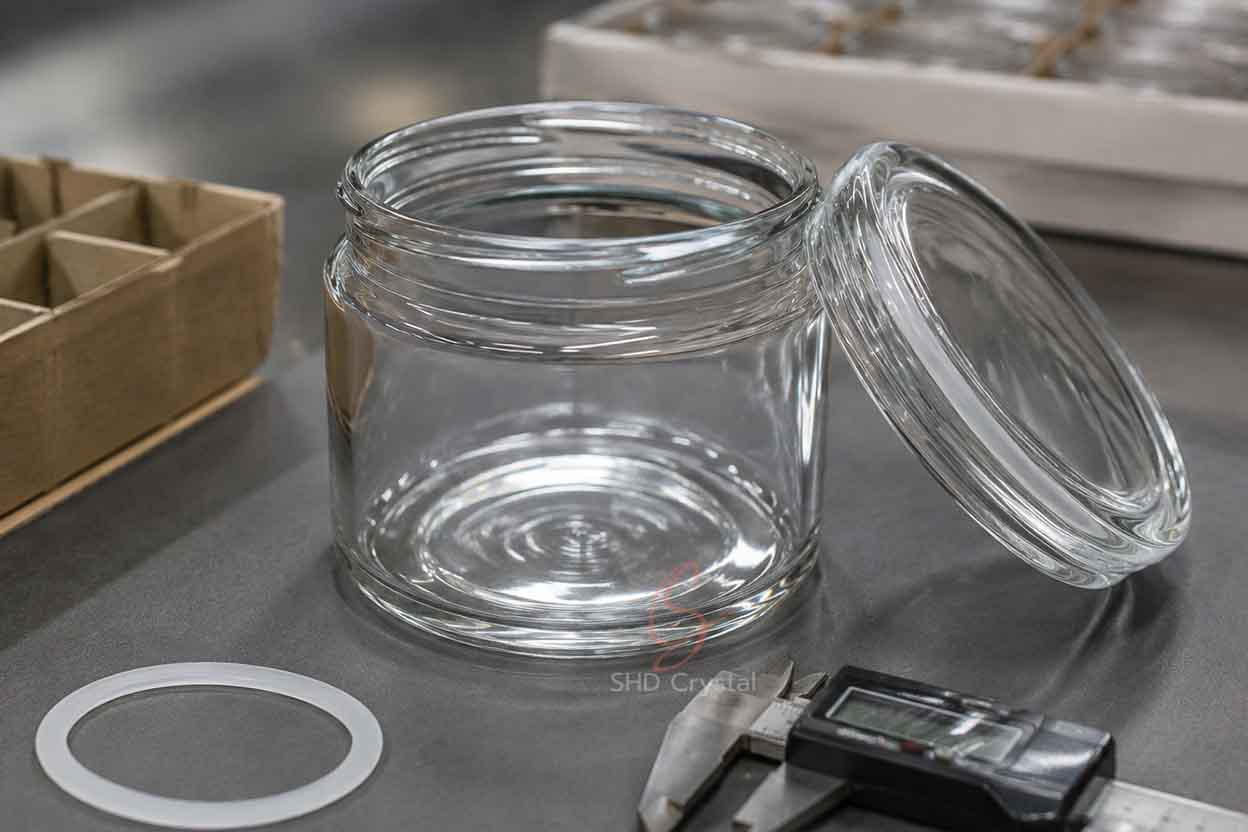
Production variables are also important. Glass dimensional tolerance, lid machining accuracy, gasket size consistency, surface flatness, and assembly repeatability can all affect sealing results. Among these factors, compression consistency is often critical. Even a suitable gasket may perform poorly if it is compressed unevenly from one unit to another.
For this reason, closure fit evaluation should be combined with functional sealing verification. Dimensional inspection can identify possible mismatch, but it cannot fully confirm airtight performance by itself.
Conclusion
Airtight glass container testing helps product developers verify whether a glass container performs reliably as a complete sealing system. A tight-feeling lid may create confidence during sample review, but real sealing performance depends on the interaction between the glass body, closure structure, gasket material, contact surface, and production consistency.
By combining container leak testing with closure fit evaluation, manufacturers and buyers can identify sealing risks earlier, reduce unnecessary revisions, and make better decisions before mass production.
For projects involving glass jars, storage containers, candle vessels, beverage packaging, or custom closure-based products, SHD Crystal can support early discussion around container structure, closure matching, and manufacturability. If a project requires airtight glass container testing, the sealing goal should be defined clearly before production so the design can be evaluated under suitable conditions.
Validating Sealing Performance Before Launch
For glass jars, storage containers, beverage packaging, candle vessels, and other closure-based products, early-stage sealing evaluation is often an important part of development. Defining the expected use condition, selecting an appropriate test method, and evaluating the assembled product as a complete system can reduce rework and improve confidence before production moves forward.
If a glass container project requires discussion around closure structure, fit, or manufacturability, SHD Crystal can support early product-development communication based on the container design and intended application.
Read the original full version: https://shdcrystal.com/blogs/airtight-glass-container-testing/