
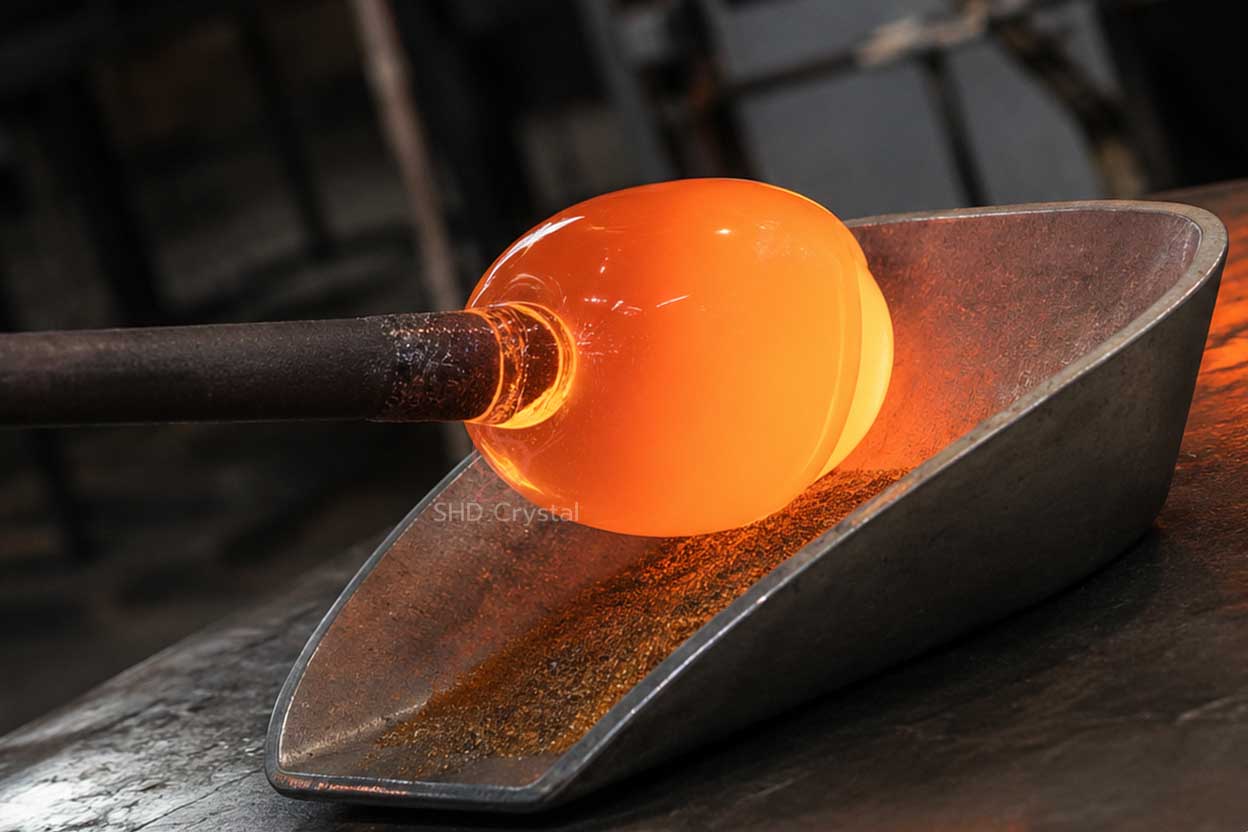
A glassblowing gather may look like nothing more than a glowing mass hanging from the end of a blowpipe, but an experienced glassblower knows that much of the future vessel is already being decided at this stage. Before the first breath enters the pipe, the glassmaker has to judge how much material has been collected, whether it is sitting on axis, how quickly gravity is moving it, how the surface is cooling, and whether its shape is suitable for the first bubble. Good blowing begins long before anyone actually blows.
Glassblowing Gather Control Is Really About Mass, Axis, and Heat
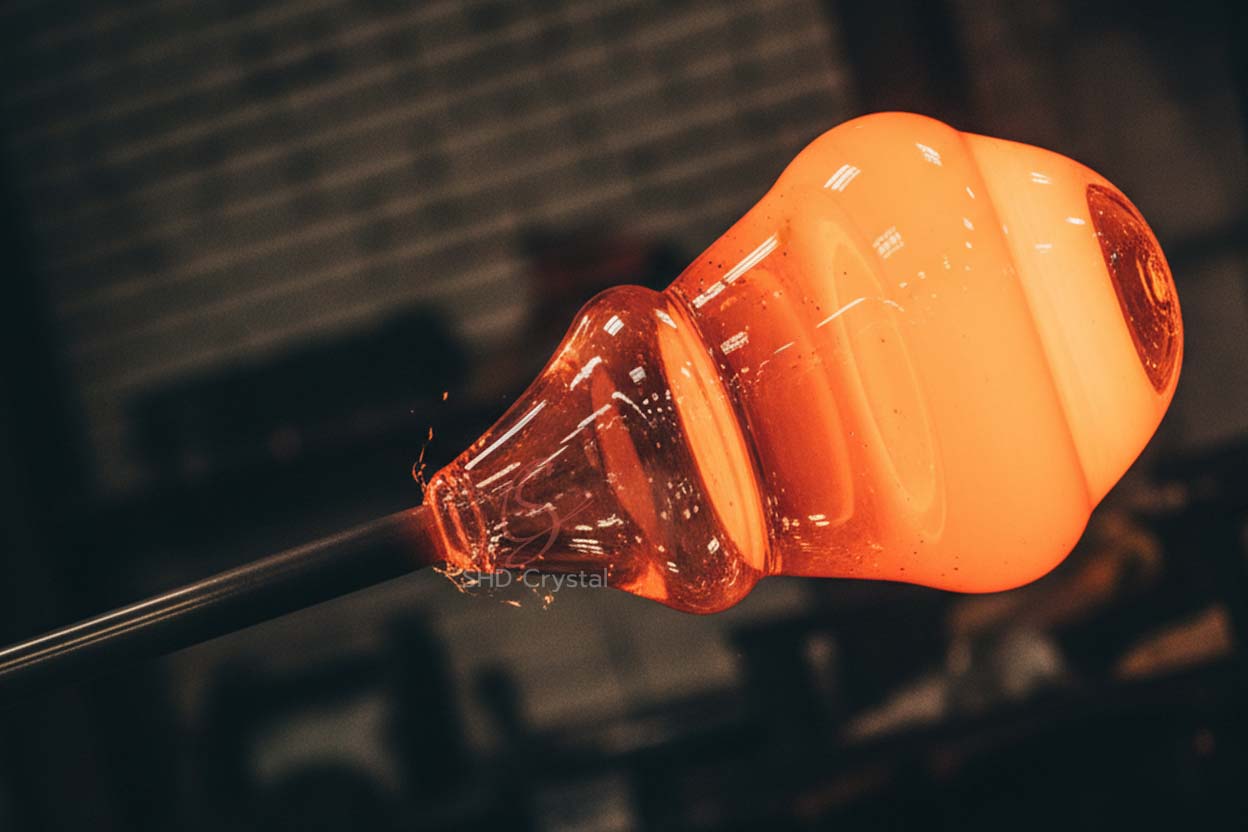
In traditional hot-glass terminology, a gather is the mass of molten glass collected on the end of a blowpipe, pontil, or gathering iron. Corning Museum of Glass notes that it may also be called a gob, but gather is the more specific term for this stage of hand glassworking. Once the gather has been partly inflated, it moves into another useful term: the parison.
That difference in terminology also describes a real change in the process. Before inflation, the glassblower is not yet trying to create the final vessel. The immediate job is to turn an unstable mass of hot glass into a controlled starting condition. This begins during gathering molten glass itself.
A blowpipe entering the furnace does not simply pick up a predetermined “drop.” The glass adheres as the pipe is rotated, and the amount collected depends on how the glassmaker gathers, the depth and position of the pipe, the viscosity of the melt, and whether additional gathers will be needed later. The correct gather size is therefore relative to the object.
Too little material restricts what can be expanded and shaped later. Too much gives gravity a larger mass to act upon and makes early control harder. For larger work, experienced glassblowers may build material through multiple gathers rather than attempting to collect the entire required mass in one pass. The challenge then becomes more subtle: the existing inner gather has already begun cooling while the newly gathered outer glass arrives hotter and more mobile.
At that point, the glassblower is controlling a temperature gradient as well as a shape.
A Gather Never Stops Moving Just Because It Looks Still
One of the first lessons in gather control is that hot glass has no interest in remaining centered by itself.
Gravity is always working. When a freshly gathered mass leaves the furnace, the glass is soft enough to slump and elongate. If the pipe is held still, the material begins to fall away from the axis. Once a significant offset develops, later blowing may magnify the imbalance rather than remove it. That is why rotation begins immediately and continues almost constantly.
But an experienced glassblower does not rotate at one fixed speed. Keeping the gather centered depends on reading the viscosity of the glass. When the gather is extremely hot and fluid, gravity can move it quickly, so the pipe must be rotated with enough continuity to prevent one side from carrying the mass. As the glass loses heat, it becomes progressively more resistant to deformation and the rhythm can change. This is where experienced hands look very different from beginners.
A beginner often looks at the outline of the glass and asks, “Is it still round?”
A veteran watches how the glass responds between rotations and asks, “How fast is it trying to leave center?”
The movement is telling him about temperature.
The Useful Number Is a Range, Not a Magic Temperature
Gather temperature is one of the most important variables, but glassblowing rarely works by waiting for one exact thermometer reading. Glass does not have a single working temperature in the way ice has a sharply recognizable melting point. Its viscosity changes continuously as it heats and cools.
The Corning Museum of Glass provides a useful real-world reference. Its Hot Glass Demo team works with soda-lime glass and reports working the glass at around 2100°F, or 1150°C, while shaping on the pipe takes place across roughly 1500–2100°F, or 800–1150°C. The same glass begins to soften at around 1200°F, or 650°C.
Those numbers should not be treated as universal settings for every glass composition or studio. They illustrate something more important: the glassblower has a very wide thermal window in which the material is changing behavior.
At the hotter end, the gather moves readily under gravity and tool pressure. As heat is lost, the exterior becomes increasingly resistant while the interior can remain much hotter. A skilled glassblower uses this difference rather than fighting it.
Sometimes the correct action is to rotate faster. Sometimes it is to change the angle of the pipe. Sometimes the glass needs the marver. And sometimes the most useful action is simply to wait several seconds and allow the surface to stiffen.
The old hand is not merely shaping glass. He is shaping where the heat remains.
Marvering Changes Both Geometry and Temperature
This is why marvering glass deserves more respect than the usual description of “rolling the glass until it becomes smooth.” A marver is a smooth, flat working surface on which softened glass is rolled while attached to a blowpipe or pontil. Historically the name is associated with the French word marbre, or marble, while modern hot shops commonly use metal surfaces.
When a molten glass gather rolls across the marver, two things happen at once. The first is obvious: geometry changes. The flat surface pushes projecting areas inward while rotation distributes that action around the axis. An irregular mass can therefore be organized into a more useful cylindrical, tapered, or rounded gather shape depending on what the glassblower intends to make.
The second effect is thermal. The marver removes heat from the glass surface. This creates a slightly cooler, stiffer exterior around a hotter interior. That temperature relationship can become valuable when the first bubble is introduced because the surface now provides greater resistance while the hotter inner glass remains more responsive. This is why endless marvering is not automatically good marvering.
Too little may leave the mass poorly organized. Too much contact can remove more surface heat than the next operation requires. Excessive pressure can also change the geometry in the wrong direction. An experienced glassblower does not ask whether the gather looks perfectly neat on the marver. The real question is whether the gather leaves the marver in the correct condition for what comes next.
There Is No Universal Perfect Gather Shape
The desired gather shape depends on the intended vessel. A broad bowl, narrow-necked vessel, tumbler, or elongated form does not necessarily benefit from exactly the same starting geometry. The glassblower is already anticipating how the first bubble should expand and where material needs to remain. This is one of the reasons glassblowing can be misleading when watched from outside.
The gather may look almost symmetrical, but the glassblower may deliberately maintain more material in a particular region. What appears to be a simple round blob is already being prepared for later stretching, inflation, tooling, or additional gathering.
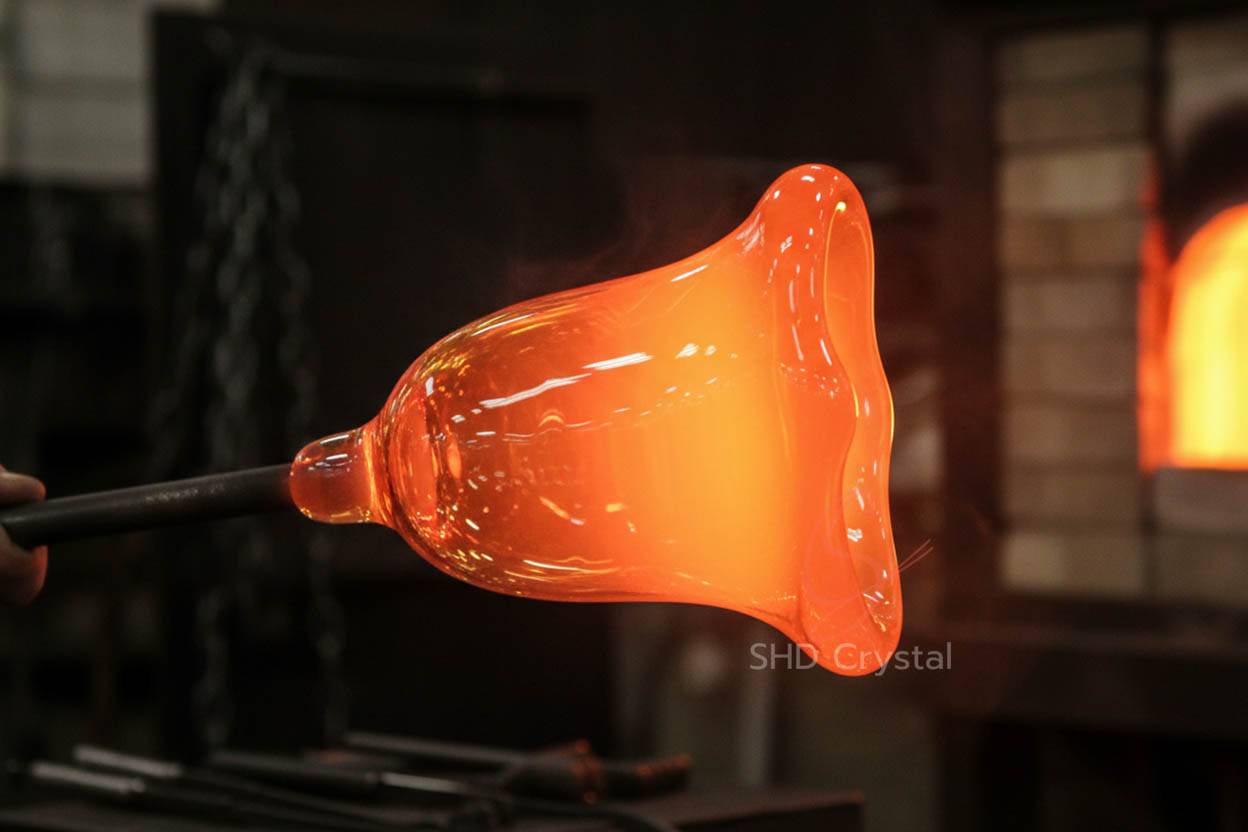
Corning describes the subsequent blowing process in similar terms: after the gather has been slightly inflated, it may be swung, rolled on the marver, shaped with tools, or placed in a mold before being inflated further.
The first gather therefore provides the material map from which those later movements begin. If that map is badly organized, every later operation becomes corrective.
The First Bubble Reveals the Quality of Everything Before It
A poor gather is not always immediately obvious. The real evidence often appears when inflation begins. If the glass was substantially off center, one side of the first bubble may move faster than the other. If the temperature distribution was uneven, the hotter region may expand more readily. If the gather size was poorly judged, the blower may find that there is insufficient material where it is needed or too much mass remaining somewhere else.
Skilled glassblowers can correct many of these conditions.
But correction costs something. It costs heat because the piece may need reheating. It costs working time. It may require additional tooling. Most importantly, it consumes the glassblower’s attention during stages when that attention should already be moving toward the next operation.
Good gather control is therefore not about creating a beautiful lump of glass. It is about reducing the amount of correction required later.
That is why experienced glassblowing can sometimes look deceptively easy. The pipe rotates steadily, the gather briefly touches the marver, the glassblower waits, turns again, and then begins the first inflation.
Very little appears to happen. In reality, the glassmaker has been reading mass, viscosity, axis, surface temperature, gravity, and timing continuously.
When Is the Gather Actually Ready to Blow?
There is no single visual signal. A well-prepared glassblowing gather has the required amount of material, remains reasonably centered on the blowpipe, carries a shape appropriate for the intended vessel, and has reached a temperature distribution that allows the first bubble to expand in a controlled way.
More importantly, its movement has become predictable. This may be the clearest difference between simply handling hot glass and controlling it. The experienced gaffer knows roughly what the gather will do before it does it.
By the time the first breath travels down the pipe, many of the most important decisions have already been made.
Conclusion
A glassblowing gather is not merely raw molten glass waiting for the interesting part of the process to begin. It is the first deliberately controlled state of a hand-blown object. Gathering molten glass establishes material quantity; continuous rotation manages gravity and helps maintain the axis; changes in gather temperature determine how readily the material moves; and marvering glass adjusts both surface geometry and heat distribution.
The first visible bubble may mark the beginning of blowing for the observer. For an experienced glassblower, it is closer to the end of the first critical stage.
Reading Hand-Blown Glass From the Beginning
Understanding the glassblowing gather also provides a different way to look at finished handmade glassware. Subtle control of material distribution, symmetry, thickness, and final proportion begins when the glass is still an incandescent mass on the blowpipe. The skill is not simply the ability to inflate molten glass, but the ability to recognize how heat and gravity are moving through it before the shape exists.
Read the original article on custom crystal glass manufacturing: https://shdcrystal.com/blogs/glassblowing-gather/