
The crystal glass molding process is not simply a matter of pressing hot glass into an attractive shape. Crystal formulations are valued for clarity, brilliance, density, and optical character, but those same material characteristics affect viscosity, heat retention, mold filling, cooling, and finishing behavior. As a result, a molded crystal product must be controlled as both a thermal system and a precision-forming project.
An important distinction should also be made at the beginning: crystal glass is not one universal composition. Traditional lead crystal contains lead oxide, while modern lead-free crystal formulations may use other oxides to achieve higher refractive and density characteristics. In the EU, the term “lead crystal” is tied to specific compositional requirements, including at least 24% PbO for regulated lead-crystal categories. This means process parameters cannot simply be copied from one crystal formulation to another.
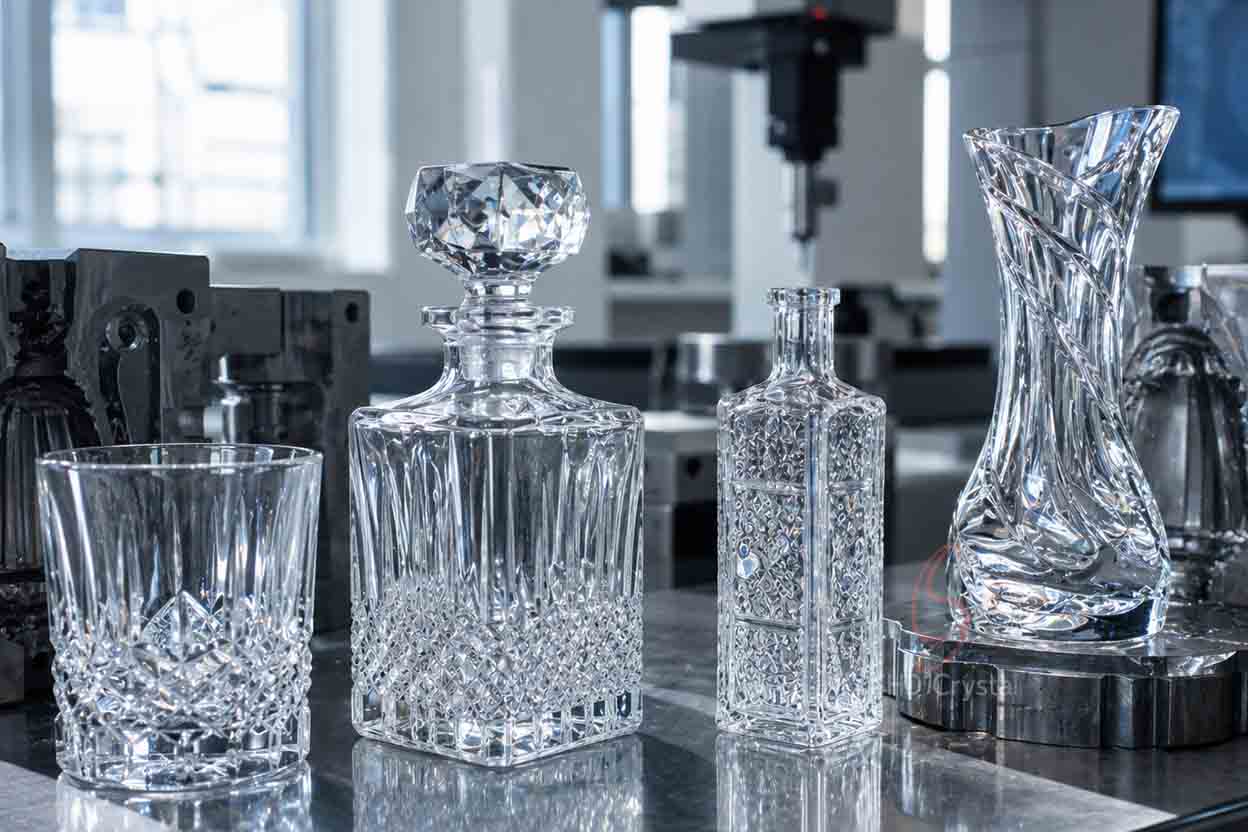
Crystal Glass Molding Process Starts With the Material, Not the Mold
The crystal glass molding process begins with understanding how the selected glass behaves while hot. Every glass formulation has its own viscosity-temperature relationship. As the temperature rises, the material becomes more fluid and easier to form. As it cools, viscosity increases until the glass can hold its shape. The useful forming window therefore depends on composition, product geometry, glass mass, and production method.
Traditional lead-containing crystal generally behaves differently from conventional soda-lime container glass, while lead-free crystal compositions introduce their own forming characteristics. Good crystal glass manufacturing therefore begins with a known material formulation and a production window established for that glass, rather than a generic “crystal” setting.
Gob Weight Influences More Than Finished Weight
Before molding begins, the amount of hot glass delivered to the mold needs to match the intended geometry. Too little glass may leave thin regions, poorly defined decorative details, or incomplete filling. Too much glass can create excess material around parting areas, increase finishing work, and distort wall distribution.
For a heavy tumbler, decanter, decorative bottle, bowl, or similar product, glass should also be distributed where the design actually needs mass. A thick base may be intentional because it creates optical depth and physical stability. But if the transition from the heavy base into thinner walls is too abrupt, the product becomes harder to cool uniformly.
Glass Mold Design Determines How the Material Moves
Effective glass mold design does more than reproduce the external shape shown in a drawing. The mold has to consider how hot glass enters the cavity, how air can escape, how surfaces contact the glass, where parting lines will appear, and how the finished piece will release after forming.
Sharp decorative geometry deserves particular attention. Crystal glass is often selected precisely because buyers want facets, ribs, relief, deep bases, or strong optical effects. However, extremely sharp internal corners can become difficult to fill cleanly and may increase visible flow or surface defects.
Appropriate radii, draft, cavity transitions, and venting can make a design easier to reproduce without noticeably reducing its visual character. This is where glass mold design becomes part of the optical result.
A facet that looks excellent in CAD may still appear weak in real glass if the molten material cannot reach the cavity consistently or if the mold surface cools that region too quickly.
Mold Temperature Is a Balance, Not a Single Target
The mold is constantly receiving heat from the glass and losing heat to the surrounding environment and cooling system. If a local mold area becomes too cool, the contacting glass surface may stiffen too early. This can contribute to incomplete detail reproduction, wrinkles, or chill-related surface marks.
If the mold remains excessively hot, cycle stability, release behavior, and dimensional consistency can become more difficult to control. Thick bases and thin walls complicate the problem because they do not release heat at the same rate. For this reason, good mold thermal management aims for repeatable heat balance, not merely the highest possible cooling rate.
In production, the correct strategy depends on mold material, glass formulation, cavity geometry, cycle time, and product thickness. Those variables should be established during sampling and process validation rather than assumed from another product.
Forming Method Should Follow the Geometry
There is no single forming method for every crystal product. Pressed glass is useful for products where a plunger can define the internal surface while the mold creates the exterior. This approach is common for bowls, tumblers, decorative pieces, heavy-base glassware, and other shapes that benefit from strong repeatability and detailed surface definition.
Hollow products may use blowing, press-and-blow, or other forming sequences depending on their geometry and production system. The important point in crystal glass manufacturing is that the forming method changes the distribution of glass.
A pressed object naturally develops according to the relationship between gob volume, mold cavity, and plunger geometry. A blown object distributes material through inflation and subsequent shaping. Neither method is automatically more premium. They simply create different structural possibilities.
Optical Quality Makes Small Defects Easier to See
Crystal is unforgiving in a useful way. The material is selected because light is expected to travel through it beautifully. As a result, defects that might be less noticeable in opaque or colored glass can become obvious in high-clarity products.
Typical issues can include:
- visible mold seams
- surface wrinkles
- flow marks
- -uneven facet definition
- bubbles or inclusions
- distorted walls
- irregular base thickness
- polishing inconsistency
For decorative crystal, these are not merely cosmetic details. They directly affect light refraction and perceived quality. This is why mold condition, surface finishing, and cavity consistency should be reviewed alongside dimensional tolerances.
Annealing Protects What Forming Has Created
Annealing is one of the most important stages after forming. The outer surface of a newly formed glass object cools before the interior. If this temperature difference is not reduced in a controlled way, residual stress can remain inside the product.
The correct annealing profile is not universal. It depends on the glass formulation, annealing and strain points, product thickness, geometry, and how rapidly different areas lose heat.
A heavy crystal decanter, for example, does not cool in the same way as a relatively thin bowl. For the crystal glass molding process, the objective is to guide the product through the critical cooling range without leaving harmful internal stress.
Polarized-light inspection can also help reveal residual stress patterns in transparent glass after annealing. This gives production teams another way to evaluate whether a visually acceptable part is also thermally stable.
Why Fixed Annealing Numbers Can Be Misleading
A frequent technical mistake is to publish one annealing temperature or cooling rate as though it applies to every crystal product.
It does not.
Lead crystal, lead-free crystal, soda-lime glass, borosilicate glass, and other formulations have different thermal properties. Even products made from the same glass can require different annealing programs if their thickness distributions differ substantially. A reliable crystal glass manufacturing process therefore uses material data and actual product geometry to establish the cooling curve.
Molded Crystal and Hand-Blown Crystal Are Different, Not Better or Worse
Another misconception is that molding should reproduce the exact structure of hand-blown crystal. The two processes create different characteristics.
Hand blowing gives the glassmaker direct control over inflation, gravity, tooling, and local material movement. It is particularly suited to expressive forms and controlled handmade variation.
Molding offers stronger geometric repeatability and can reproduce facets, relief, logos, bases, and other structured features consistently across a production run.
A well-planned glass mold design should therefore take advantage of molding rather than imitate a hand-blown structure that is poorly suited to mechanical forming. This is especially important for products with very thin walls, severe undercuts, extremely deep relief, or unusually abrupt transitions. Manufacturing feasibility is part of design quality.
Interested in custom glassware or related products?
Contact our team to discuss your project requirements.
What Should Buyers Review During Sampling?
For technically demanding crystal products, buyers should look beyond one attractive prototype. Several pieces should be compared for:
-overall dimensions and symmetry;
-wall and base distribution;
-facet or relief definition;
-parting-line appearance;
-bubbles and visible inclusions;
-surface marks;
-polishing quality;
-residual stress;
-consistency between mold cavities.
This kind of sample review provides a better picture of production capability than judging one carefully selected piece. It also gives the engineering team a chance to adjust glass mold design before larger production volumes make changes more expensive.
Frequently Asked Questions
Q1: Does Crystal Glass Always Contain Lead?
No. Traditional lead crystal contains lead oxide, but many contemporary crystal products use lead-free formulations. The exact composition should be confirmed because it influences optical properties, density, processing behavior, product positioning, and applicable requirements.
Q2: Can a Soda-Lime Glass Mold Be Used Directly for Crystal?
Not necessarily. The basic geometry may provide a starting point, but differences in glass behavior, shrinkage, thermal management, product weight, and finishing expectations may require changes to the mold or forming parameters.
Q3: Why Can a Clear Molded Sample Look Good but Still Fail Production Approval?
One sample does not reveal cavity-to-cavity variation, mold wear, repeated thermal cycling, batch consistency, or annealing stability. Production approval should evaluate several pieces and repeatability rather than appearance alone.
Q4: Is Heavier Crystal Automatically Higher Quality?
No. Higher density can contribute to the traditional feel of crystal, but excessive or poorly distributed glass can make a product unnecessarily heavy and more difficult to cool uniformly. Optical quality, proportion, finishing, and structural consistency matter just as much.
Conclusion
The crystal glass molding process is a coordinated balance of glass chemistry, viscosity, gob distribution, mold geometry, thermal management, forming pressure, cooling, and finishing. Precision comes not from assigning one fixed number to every stage, but from understanding how the selected glass and product geometry behave together.
For premium crystal products, the best results appear when glass mold design supports natural material flow and the annealing program supports the actual thickness distribution of the finished piece. That combination allows molded crystal to achieve both strong geometric consistency and the optical character expected from high-quality glassware.
Crystal Glass Production Support From SHD Crystal
SHD Crystal supports custom crystal and high-clarity glass projects through drawing review, mold development, forming evaluation, sampling, annealing, polishing, decorative finishing, inspection, and production coordination. For projects involving crystal glass manufacturing, the focus is on matching product geometry with a practical molding route while reviewing wall distribution, surface definition, dimensional consistency, and finishing requirements before volume production.
Rather than treating every crystal product as the same material and process, SHD Crystal works to align glass characteristics, tooling, product structure, and quality expectations so that the finished result can better match the approved design and project requirements.
【Reference Note】Traditional lead crystal is chemically distinct from ordinary soda-lime glass. European regulatory material notes describe leaded glass as having higher density and refractive index and state that glass products require at least 24% PbO to be described as lead crystal in the EU.
Exclusive Release by SHD Crystal
Custom Crystal Glass OEM Manufacturer
This article is originally published by SHD Crystal. Original Link: https://shdcrystal.com/blogs/crystal-glass-molding-process/