
A medicinal tonic liquor bottle often has a familiar appearance: a relatively narrow neck, controlled shoulder transition, upright body, and enough glass weight to create a stable, traditional presentation. These bottles are commonly associated with herbal liquor, tonic-style spirits, and other products where the packaging needs to feel substantial rather than lightweight. Behind that conventional silhouette, however, is a highly repetitive automated forming process in which glass distribution, neck accuracy, mold condition, and cooling control determine whether thousands of bottles can leave the line looking nearly identical.
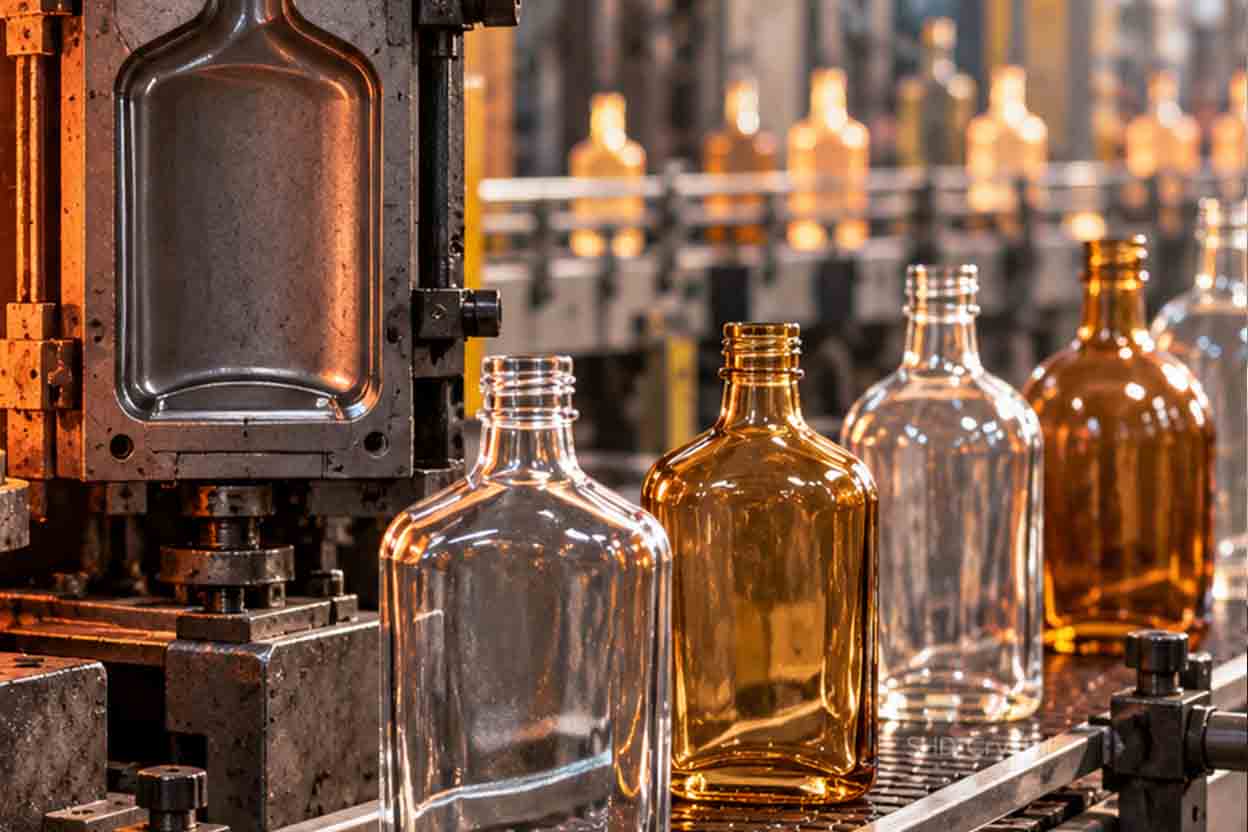
Medicinal Tonic Liquor Bottle Forming Begins With the Gob
On an automated production line, molten glass is first cut into controlled portions known as gobs. Each gob carries approximately the amount of glass needed for one bottle.
For a medicinal tonic liquor bottle, gob control matters because the final design often combines several different structural zones: a comparatively narrow neck, sloping or rounded shoulder, longer body wall, and a thicker base.
If too much glass accumulates around the bottom, the bottle becomes unnecessarily heavy and may cool unevenly. If insufficient material reaches the shoulder or sidewall, wall thickness distribution can become inconsistent.
The Blank Mold Creates the First Structural Distribution
After entering the forming machine, the gob is guided into the blank mold where the initial glass shape is created.
Depending on the bottle geometry and production setup, blow-and-blow or press-and-blow methods may be used. The objective at this stage is not to create the final exterior appearance. It is to establish a controlled preliminary form with the right glass distribution before the bottle enters the final mold. This early stage is especially important for a molded liquor bottle with a defined shoulder.
If glass is distributed poorly in the preliminary form, the final blowing stage may produce excessively thin shoulders, uneven sidewalls, or unnecessary glass concentration around the heel. The final mold can shape the surface, but it cannot completely rescue a badly prepared glass distribution.
Neck Finish Control Comes Early
The bottle neck may look like a small feature, but it is one of the most important dimensional areas in production. A medicinal tonic liquor bottle may eventually use a screw cap, pilfer-proof closure, cork-style stopper, or another sealing system depending on the product. The neck finish therefore needs repeatable diameter, thread geometry, roundness, and height.
In automated forming equipment, the neck area is created early and must remain stable while the rest of the hot glass is transferred and blown into its final shape.
That makes mold alignment and temperature control particularly important. A bottle with an attractive body but inconsistent neck dimensions can create problems later during filling and capping.
Final Molding Defines the Familiar Bottle Character
Once the preliminary glass form enters the final mold, compressed air expands the hot glass against the cavity walls. This is where the recognizable molded liquor bottle shape appears.
The shoulder becomes defined, the sidewall reaches its final profile, molded decorative details can develop, and the base structure takes shape. In many tonic-liquor bottles, this geometry remains relatively conservative because a stable upright bottle works well with automatic filling, labeling, carton packing, and retail display.
That does not mean the mold is simple. Shoulder symmetry, mold seams, heel definition, base flatness, and body diameter all need to remain consistent across multiple mold cavities. In automated glass bottle forming, a worn or poorly aligned mold section can create visible differences long before the entire production run is completed.
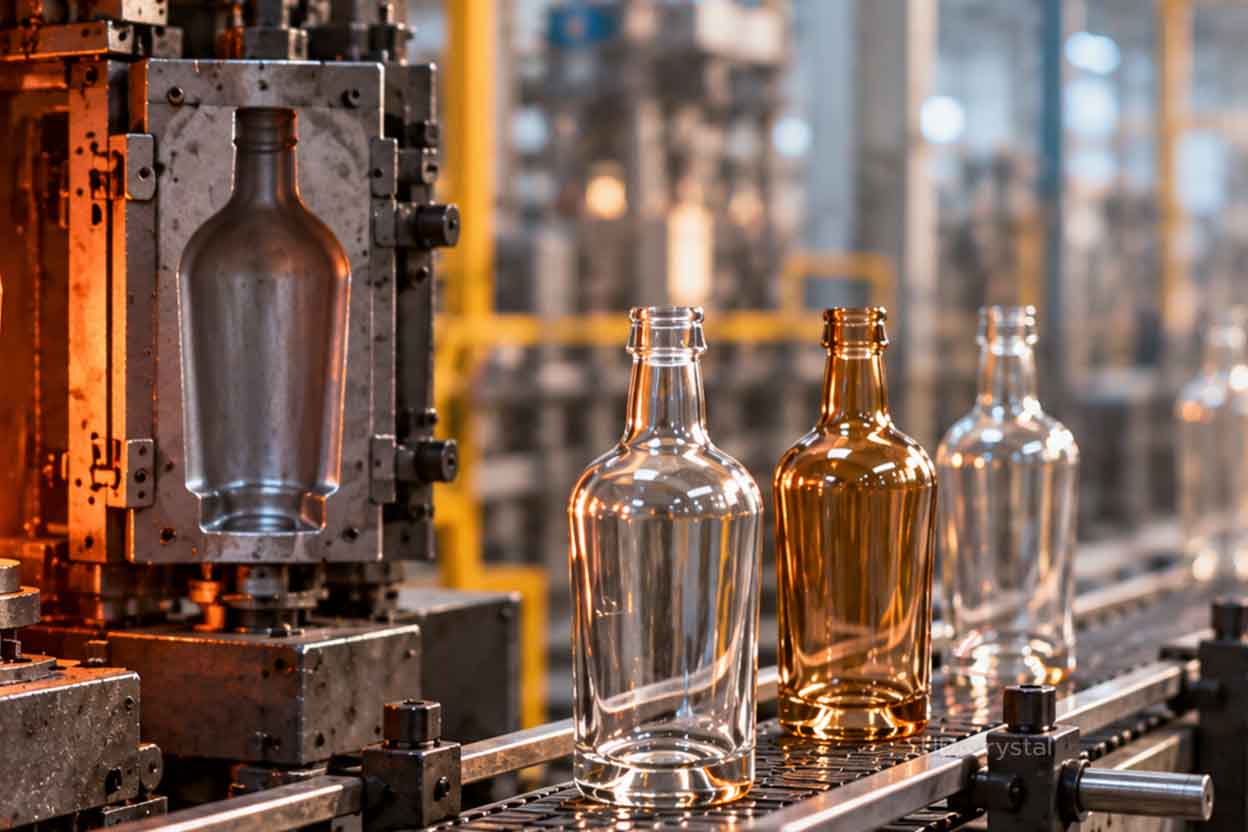
The Shoulder Is Often More Difficult Than It Looks
The transition from neck to body is particularly important in this bottle category. A narrow neck opening into a wider body forces the glass to redistribute during forming. If the shoulder transition is too abrupt, controlling uniform wall thickness becomes harder. If glass cools too early in this area, surface definition and expansion can also suffer.
For a medicinal tonic liquor bottle, this is one reason traditional rounded or gently sloping shoulders remain practical. They provide a recognizable packaging style while allowing molten glass to flow more naturally during final forming. A more dramatic shoulder can certainly be produced, but mold geometry, preliminary forming, glass temperature, and wall distribution all need to support it.
Interested in custom glassware or related products?
Contact our team to discuss your project requirements.
Conveyor Transfer and Annealing Complete the Hot-End Process
The bottle is still extremely hot when it leaves the forming machine. Automatic take-out mechanisms place finished bottles onto conveyor systems, where spacing and transfer need to remain controlled. Contact damage at this stage can create surface marks or instability while the glass is still thermally vulnerable.
The bottles then enter an annealing lehr. Annealing allows internal temperature differences to decrease gradually so that residual stress is reduced. This matters particularly where a molded liquor bottle has a heavier base or substantial wall transitions.
Simply allowing the bottle to cool in open air would create a much less controlled thermal history.
Automated Inspection Protects Batch Consistency
After annealing, automated and manual inspection can check the characteristics that matter most for subsequent filling and packaging.
Typical checks may include:
- neck finish dimensions;
- bottle height and diameter;
- base stability;
- wall and body defects;
- cracks or checks;
- visible bubbles and inclusions;
- mold seam condition;
- surface appearance.
This is one of the strongest advantages of automated glass bottle forming. Production speed is combined with repeatable inspection so that dimensional or forming abnormalities can be identified before bottles enter later decoration, filling, or packing stages.
For a bottle format that may be ordered in high quantities, stable repetition is often more important than making one perfect sample.
Conclusion
A medicinal tonic liquor bottle may appear traditional and structurally straightforward, but its reliable production depends on carefully coordinated automated forming. Gob control establishes the available glass mass, the blank mold creates the initial distribution, final blowing defines the body and shoulder, and controlled annealing reduces residual stress.
The effectiveness of automated glass bottle forming lies in keeping those stages repeatable across thousands of bottles. For tonic liquor and similar beverage packaging, that consistency helps preserve neck fit, bottle stability, wall distribution, and the familiar substantial appearance expected from a molded liquor bottle.
Automated Glass Bottle Production With SHD Crystal
SHD Crystal supports medicinal tonic liquor bottle projects through mold development, automated glass forming, annealing, dimensional inspection, surface finishing, and export packing. Its glass bottle production capabilities cover both conventional and more distinctive bottle structures, with attention to neck finish consistency, shoulder forming, wall distribution, and batch repeatability.
For projects involving automated glass bottle forming, SHD Crystal works to connect bottle geometry with practical mold and production requirements so that the final molded liquor bottle can move more reliably from forming line to filling, decoration, and commercial packaging.
Read the original article on custom crystal glass manufacturing: https://shdcrystal.com/blogs/medicinal-tonic-liquor-bottle/