The full-lead crystal market occupies a distinctive position within the global glassware industry. Its appeal comes from the brilliance, weight, and decorative qualities traditionally associated with high-lead crystal. Yet its commercial future depends on more than visual appeal. Material classification, international trade, changing buyer preferences, and food-contact safety requirements are all influencing how these products are developed and sold.
For manufacturers such as SHD Crystal, understanding this market means looking beyond the finished glass. Buyers need to know what they are purchasing, where demand exists, and whether the material is appropriate for its intended application.
How the Full-Lead Crystal Market Is Changing
The term full-lead crystal has a specific technical meaning in European crystal-glass classification. Under Council Directive 69/493/EEC, the two principal lead-crystal categories have different minimum lead oxide contents:
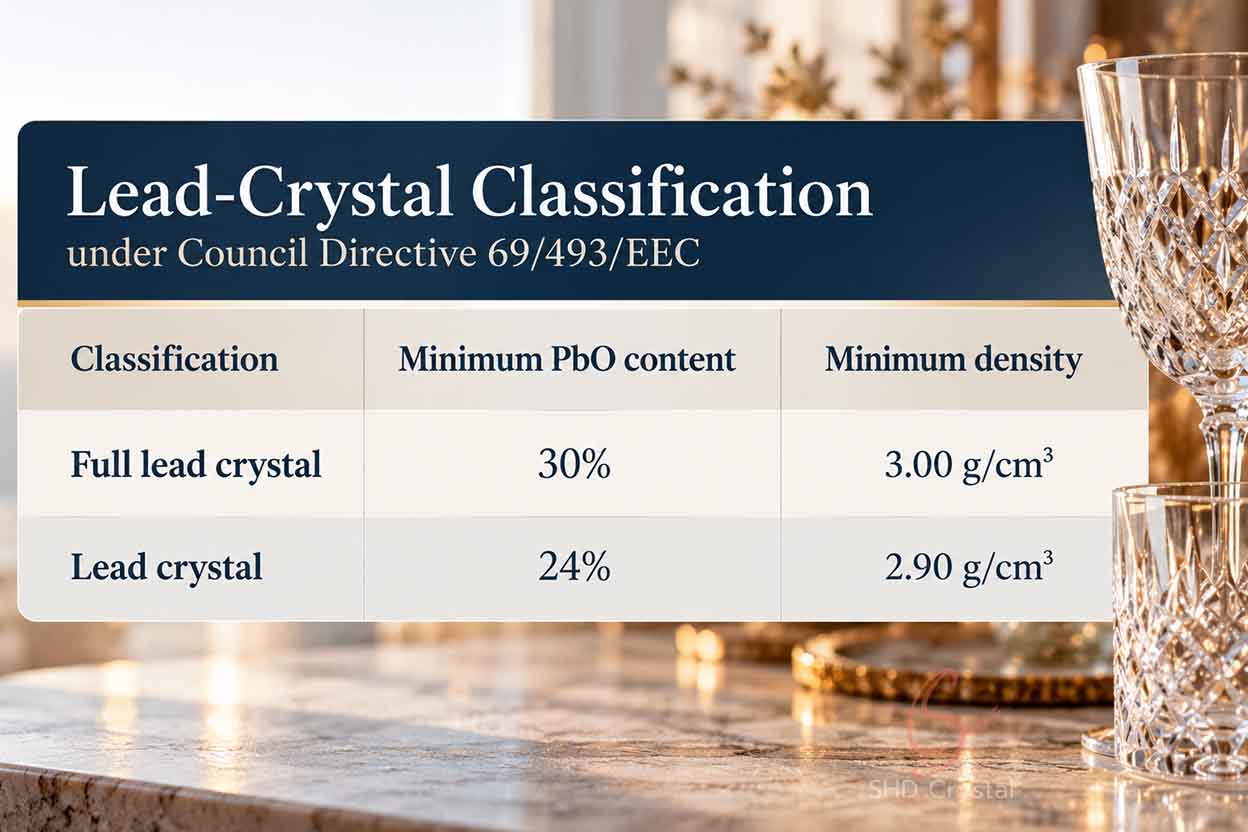
These are classification requirements, not indicators of food-contact safety.
Lead oxide influences the optical and physical characteristics of traditional crystal, contributing to its high refractive index, density, and suitability for decorative cutting. However, we should not assume that every product marketed as crystal contains lead. Modern lead-free crystal formulations are also widely used. This distinction matters when buyers compare suppliers or request a particular material composition.
International Trade Reveals an Established Market
Although comprehensive statistics for full-lead crystal alone are difficult to isolate, international trade records provide useful evidence of commercial activity in the wider lead-crystal category. According to the World Bank’s WITS trade database, the following export values were reported for lead-crystal drinking glasses under HS 701321 in the 1988/92 classification for 2024:
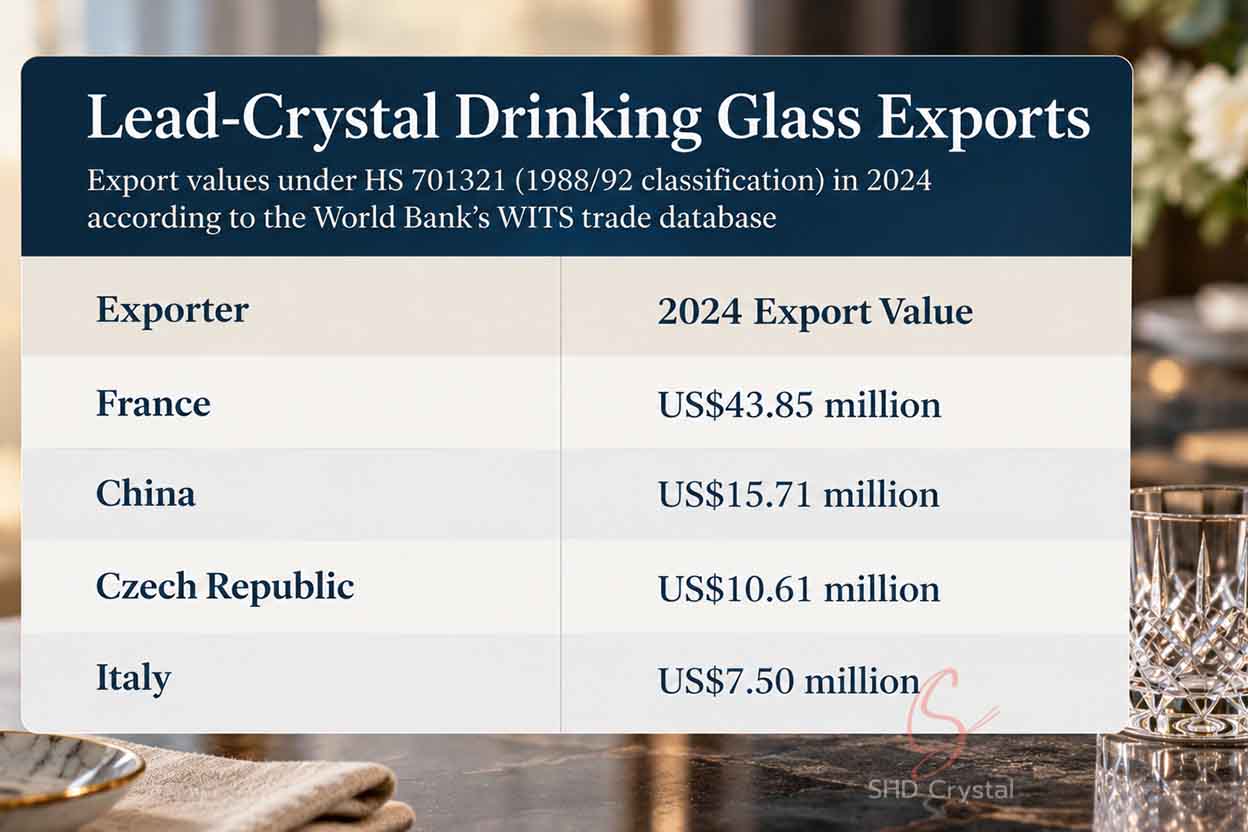
France’s reported exports were particularly significant. Its established crystal industry has maintained an international presence through decorative tableware and luxury glassware collections.
The United States also remains an important destination. WITS recorded approximately US$20.92 million in American imports under the same classification in 2024, with France representing the largest reported country of origin.
These figures demonstrate continuing international trade in lead-crystal drinking glasses.
They do not, however, establish the total value of the full-lead crystal market. The customs classification includes lead-crystal products with different compositions and does not separate the 30% PbO category.
Why Buyers Still Value Traditional Lead Crystal
The commercial appeal of lead crystal glassware is closely connected to its material character. Traditional high-lead crystal is particularly associated with decorative patterns, substantial weight, optical brilliance, and a sense of established luxury. These characteristics can remain attractive in ornamental vases, collectible crystal pieces, display objects, and selected premium gift collections.
A deeply cut crystal vase, for example, may be valued for the way its facets reflect light. A commemorative decorative piece may derive its appeal from its weight, transparency, and traditional appearance.
From our manufacturing perspective, these expectations help explain why buyers continue to ask about specific crystal compositions rather than accepting every glass material as interchangeable. However, decorative value and suitability for direct food contact must be evaluated separately.
Lead-Free Crystal Is Changing the Competitive Landscape
The broader crystal industry has also moved toward alternative formulations. For example, some famous glassware manufacturer states that it has exclusively produced crystal glass without lead oxide as a principal ingredient since 2015.
The broader crystal glassware market has gradually expanded toward lead-free alternatives, particularly for everyday drinking glasses and hospitality applications. These changes reflect growing attention to material selection, product durability, and food-contact requirements. Traditional lead crystal, however, continues to hold value in decorative and heritage-inspired collections where its distinctive optical characteristics remain an important consideration.
Lead-free products compete through clarity, strength, design, cleaning performance, and food-contact suitability. This does not mean traditional full-lead crystal has disappeared. Instead, the market increasingly requires buyers to distinguish between the visual qualities they want and the material properties they actually need.
For repeated beverage service, a suitable lead-free formulation may be preferable. For certain non-food decorative applications, traditional high-lead crystal may remain an appropriate material choice.
Food-Contact Safety Is a Commercial Consideration
Safety is one of the most important issues shaping the market. Health Canada explains that lead can migrate from leaded crystal into beverages, particularly acidic drinks. The amount depends on the crystal composition, beverage type, and contact duration.
Its guidance warns against storing beverages in lead-crystal decanters for extended periods and advises against serving pregnant women or children drinks in leaded crystal glasses.
A 2024 study published in Food Additives & Contaminants: Part A also examined lead release from crystal drinking vessels. The researchers found that lead migration could increase with contact time, reinforcing the importance of evaluating intended use rather than relying on material appearance.
In the European Union, Regulation (EC) No. 1935/2004 establishes general safety requirements for food-contact materials, including the principle that substances must not transfer to food in quantities that endanger human health.
For commercial buyers, a material designation alone cannot establish that a particular product is safe for every drinking or food-storage application.
What Reliable Lead Glass Supply Requires
When reviewing lead glass supply for a custom project, we consider material identity, intended use, destination-market requirements, and product documentation.
A customer requesting 30% PbO crystal should receive a clear explanation of how the composition will be verified. Product appearance or weight alone cannot reliably establish the actual lead oxide percentage.
Material testing and appropriate technical documentation become particularly important when the finished product will be marketed using a regulated crystal designation.
Buyers should also establish whether the item is intended for decoration, occasional beverage service, or another application. These uses can involve different safety assessments and commercial requirements.
For ongoing lead glass supply, consistency in composition, transparency, decorative finish, and inspection criteria helps maintain an agreed product specification across production batches.
The objective is not simply to supply a traditional material. It is to ensure that the material corresponds to the product’s intended use and the buyer’s market obligations.
Where the Market May Retain Commercial Value
The available evidence suggests that traditional lead crystal is better understood as a specialized market than as a universal solution for premium glassware.
Decorative collections, artistic objects, and selected heritage-inspired products can continue to benefit from the material’s distinctive visual properties.
Meanwhile, manufacturers serving hospitality and everyday drinkware markets must recognize the growing role of lead-free alternatives. For buyers, the central question is no longer whether lead crystal looks more luxurious. It is whether its specific properties justify its selection for a particular product. That distinction creates opportunities for clearer product positioning and more informed purchasing decisions.
Conclusion
The full-lead crystal market continues to reflect the relationship between traditional material value and changing commercial expectations. International trade confirms ongoing activity in lead-crystal glassware, while lead-free alternatives and food-contact safety concerns are reshaping purchasing decisions. For manufacturers and buyers, future opportunities depend on accurate material classification, realistic product positioning, and responsible selection of crystal compositions.
Discussing Full-Lead Crystal Projects with SHD Crystal
SHD Crystal welcomes OEM and ODM inquiries involving traditional crystal compositions and decorative glassware development. Buyers researching the full-lead crystal market can share their material specifications, product designs, intended applications, destination markets, and estimated order quantities for a feasibility review. Material verification, applicable safety requirements, and production capabilities should be established before project approval.