
A serving tray may appear simple until several different snacks need to share the same space. Nuts, olives, dried fruits, and sweets each have their own shapes and serving requirements. Glass divided snack trays bring these foods together without completely mixing them, while transparent glass adds a decorative quality to the table.
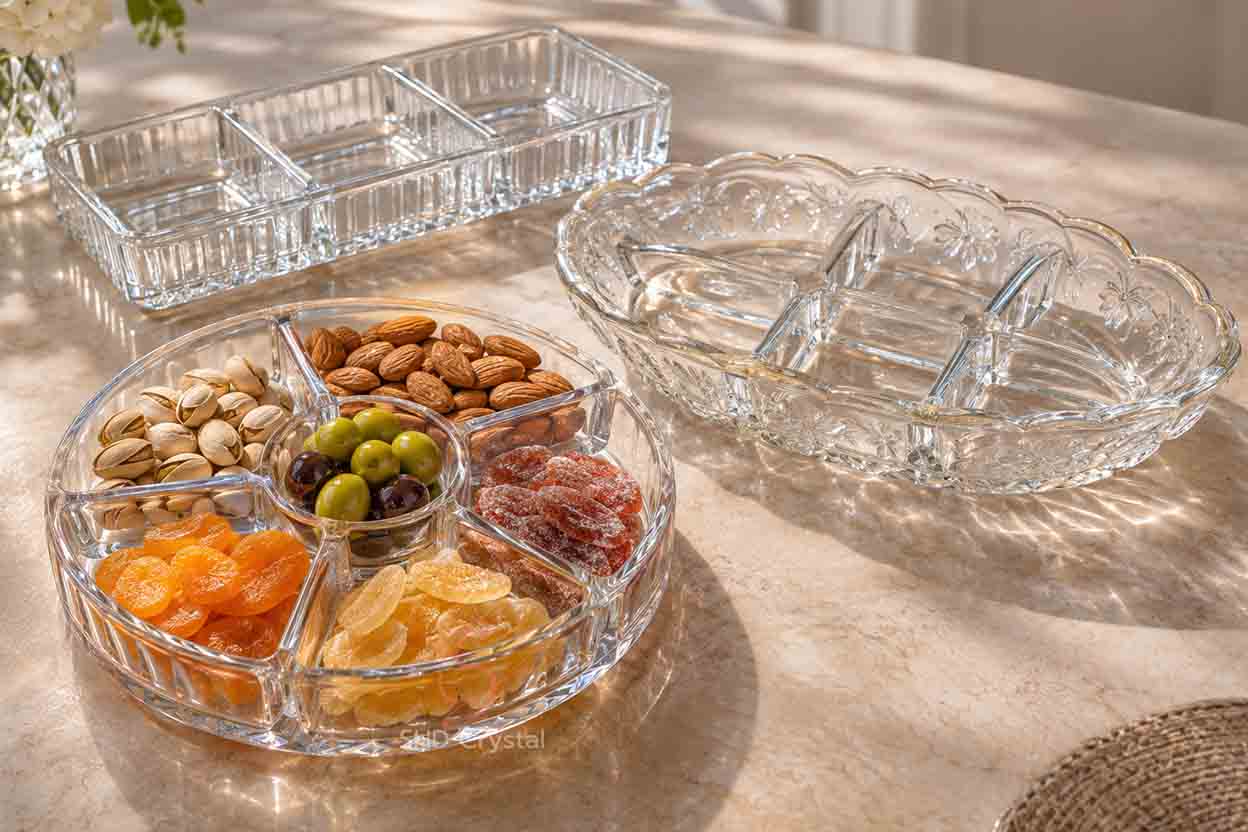
As an OEM glassware manufacturer, we approach these trays through three connected considerations: how the compartments work, how the glass looks, and whether the proposed design can be produced consistently. A successful tray should feel natural in everyday use, not simply attractive in a product rendering.
Designing Glass Divided Snack Trays for Different Table Settings
The First Decision: How Many Compartments?
Not every divided tray needs the same arrangement. A three-section tray offers a simple layout for small gatherings, while four to six compartments provide more variety for parties and shared snacks. Some designs use a central circular section for dips, surrounded by larger compartments for crackers, nuts, or vegetables.
We consider the size and shape of the intended food before deciding how the divisions should work. A narrow compartment may look elegant but become inconvenient when guests try to pick up larger snacks. Deep partitions can keep foods separated, but they also create corners that require attention during cleaning. The best arrangement balances available serving space with comfortable access.
Shape Gives the Tray Its Personality
Round, oval, square, and petal-shaped trays each create a different impression. A round tray with radial dividers encourages sharing from every direction. An oval design fits naturally along the center of a dining table, while a rectangular version may suit contemporary serving collections.
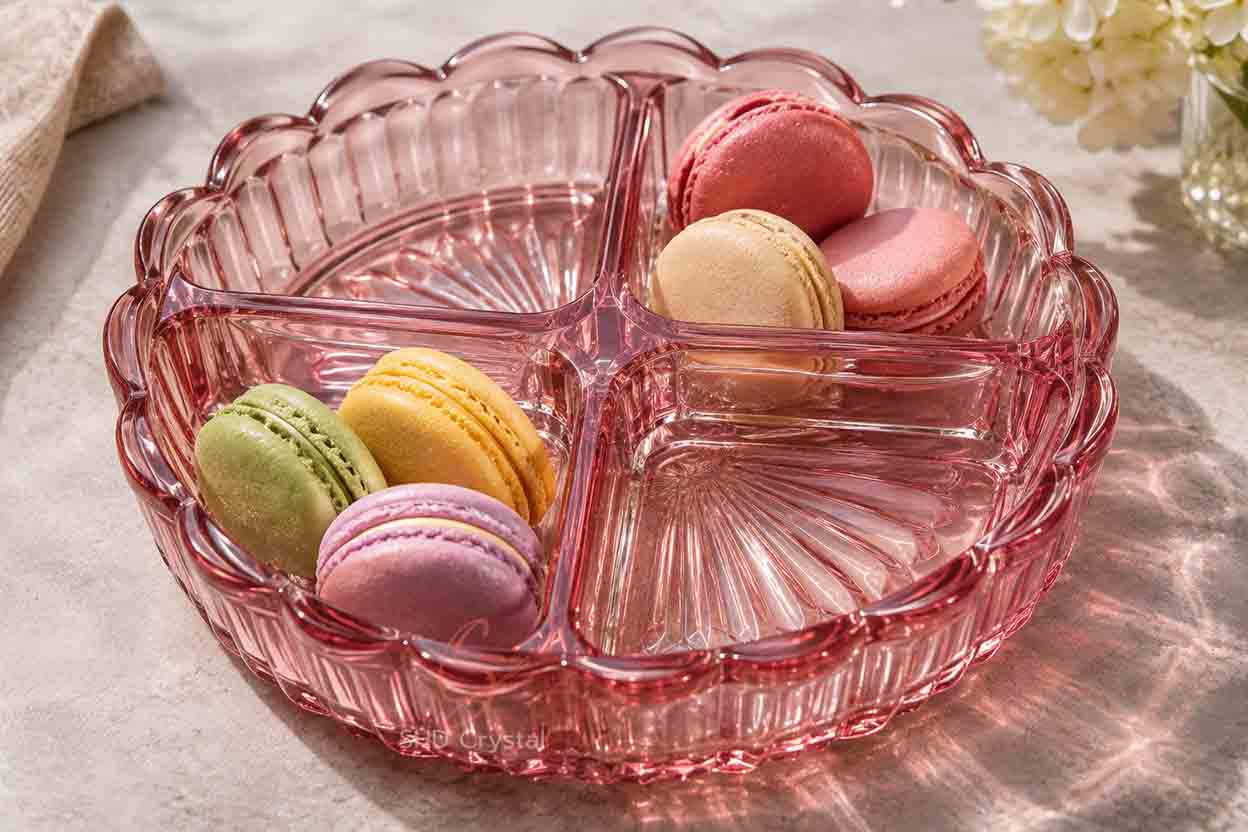
Scalloped edges introduce a more traditional appearance. Petal-shaped compartments can also turn a functional serving dish into a decorative centerpiece. However, the external silhouette should work with the internal partitions. We avoid treating these as separate design decisions because the outer shape determines how much usable space remains inside each section.
From Vintage Relish Trays to Modern Minimalism
Decorative divided glassware has a long history in tabletop collections. Vintage glass relish trays often feature molded floral patterns, scalloped rims, and geometric textures. Clear, green, and amber glass versions evoke the decorative tableware styles popular during the mid-twentieth century. These historical designs remain useful references for contemporary product development.
For a vintage-inspired collection, raised fruit patterns, diamond textures, or softly curved compartments can create a distinctive appearance. The glass catches light across the embossed surfaces, making the empty tray decorative as well.
Modern minimalist designs take a different approach. Clear glass, clean partitions, and restrained edges allow the food to become the main visual element. Both styles can work commercially. The choice depends on the intended customer, surrounding tableware, and product positioning.
Material and Texture Should Work Together
For many compartmentalized designs, pressed glass serving trays offer a practical manufacturing approach. Pressing allows internal partitions, decorative patterns, and outer contours to be incorporated into the molded structure.
We pay particular attention to the transitions where the dividers meet the base. These areas should be properly formed, with suitable glass distribution and no sharp internal edges.
A substantial base can provide stability, but excessive thickness adds unnecessary weight. Deep embossed textures may improve visual interest, while smooth food-contact surfaces are generally easier to clean.
Transparent lead-free glass can be considered for everyday serving applications. Colored glass and decorative finishes may also be evaluated, provided the selected materials meet the intended food-contact requirements.
Should a Divided Snack Tray Have a Lid?
A matching glass lid can make the tray suitable for covered tabletop presentation and help protect snacks from dust. Some product concepts also include handles or removable sections for easier serving. However, a decorative lid should not automatically be described as airtight. Effective sealing requires an appropriate closure design and testing.
Additional components also influence the overall weight, packaging dimensions, and handling requirements. For this reason, we prefer to establish the intended use before adding accessories that may complicate the design.
What We Check Before Approving an OEM Sample
A physical sample provides answers that drawings cannot always reveal. We review whether the compartments are large enough for the intended foods, whether the dividers are comfortable to clean around, and whether the tray sits evenly on a flat surface.
Visible bubbles, molding marks, rim quality, glass distribution, and decorative consistency also require attention. For pressed glass serving trays, the final texture and divider definition should be assessed together rather than as separate details. If the tray belongs to a coordinated snack set, matching cups or serving accessories may introduce additional dimensional and visual requirements. The approved sample becomes an important reference for subsequent production.
FAQs Focus on Glass Divided Snack Trays
Can glass divided snack trays be customized with different compartment layouts?
Yes. Compartment quantity, shape, divider arrangement, and overall dimensions can be developed according to the intended application. Custom geometry may require new tooling.
Are embossed glass snack trays suitable for food contact?
They can be, provided the glass composition and any applied decorations meet the applicable requirements for the intended food-contact use. Surface textures should also be evaluated for cleanability.
Can divided glass trays be made in vintage colors?
Clear, green, amber, and other glass colors may be considered according to the selected material and manufacturing process. Physical samples help confirm the intended color appearance.
Are these trays suitable for repeated hospitality use?
Suitability depends on the tray’s weight, geometry, durability, and cleaning requirements. Commercial washing compatibility and handling performance should be assessed before approving a hospitality collection.
Conclusion
The appeal of glass divided snack trays comes from combining food organization with decorative glass design. Compartment proportions, rim shapes, material clarity, and surface textures all influence how the finished tray looks and functions. For OEM development, successful design means finding a practical balance between the visual concept, everyday usability, and manufacturing feasibility.
SHD Crystal supports OEM and ODM glass divided snack trays for tabletop collections, hospitality programs, and decorative serveware brands. We welcome original drawings, reference samples, preferred compartment layouts, material requirements, and estimated order quantities for a manufacturing feasibility review. From classic embossed patterns to modern transparent designs, each project can be evaluated according to its intended market and production requirements.
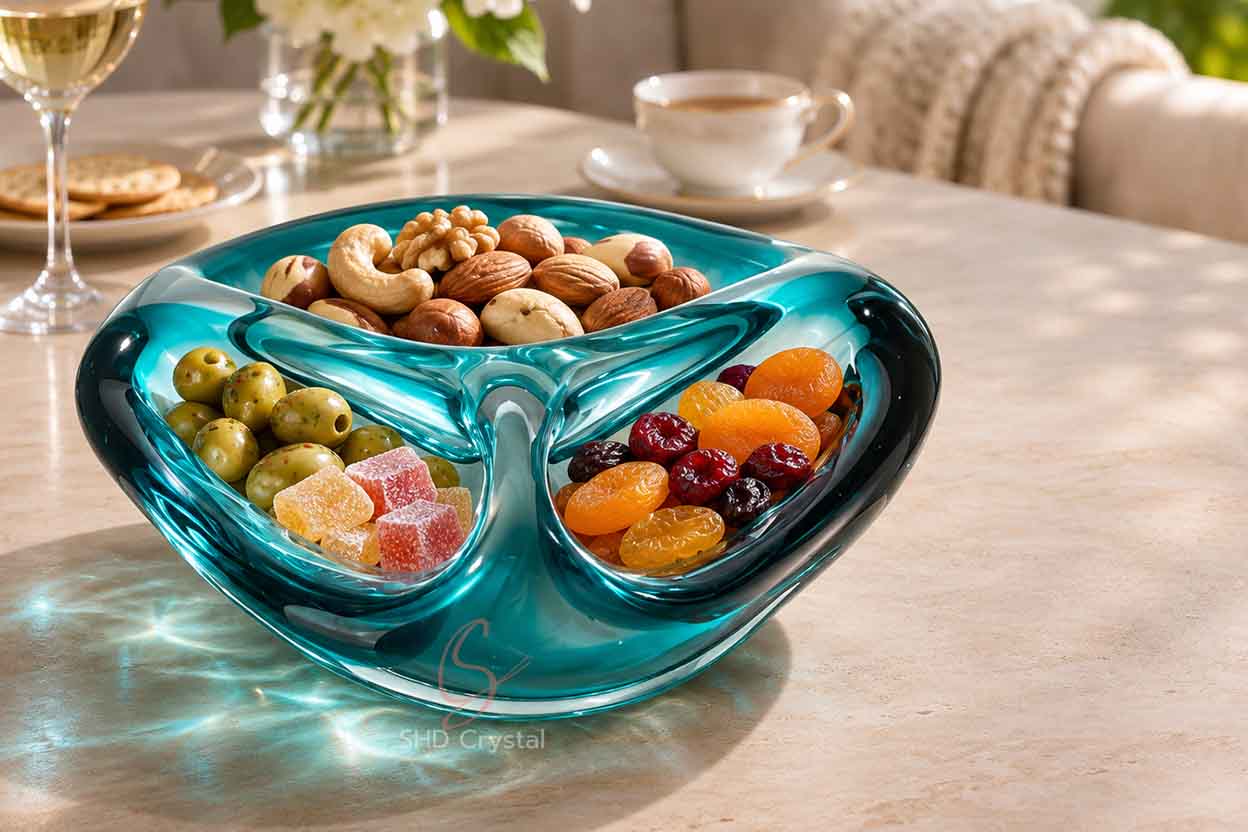
A practical example from our current serveware line is the Teal Blue Sectioned Crystal Snack Dish shown above. This design combines a compact sculptural silhouette with integrated divided sections, allowing small snacks, dried fruits, nuts, or candies to be served in an organized and visually distinctive way. Its teal blue transparent crystal body gives the piece a decorative presence even when not in use, while the thick rounded walls and smooth partition transitions create a more substantial tabletop feel. For buyers developing decorative serveware collections, this type of divided dish shows how color, form, and practical snack-serving function can be combined into one compact glass product.