
Some glass objects are admired for their simplicity, while others attract attention through their shape, weight, and interaction with light. Luxury cut lead glassware belongs to the latter category. Its deep geometric facets create shifting reflections that give even a transparent object a strong visual presence.
At SHD Crystal, we see this artistic potential particularly clearly in two decorative categories: geometric crystal vases and sculptural crystal ashtrays. Although their functions differ, both demonstrate how carefully arranged angles and substantial glass forms can turn everyday objects into distinctive pieces of interior decoration.
The Artistic Language of Luxury Cut Lead Glassware
Geometry gives luxury cut lead glassware much of its visual identity. Triangular facets, diamond patterns, vertical cuts, and angular silhouettes interact with light in different ways. The result depends not only on the number of decorative surfaces but also on their depth, direction, and relationship with the overall form.
A restrained geometric pattern can feel architectural and contemporary. Deeper intersecting cuts often create a richer, more traditional appearance. Understanding this relationship helps us evaluate whether a design should emphasize modern simplicity or classical crystal elegance.
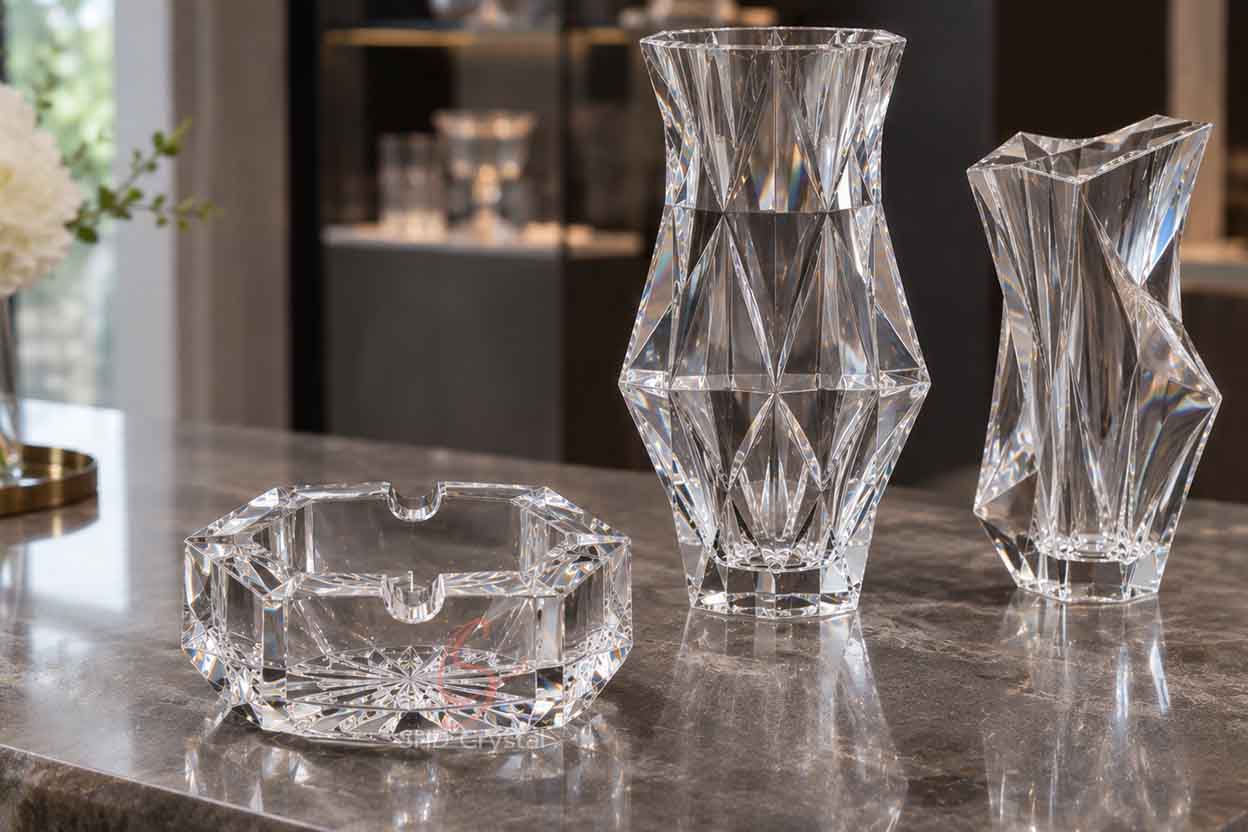
Geometric Crystal Vases as Sculptural Objects
A crystal vase does not need flowers to become the focal point of a room. For geometric crystal vases, the exterior silhouette can be just as expressive as the decorative cuts. Tall polygonal forms suggest architectural columns, while broader, asymmetrical designs can resemble abstract sculptures.
Clear lead crystal offers a distinctive combination of density and optical brilliance. When light enters the faceted surface, it produces internal reflections that emphasize the vase’s depth and structure. This visual character makes geometric vases particularly suitable for luxury interiors, decorative collections, and curated hospitality spaces.
We also consider the relationship between the opening and the body. A narrow opening may reinforce a sculptural silhouette, while a wider opening allows more flexibility for floral arrangements. The strongest designs balance decorative impact with the practical purpose of a vase.
Cut Crystal Ashtrays: Small Objects with Strong Character
Unlike tall decorative vases, cut crystal ashtrays concentrate their visual character into a compact form. Square, octagonal, and irregular polygonal outlines are especially effective because they provide a clear geometric foundation. Deep exterior facets create visual depth, while a substantial base gives the object a grounded appearance.
Traditional ashtray designs may incorporate cigarette rests around the rim and a recessed central bowl. These functional details can be integrated into the overall geometric composition rather than treated as separate features. For example, an octagonal ashtray with broad polished facets can evoke the symmetry of Art Deco design. A more irregular arrangement of angular surfaces may feel contemporary and sculptural. Even when displayed without being used, a crystal ashtray can retain the visual presence of a decorative object.
Why Geometric Cutting Creates Different Visual Effects
Not all geometric decorations produce the same impression. Large, flat facets reveal broad reflections and emphasize the overall silhouette. Smaller intersecting cuts produce more fragmented highlights, creating a visually intricate surface.
The thickness of the glass also matters. Deep decorative cuts need sufficient material around them, particularly where several facets meet.
For geometric crystal vases, vertical cutting patterns can emphasize height, while diagonal or diamond arrangements create more complex reflections.
For cut crystal ashtrays, broad angled surfaces may highlight the substantial body, while patterned sides can make a relatively small object appear more elaborate.
From a design perspective, cutting should strengthen the original form rather than overwhelm it.
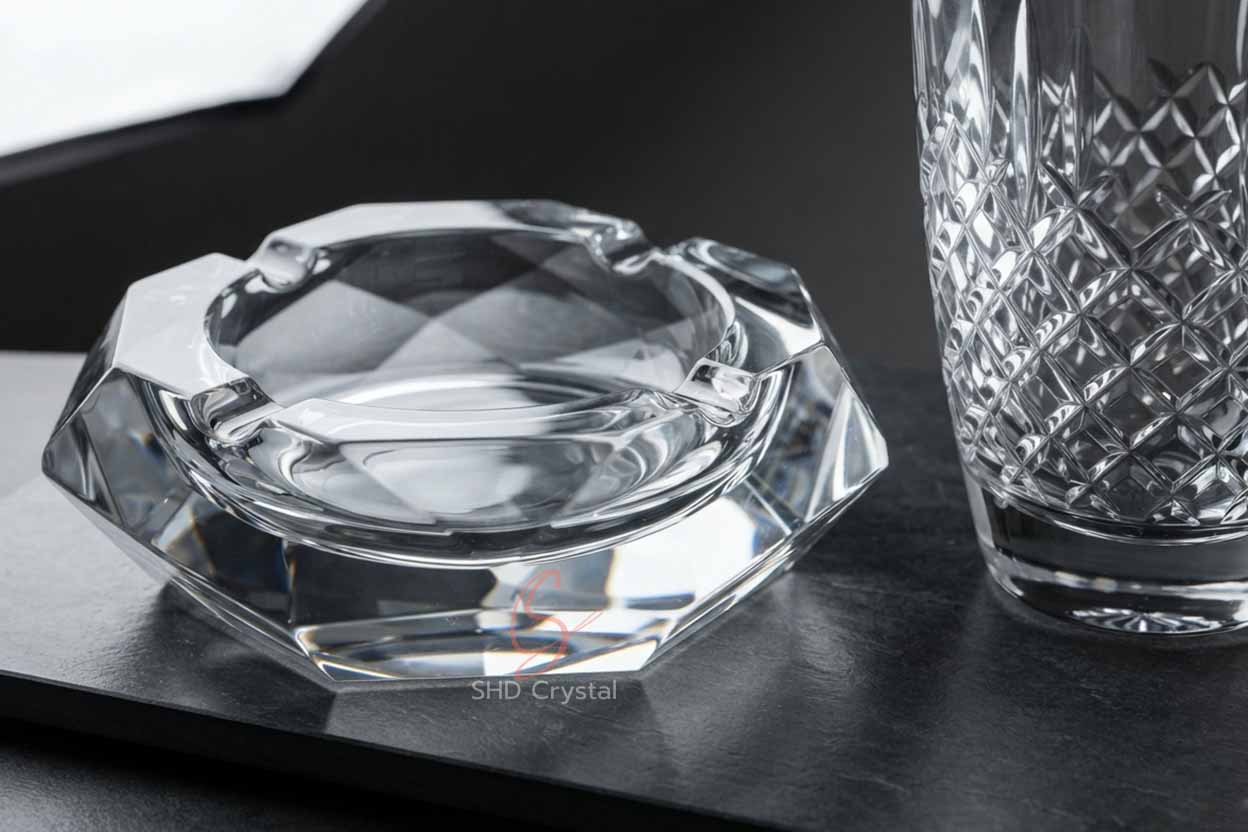
Traditional Crystal and Modern Decorative Styles
The appeal of traditional lead crystal is not limited to classical interiors. Deeply cut glassware is often associated with vintage decorative collections, but similar geometric principles can work in modern settings.
A transparent polygonal vase on a minimalist console table introduces reflected light without adding strong color. A faceted crystal ashtray on a dark wooden surface creates contrast through its weight and sharp optical details. These combinations allow traditional material characteristics to appear contemporary.
We find that the most successful decorative collections do not necessarily use the most complicated patterns. Clear proportions, well-positioned facets, and a consistent design language often create a stronger artistic result.
Material Selection and Custom Design
Lead crystal has defined material characteristics that should be distinguished from general crystal glassware.
Under European crystal classification rules, lead crystal contains at least 24% lead oxide (PbO), while full-lead crystal requires at least 30%. These classifications are important when buyers specify traditional crystal compositions for decorative products.
For OEM development, we review the proposed shape, material requirements, cutting pattern, surface finish, and intended application together. A decorative vase and a functional ashtray may share a visual style, but their structural requirements are different. Rim quality, base stability, cutting depth, and intended handling conditions should be assessed through samples.
For lead-containing products, material verification and applicable destination-market requirements must also be considered.
FAQs
Q01 | What makes geometric lead crystal different from ordinary decorative glass?
Traditional lead crystal contains lead oxide, which contributes to its density and optical characteristics. Geometric cutting adds decorative facets that create distinct reflections. The actual material composition should be verified rather than judged by appearance alone.
Q02 | Can geometric crystal vases and ashtrays share the same design style?
Yes. Coordinated collections can use similar polygonal outlines, diamond patterns, or faceted surfaces while adapting the dimensions and internal structure to each product.
Q03 | Can original geometric designs be developed for OEM projects?
Yes. Buyers may provide drawings, reference samples, or original design concepts. Material selection, structural feasibility, cutting requirements, and sample development should be reviewed before production.
Conclusion
Luxury cut lead glassware demonstrates how geometry can transform transparent material into expressive decorative objects. From tall faceted vases to compact sculptural ashtrays, the combination of substantial glass forms and carefully arranged surfaces creates a distinctive visual identity.
For premium decorative collections, the lasting appeal lies in the balance between artistic form, material character, and practical design.
Developing Luxury Cut Lead Glassware with SHD Crystal
SHD Crystal welcomes OEM and ODM luxury cut lead glassware projects involving original geometric crystal vases, decorative ashtrays, and coordinated interior accessories. Our development discussions consider material composition, sculptural proportions, decorative patterns, sample requirements, and intended markets. Buyers can share original designs, reference images, material specifications, and target order quantities for a manufacturing feasibility review.
The link to this article is managed and owned by SHD Crystal. Please cite the source if reposting. Thank you for your cooperation.