
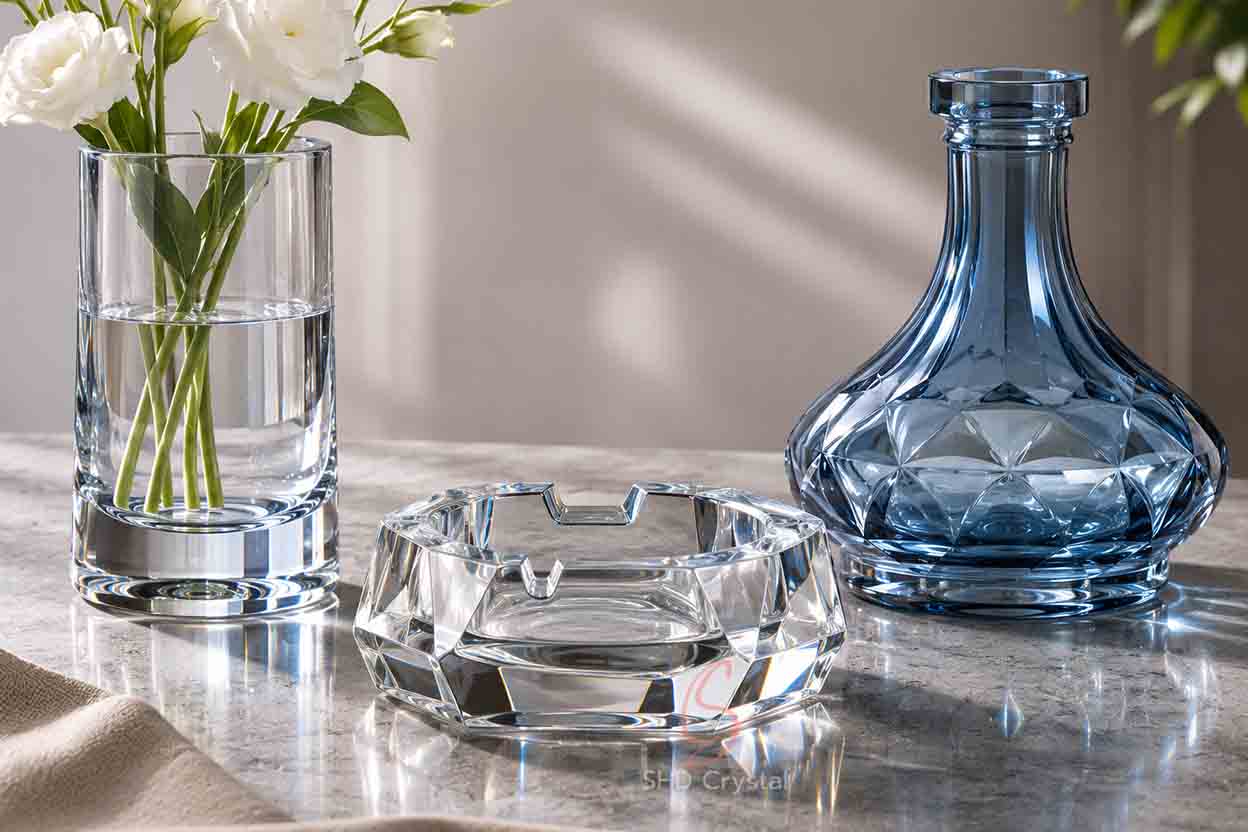
A glass vase holding a single flower, a sculptural ashtray resting on a coffee table, or an elegant hookah base catching the evening light—these objects have something in common. Their beauty often begins at the bottom. Through heavy-base glass decoration, an ordinarily overlooked part of a glass vessel becomes a feature that adds visual depth, character, and a distinctive sense of substance.
The interesting part is that a heavy base does not need elaborate decoration. Sometimes, the thickness of the transparent glass is already enough to make light behave differently.
Why Heavy-Base Glass Decoration Makes Ordinary Objects Special
A substantial glass base creates a different visual impression from a thin, lightweight bottom. Light passes through the thicker material, producing layered reflections and a sense of depth. Depending on the design, the base can appear almost like a separate crystal sculpture supporting the vessel above it.
This approach works particularly well for decorative glassware because the base can contribute to both appearance and physical balance. However, greater weight alone does not guarantee better stability.
Glass Vases: A Foundation for Light and Color
Consider a simple cylindrical vase with a deep, transparent base. Without flowers, it can still look interesting. The thicker glass catches reflections from the table, while its smooth walls give the entire piece a clean, architectural character. For thick-bottom glass vases, designers can explore rounded bases, geometric profiles, colored glass, or polished decorative facets.
A pale amber base may introduce warmth, while a clear sculptural foot can create a more minimalist appearance. The goal is not always to make the vase heavier. It is to give the bottom a visual purpose that complements the overall silhouette.
Glass Ashtrays: Small Objects with Strong Character
Glass ashtrays offer another interpretation of decorative weight. Their shallow bodies provide room for broad geometric cuts, rounded contours, and thick polished edges. A square ashtray with a substantial transparent base can look almost like a miniature architectural object.
Deep relief patterns or colored glass can strengthen that impression. The manufacturing approach may involve pressing, molding, or subsequent cutting and polishing, depending on the design. For functional ashtrays, decorative choices must also account for heat exposure, cleaning, and the intended contact with smoking materials.
A striking appearance should never replace practical material suitability.
Hookah Bases: Where Decoration Meets Structure
Among decorative glass products, decorative hookah bases offer particularly interesting design possibilities. Their larger glass bodies provide generous space for color, molded textures, hand-painted motifs, or geometric cutting. A substantial lower section can create an attractive sense of balance beneath the narrower neck, while transparent glass reveals the water and internal contours.
Yet the base is not purely decorative. Its neck must connect securely with the intended hookah assembly, and its dimensions must accommodate the required internal components. For decorative hookah bases, the strongest designs combine an expressive lower body with carefully planned connection geometry and stable placement.
How Decorative Thickness Is Created
The visual effect begins with the glass structure itself. Depending on the product, manufacturers may use pressing, mold blowing, or suitable hand-forming techniques to create the required body and base. After forming and annealing, selected areas can undergo grinding, cutting, polishing, or other decorative finishing.
Genuine wheel-cut patterns remove glass from the surface, while molded relief is created during forming. Although both can produce geometric decoration, they are not the same manufacturing method. The appropriate technique depends on the vessel’s geometry, material, and desired finish.
The Manufacturing Challenges Behind a Heavy Base
Thicker glass sections require careful attention to cooling and stress control. Significant differences between base and wall thickness can complicate forming and annealing. An attractive design should therefore be evaluated for glass distribution, remaining wall thickness, and internal stress.
Product handling also matters. A heavy vase should sit evenly, an ashtray needs a properly finished contact surface, and a hookah base must fit its intended assembly.
For heavy-base glass decoration, successful development means making the decorative feature compatible with the product’s actual use.
FAQ
Q01 | Does a heavy glass base always contain lead crystal?
No. A substantial base can be made from different suitable glass formulations. Weight alone does not identify lead content or material quality.
Q02 | Can thick glass bases feature carved decorations?
Yes. Cutting, engraving, and polishing can create decorative effects when the glass geometry and remaining thickness are suitable.
Q03 | Can decorative glass bases be customized in different colors?
Yes. Depending on the manufacturing process, color may come from the glass material or a suitable surface finish. Samples should establish the intended appearance and performance.
Conclusion
Heavy-base glass decoration shows how a practical structural feature can become part of a product’s artistic identity. From transparent vases and geometric ashtrays to richly decorated hookah bases, the bottom of a glass vessel can contribute as much visual character as the body above it. Sometimes, the most interesting detail is the one closest to the table.
Give the Base a Design Purpose
A substantial glass base can be understated, colorful, or boldly sculptural. At SHD Crystal, we approach heavy-base glass decoration by considering how the intended silhouette, glass thickness, and glass decorative treatment work together. For an original vase, ashtray, or hookah base collection, the right starting point may be surprisingly simple: deciding what the base should contribute to the finished design.
The link to this article is managed and owned by SHD Crystal. Please cite the source if reposting. Thank you for your cooperation.