
A clear glass surface reflects its surroundings with familiar brightness. After acid etching, that same surface can take on a softer, almost silky appearance. Light becomes diffused, reflections lose their sharpness, and subtle decorative patterns begin to emerge. The glass acid etching process creates these effects through controlled chemical modification of the glass surface rather than an added layer of matte paint.
From elegant glass vases to decorative bottles and lighting components, acid etching offers a distinctive way to change the appearance of glass without changing its original form.
Understanding the Glass Acid Etching Process
Unlike sandblasting, which uses abrasive particles, acid etching produces its decorative effect through a chemical reaction with the glass surface. Industrial acid-etching systems commonly involve fluoride-based chemistry capable of reacting with the glass. The treated surface develops a microscopic texture that scatters incoming light and produces a satin appearance. The finished effect depends on the glass composition, surface condition, selected treatment, and process control.
1. From a Clear Glass Blank to an Etched Surface
Industrial etching begins with a suitable glass blank. Before treatment, the surface must be examined for cleanliness, existing defects, and compatibility with the intended finish.
For uniform satin decoration, the designated surface receives controlled chemical treatment in a specialist facility. When only selected areas are to be etched, appropriate protective masking can preserve transparent sections. After treatment, the finished glass undergoes the required decontamination, cleaning, and inspection procedures.
These stages require professionally managed equipment and chemical safety systems. Hydrofluoric acid, associated with traditional glass etching, presents serious health hazards and is not appropriate for casual workshop handling.
2. Why Acid-Etched Glass Looks Different
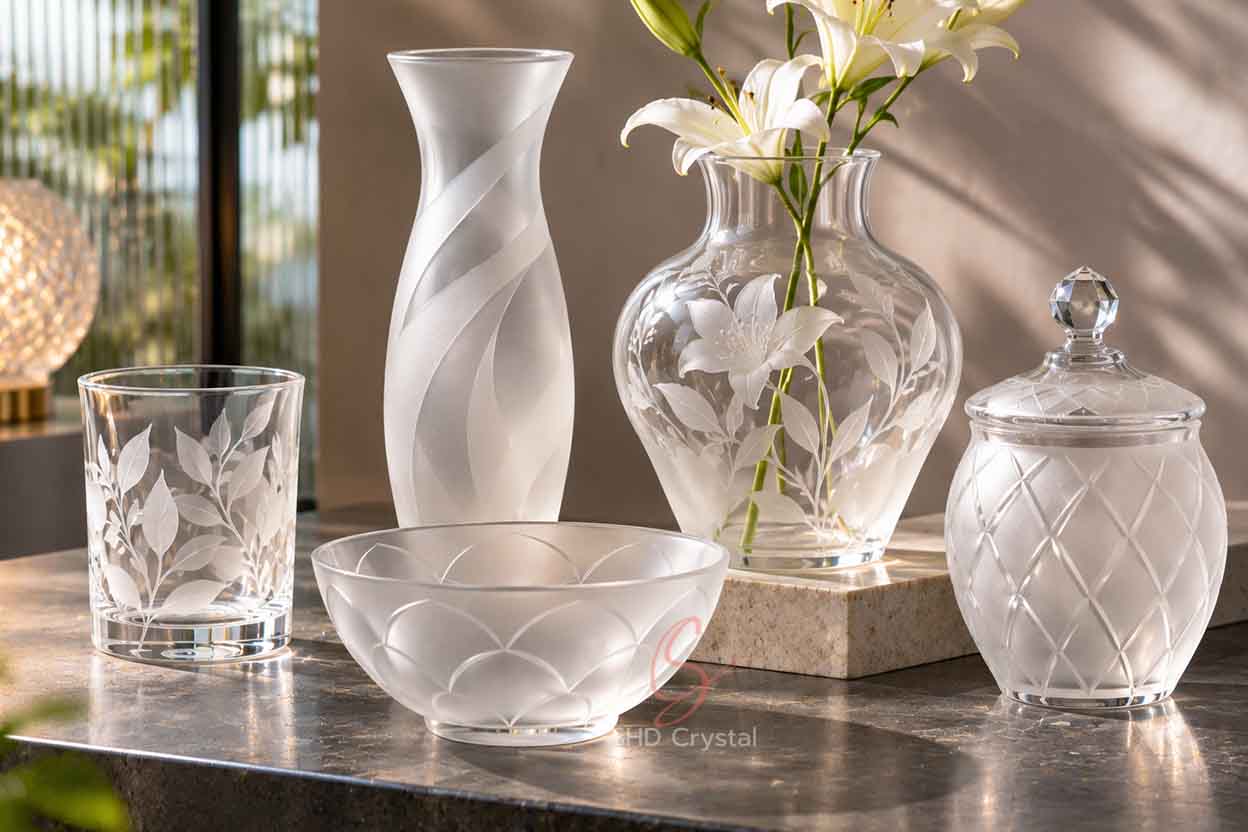
The characteristic appearance of acid-etched glass comes from the way its modified surface scatters light. Instead of producing sharp reflections like polished transparent glass, a satin finish creates a softer, more diffuse appearance. This is especially attractive for acid etched glass vases, where the original silhouette remains visible while the surface develops a gentle translucent character.
Compared with many abrasive treatments, acid etching can achieve a particularly fine-looking satin texture. However, the final visual result should be assessed using actual samples rather than assuming every etched surface has identical smoothness.
3. Selective Etching and Decorative Patterns
Acid etching does not have to cover the entire object. By protecting selected areas, manufacturers can create etched glass patterns that contrast with polished transparent surfaces.
Botanical motifs, decorative borders, geometric bands, and simple abstract forms can all benefit from this contrast. A clear vase with softly frosted leaves may appear more delicate than a completely matte vessel. Likewise, a decorative bottle can use a restrained etched section without obscuring its entire glass body.
Pattern clarity depends on surface curvature, masking accuracy, and the selected processing arrangement.
4. Acid Etching Compared with Sandblasting
Both techniques can produce frosted glass, but their mechanisms differ. Sandblasting mechanically roughens the surface through abrasive impact. Acid etching chemically modifies the exposed glass.
Acid-etched surfaces are often associated with a finer satin appearance, while sandblasting provides different possibilities for localized abrasive texture. Neither method is automatically superior. For products with deep relief, narrow openings, or difficult-to-access surfaces, processing feasibility should be evaluated individually.
5. Where Acid-Etched Glass Is Most Effective
Decorative vases provide a particularly suitable application because their surfaces can become part of the visual design. Transparent and frosted sections may be combined to create understated floral or geometric decoration. Selected lighting components can also benefit from satin surfaces that soften visible reflections.
For acid etched glass vases, the result can suit contemporary homeware, boutique interiors, and decorative gift collections. However, industrial acid-etched flat glass products should not be treated as proof that every three-dimensional vessel can receive the same finish.
6. Quality Control and Commercial Considerations
A consistent satin finish requires clear inspection standards. Manufacturers should evaluate surface uniformity, visible marks, pattern boundaries, handling sensitivity, and acceptable differences between samples. The finish is chemically formed rather than applied as a separate paint layer, but that does not make it immune to fingerprints, stains, or improper cleaning. For OEM projects, approved samples should establish the intended appearance and maintenance requirements before production.
Conclusion
The glass acid etching process demonstrates how a subtle surface transformation can change the entire character of a glass product.
From uniform satin finishes to delicate etched glass patterns, its decorative possibilities depend on controlled processing, suitable product geometry, and clear quality requirements. The most successful applications use the finish to complement the glass form rather than conceal it.
A Different Expression of Glass Decoration
A familiar vase or decorative vessel can take on a new identity through the contrast between transparency and satin texture. For designs exploring the glass acid etching process, SHD Crystal can help assess the intended visual effect and identify appropriate finishing considerations, with specialist processing capabilities confirmed for each project.
Read the original article on custom crystal glass manufacturing: https://shdcrystal.com/blogs/glass-acid-etching-process/