
Blogpost keywords: how hookah works, hookah airflow mechanism, water filtration in hookah
Understanding how hookah works involves more than observing smoke movement—it requires examining the physical interaction between air pressure, heat, and water. A hookah operates through pressure differentials: when a user inhales, negative pressure pulls vapor from the heated bowl down through the stem into the base. There, vapor passes through water before traveling to the hose.
This interaction between airflow and water resistance forms the foundation of the hookah airflow mechanism and defines the role of water filtration in hookah systems.
How Hookah Works: Core Mechanism and Airflow Dynamics
To fully understand how hookah works, it is essential to follow the complete airflow path. Heated air from charcoal interacts with flavored tobacco, producing vapor that moves downward through the stem and downstem. Upon entering the base, vapor disperses through water, where cooling and filtration occur before clean smoke travels through the hose to the mouthpiece.
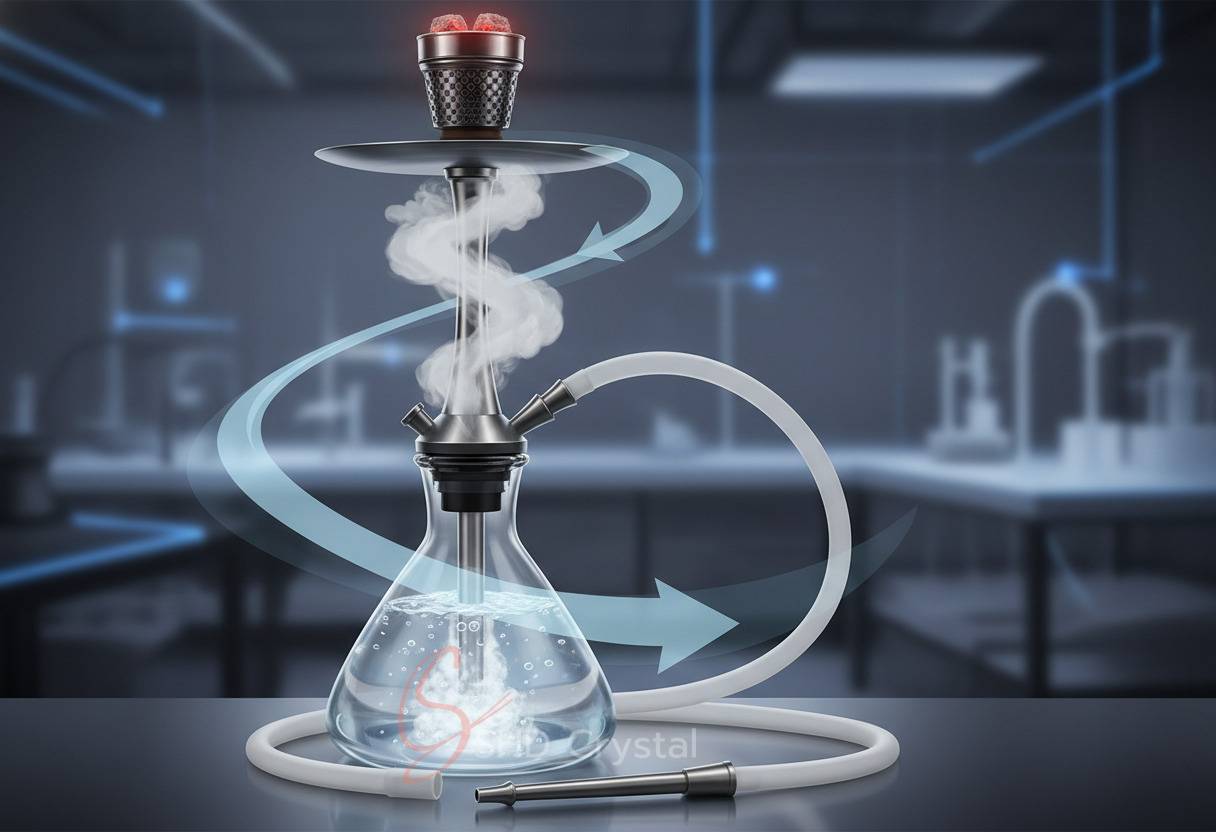
This process relies on a coordinated hookah airflow mechanism, in which each component contributes to pressure regulation and flow stability:
- Bowl: Manages heat transfer and consistent vaporization
- Stem and Downstem: Direct airflow downward while moderating temperature
- Hookah Base: Controls resistance and enables water filtration in hookah operation
- Hose and Valve: Support steady inhalation and efficient purging
Together, these elements maintain balanced airflow and predictable draw behavior.
Materials, Design Precision, and Functional Performance
A critical part of how hookah works lies in material selection and dimensional accuracy. Modern hookahs commonly use stainless steel stems for corrosion resistance and borosilicate glass for thermal stability. The base is designed with reinforced walls to tolerate temperature changes while maintaining structural integrity.
Design precision directly affects the hookah airflow mechanism. Stem diameter, downstem length, and base curvature influence pressure loss and airflow velocity. Meanwhile, water filtration in hookah systems depends on controlled water depth and bubble dispersion, which affect cooling efficiency and smoke smoothness.
Water Filtration in Hookah Systems and Cooling Efficiency
Water filtration in hookah systems serves two primary functions: cooling vapor and moderating particulate flow. As vapor passes through water, heat dissipates and resistance increases slightly, smoothing inhalation. Proper water levels ensure effective filtration without excessive drag or splashback.
If water depth is misaligned, the hookah airflow mechanism becomes unstable—either too restrictive or insufficiently filtered. Balanced water filtration helps preserve flavor clarity while maintaining consistent resistance across multiple draws.
Historical Development and Cultural Integration
Examining how hookah works also requires understanding its historical evolution. Originating in 16th-century India and spreading through Persia and the Ottoman Empire, the hookah’s structure evolved through both cultural and functional refinement. Glass bases replaced earlier materials to improve visibility, balance, and water filtration in hookah use.
Modern hookahs continue this progression, integrating contemporary materials and manufacturing precision while preserving the same underlying airflow mechanism developed centuries ago.
Maintenance and Optimization of the Hookah Airflow Mechanism
From a mechanical standpoint, maintenance is essential to preserving how hookah works effectively. Residue buildup restricts airflow, alters pressure balance, and compromises water filtration in hookah systems. Regular cleaning with warm water and mild solutions prevents obstruction and maintains airtight seals.
Grommets and seals should be replaced periodically to preserve the integrity of the hookah airflow mechanism. Consistent maintenance stabilizes resistance, improves smoke purity, and extends overall system lifespan.
Engineering Insight and Modern Refinements
Modern engineering approaches analyze how hookah works using fluid dynamics principles. Adjustments to downstem geometry, diffuser placement, and base volume regulate backpressure and bubble formation. These refinements improve temperature consistency and reduce turbulence without altering the traditional operating principle.
Visual enhancements such as etched glass or integrated lighting may affect appearance, but the core hookah airflow mechanism and water filtration in hookah systems remain unchanged—demonstrating the durability of the original design logic.
Conclusion
Mechanically and culturally, how hookah works is defined by the interaction of airflow, water, and pressure. The hookah airflow mechanism governs resistance and draw consistency, while water filtration in hookah systems shapes cooling efficiency and smoothness. Mastery lies not in altering the system, but in understanding and maintaining its balance.
When airflow dynamics and water filtration operate in harmony, the hookah delivers an experience that is both technically precise and timeless—rooted in physics, refined by design, and sustained through proper care.