
Blogpost keywords: free-blown klein bottles, four-dimensional glass sculptures, abstract glass craft
Free-blown klein bottles occupy a rare position where mathematical imagination meets physical material. These objects are often associated with four-dimensional glass sculptures, yet they are produced through entirely real-world techniques that rely on heat, timing, and control. As a result, they represent one of the most compelling forms of abstract glass craft, where geometry is translated into a continuous, tangible structure.
Free-Blown Klein Bottles And The Challenge Of Continuous Form
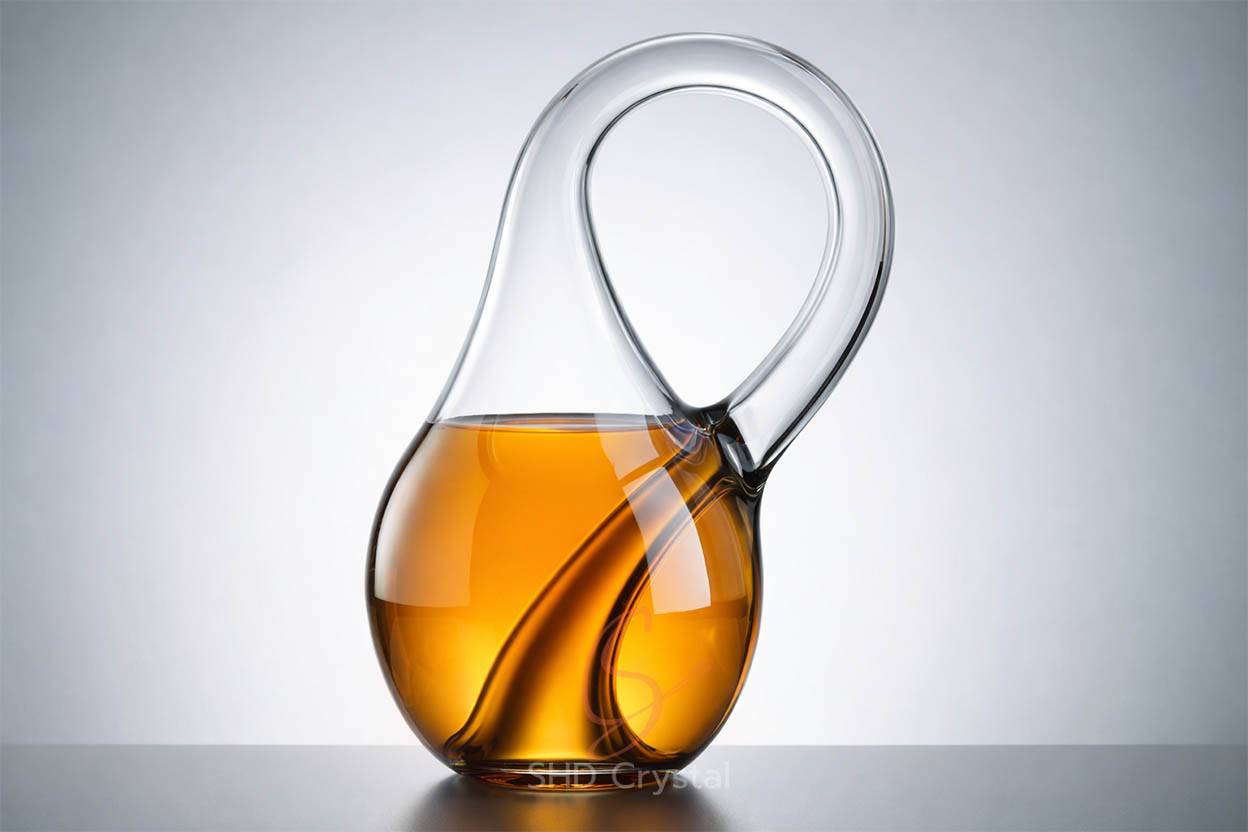
In theory, a Klein bottle is a non-orientable surface with no clear inside or outside. When translated into glass, this concept becomes a continuous loop where the neck curves back into the body, intersecting its own form without breaking continuity.
Traditional methods for producing similar shapes often rely on segmented construction or assembly. However, free-blown klein bottles attempt to achieve this continuity from a single gather of molten glass. This approach aligns them closely with four-dimensional glass sculptures, as the final object appears to defy conventional spatial logic.
Within abstract glass craft, this continuity is not just a visual effect. It defines the entire forming strategy.
Conventional Approaches To Klein Bottle Forms
Before considering free-blown klein bottles, it is important to understand how Klein bottle shapes are typically realized. Many versions are created using tubing, glass joining, or controlled bending techniques.
These methods allow for predictable shaping but often introduce visible joints or transitions. While still visually impressive, they differ from the seamless continuity expected in advanced abstract glass craft.
In contrast, four-dimensional glass sculptures produced through more integrated methods aim to reduce or eliminate these transitions. The goal is to maintain a single flowing structure, even when the geometry becomes complex.
This distinction marks the shift from constructed objects to fully formed glass expressions.
The Free-Blown Approach To Klein Bottle Formation
Creating free-blown klein bottles requires a fundamentally different mindset. Instead of assembling parts, the artisan must anticipate the entire structure from the initial gather.
The process begins with a controlled expansion of molten glass into a base volume. From there, a secondary channel is drawn and redirected, gradually forming the looping neck that defines the Klein bottle geometry.
At this stage, timing becomes critical. The material must remain workable long enough to allow redirection, yet stable enough to hold its form. This balance is central to producing four-dimensional glass sculptures without collapse or distortion.
In abstract glass craft, such transitions are often described as “moving the glass through space rather than forcing it into shape.”
Practical Difficulties In Free-Blown Klein Bottles
The difficulty of free-blown klein bottles lies in managing both geometry and material behavior simultaneously. Unlike simpler vessels, the structure must support itself while being reshaped into a continuous loop.
One major challenge is maintaining consistent wall thickness. As the neck is extended and redirected, sections of glass can thin unevenly, leading to weak points or visual distortion.
Another issue involves heat management. The outer surface may cool faster than the inner channel, creating tension that complicates shaping. In complex four-dimensional glass sculptures, even small temperature differences can affect the final alignment of the loop.
Experienced artisans often rely on subtle adjustments rather than fixed measurements. In abstract glass craft, this adaptability is essential, as the material rarely behaves exactly the same way twice.
From Concept To Finished Form
As the structure stabilizes, the free-blown klein bottles begin to reveal their defining characteristic: a seamless, continuous surface that appears to intersect itself without interruption.
At this stage, refinement focuses on clarity, proportion, and balance. The object must read as a coherent form rather than a technical experiment.
Within four-dimensional glass sculptures, visual flow is often more important than strict geometric accuracy. Slight variations can enhance the perception of movement and depth.
This is where abstract glass craft shifts from technical execution to artistic interpretation.
Market Position And Contemporary Interest
Free-blown klein bottles remain a niche category within decorative and conceptual glass. Their production complexity limits large-scale manufacturing, making them more common in studio work, galleries, and specialized commissions.
However, interest in four-dimensional glass sculptures has grown alongside contemporary design trends that favor unique and concept-driven objects. Collectors and designers increasingly view these pieces as both artistic statements and technical achievements.
In the broader context of abstract glass craft, Klein bottle forms represent a balance between intellectual concept and material expression. They appeal to audiences who value both craftsmanship and the ideas behind the object.
Conclusion
Free-blown klein bottles demonstrate how abstract glass craft can transform theoretical geometry into four-dimensional glass sculptures that exist as continuous, expressive forms shaped through controlled glassblowing techniques.
Bringing Complex Glass Forms Into Production
For projects exploring advanced geometries and artistic structures, SHD Crystal applies techniques similar to free-blown klein bottles to develop four-dimensional glass sculptures and abstract glass craft through controlled hand-blown forming and experimental shaping processes tailored for custom glass applications.