
Blogpost keywords: glass pulling process, glass tube forming, precision glass shaping
Glass pulling process is a fundamental technique in modern glass manufacturing, enabling the continuous formation of uniform glass components with controlled dimensions and high surface quality. Widely used in lighting, laboratory equipment, and industrial applications, the glass pulling process allows manufacturers to produce glass tube forming structures that meet both functional and aesthetic requirements.
As demand grows for precision-driven glass components, precision glass shaping has become increasingly dependent on stable and repeatable pulling techniques that ensure dimensional accuracy across large production volumes.
How Glass Pulling Process Enables Controlled Glass Tube Production
The glass pulling process involves heating raw glass material to a molten or semi-molten state, then mechanically pulling it into elongated forms such as tubes, rods, or profiles. In addition to industrial production, the glass drawing process is also widely adapted in hand-forming techniques, where artisans manually pull and shape molten glass into customized forms with greater flexibility in design.
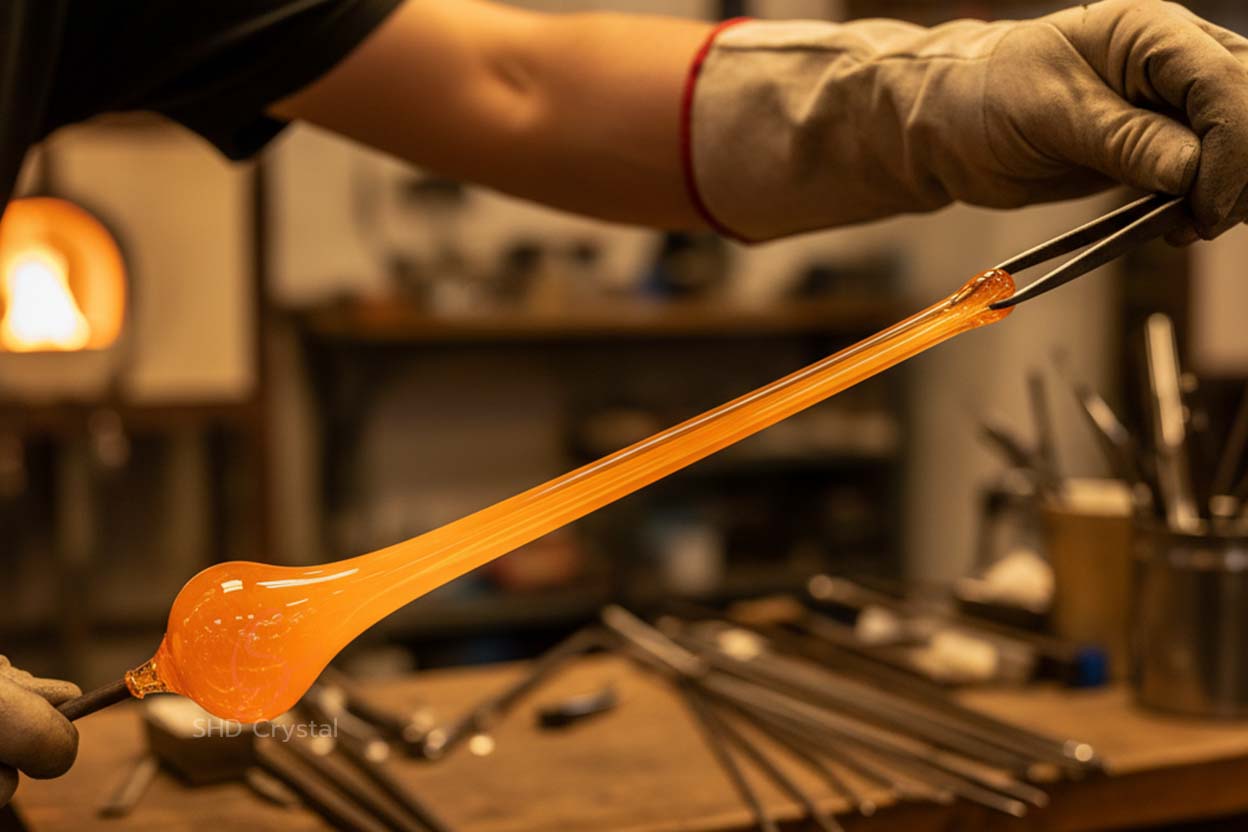
In glass tube forming, temperature control is critical. The viscosity of molten glass must be carefully regulated to ensure smooth elongation without deformation. If the temperature fluctuates, the resulting glass may exhibit uneven thickness or internal stress, which can affect durability.
Another essential factor is pulling speed. Faster pulling increases production efficiency but requires precise synchronization with cooling systems. Controlled cooling ensures that the glass retains its shape while minimizing internal stress, which is vital for precision glass shaping applications.
In many lighting applications, especially for tubular lamp structures or decorative linear elements, the glass pulling process provides a clean and uniform appearance that is difficult to achieve with molding techniques.
Key Factors That Influence pulling Quality
Several technical variables determine the success of the glass pulling process in industrial production.
Material composition is one of the most important considerations. Different glass formulations respond differently to heat and tension. For example, borosilicate glass is often preferred for glass tube forming due to its thermal resistance and stability, while soda-lime glass may be used for cost-sensitive applications.
Diameter control systems also play a critical role. Advanced production lines use real-time monitoring to adjust pulling speed and maintain consistent dimensions. This level of control is essential for precision glass shaping, particularly in applications requiring tight tolerances.
Surface quality is another defining factor. A well-executed glass pulling process produces smooth, defect-free surfaces that reduce the need for post-processing. This is especially valuable in applications where optical clarity or aesthetic finish is important.
Common Challenges And Misconceptions
One common misconception is that the glass pulling process can easily produce complex shapes. In reality, this method is best suited for linear or rotationally symmetrical forms such as tubes and rods. More intricate geometries often require secondary processing or alternative techniques.
Another challenge lies in internal stress management. Improper cooling can lead to residual stress within the glass structure, increasing the risk of cracking during use. This is particularly critical in glass tube forming used in lighting or laboratory environments.
Buyers also sometimes assume that all drawn glass products offer the same level of precision. However, precision glass shaping depends heavily on equipment capability, process control, and operator expertise.
Practical Considerations For OEM Projects
For businesses developing products that rely on the glass pulling process, early technical alignment with manufacturers is essential. Providing clear specifications for diameter, wall thickness, and tolerance helps ensure production feasibility.
Sampling and testing are highly recommended. Prototype evaluation allows teams to verify dimensional accuracy, surface quality, and compatibility with other components such as metal fittings or electrical assemblies.
It is also important to consider downstream processing. While glass tube forming provides the base structure, additional steps such as cutting, bending, or sealing may be required to achieve the final product design.
Conclusion
Glass pulling process remains a cornerstone of precision glass manufacturing, offering unmatched consistency in producing linear glass forms. Through controlled temperature, speed, and cooling, manufacturers can achieve reliable glass tube forming and high-quality precision glass shaping suitable for a wide range of applications.
Advancing Glass Manufacturing With Reliable OEM Support
For brands and product developers, leveraging the glass pulling process with an experienced OEM partner can significantly enhance production stability and design flexibility. At SHD Crystal, we combine advanced glass tube forming capabilities with precision glass shaping expertise to support both custom development and large-scale manufacturing. By aligning technical requirements with production capabilities, we help transform design concepts into consistent, high-quality glass components.