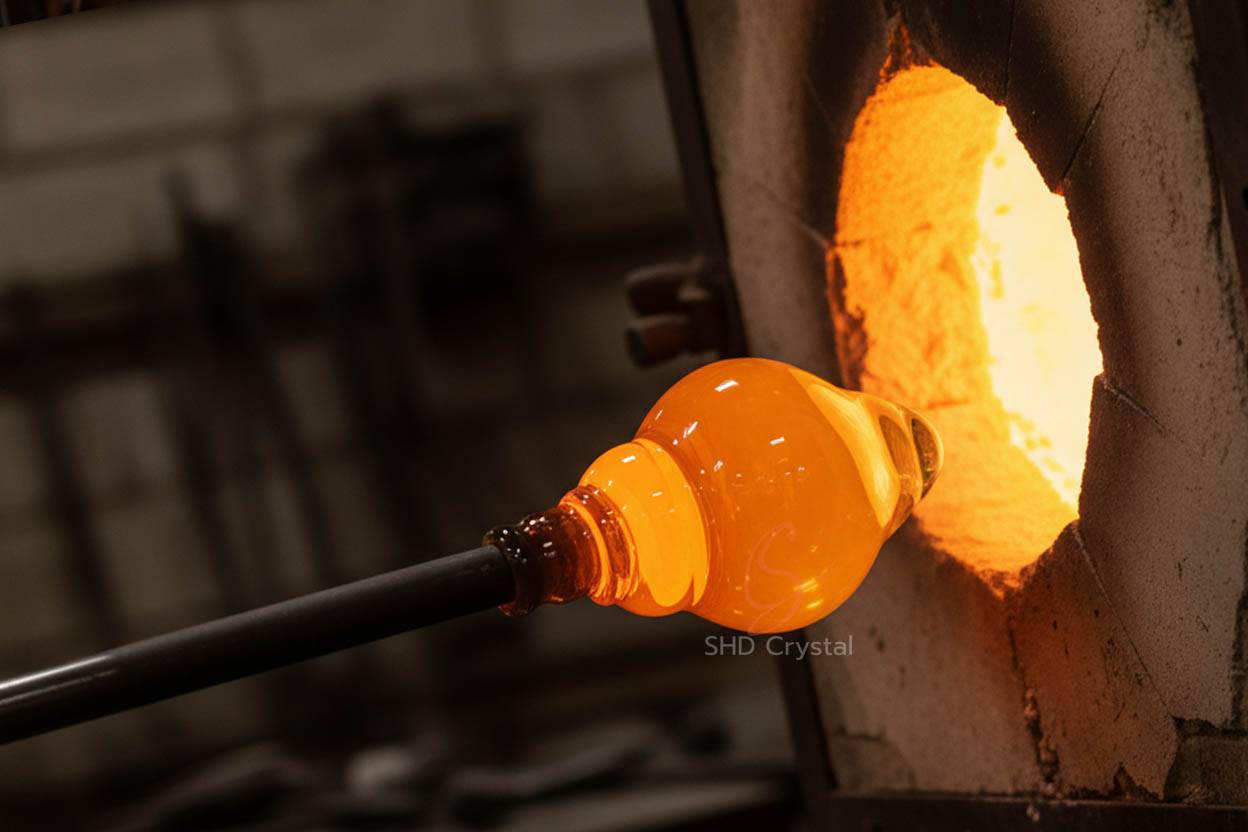
Blogpost keywords: properties of crystal glass, strength of lead crystal, molten glass
The properties of crystal glass are defined by a combination of composition, structure, and thermal history. Unlike standard soda-lime glass, crystal glass incorporates metal oxides—most notably lead oxide—which significantly alters its optical, mechanical, and thermal characteristics.
These differences are not superficial. They affect how the material forms in a molten state, how it responds to stress after cooling, and how it behaves in long-term use.
Understanding these properties requires examining both the behavior of molten glass and the resulting solid structure.
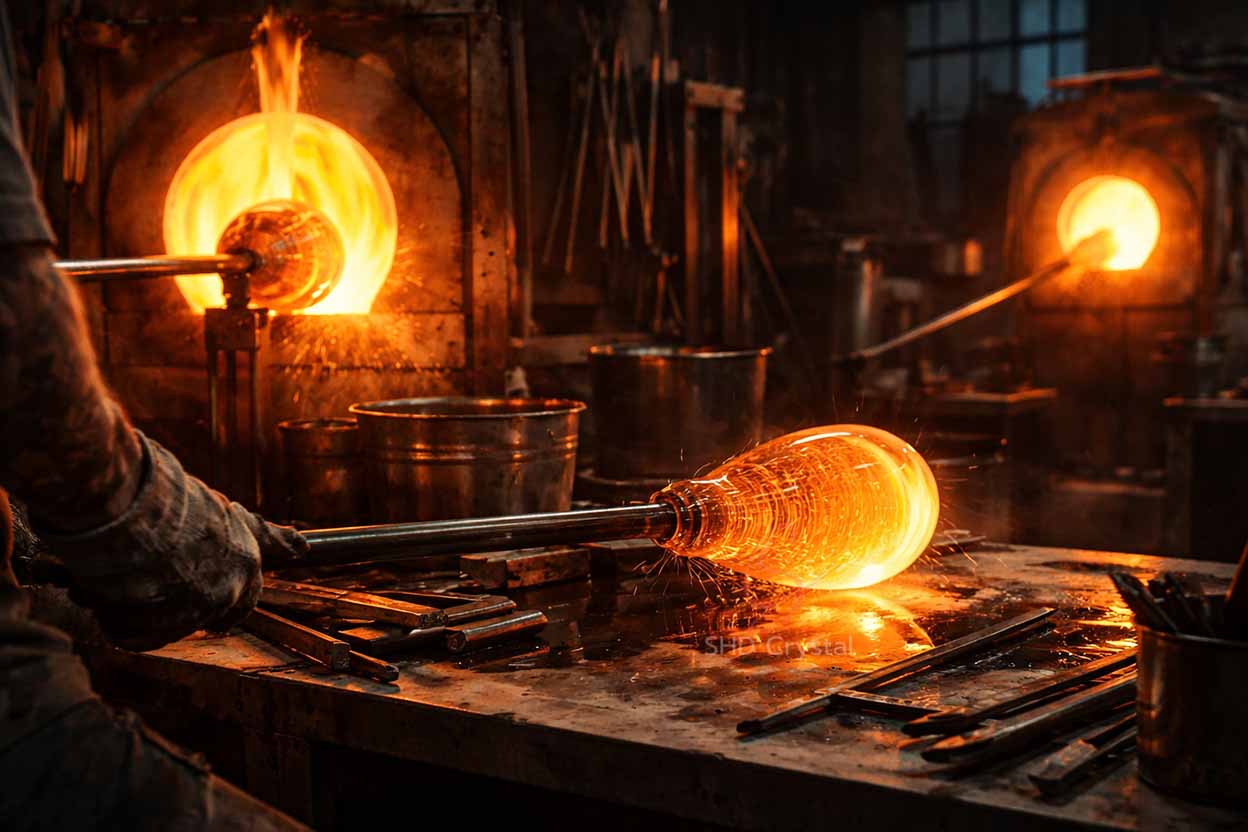
Properties of Crystal Glass in Molten State Formation
At high temperatures, glass exists as a viscous liquid rather than a true liquid with fixed flow characteristics. The behavior of molten glass is central to determining the final structure of crystal products.
In crystal compositions, the presence of lead oxide lowers viscosity compared to standard glass. This allows the material to flow more easily during forming, enabling sharper details and smoother transitions in shape.
At the same time, molten glass remains highly sensitive to temperature gradients. Small variations in heat can change viscosity significantly, affecting thickness distribution and internal stress development.
These conditions require controlled forming and cooling to preserve the intended structure.
Internal Structure and Optical Characteristics
One of the defining properties of crystal glass is its refractive index. The addition of lead oxide increases the density of the material, which in turn enhances its ability to bend and disperse light.
This is why crystal glass produces stronger brilliance and light refraction compared to ordinary glass. The internal structure allows light to interact more dynamically with surfaces and edges.
However, this optical advantage is directly linked to composition. Changes in oxide ratios can shift both clarity and dispersion, making formulation a critical factor in crystal production.
Strength of Lead Crystal Compared to Standard Glass
The strength of lead crystal is often misunderstood. While crystal glass is denser and can feel more substantial, this does not automatically translate to higher mechanical strength.
Lead crystal typically has lower hardness compared to soda-lime glass. This means it is more susceptible to surface scratching. However, its internal structure allows for better energy distribution under certain conditions, reducing the likelihood of sudden brittle failure in controlled use.
The strength of lead crystal is therefore situational. It performs well in applications where controlled handling and precision are prioritized, but it is not designed for high-impact resistance.
Thermal Behavior and Annealing Effects
Another important aspect of the properties of crystal glass is its thermal response. During cooling, glass must pass through a critical temperature range where internal stress can form.
Annealing is used to gradually reduce temperature, allowing the structure to stabilize. Improper annealing can result in residual stress, which may lead to cracking over time.
Because molten glass transitions into a rigid structure without crystallizing, its final properties depend heavily on how this cooling process is managed.
Density and Weight Distribution
Crystal glass typically has a higher density than standard glass due to the presence of lead oxide. This contributes to its characteristic weight and tactile quality.
The increased density also influences how the material interacts with vibrations and sound. For example, crystal glass can produce a clearer resonance compared to ordinary glass.
These physical characteristics are part of the broader properties of crystal glass, linking composition directly to user perception.
Surface Behavior and Finishing Response
The surface of crystal glass responds differently to finishing processes compared to other glass types. Its composition allows for more precise cutting and polishing, which enhances light interaction at edges and surfaces.
At the same time, lower hardness requires careful handling during finishing to avoid micro-abrasions. The balance between workability and durability is a defining aspect of the strength of lead crystal in practical applications.
Final Thoughts
The properties of crystal glass are the result of controlled interactions between composition, molten behavior, and thermal processing. From the flow characteristics of molten glass to the situational strength of lead crystal, each stage contributes to the final performance of the material.
Rather than being defined by a single attribute, crystal glass is best understood as a system—where optical clarity, density, and structural behavior are interconnected through material science principles.