
 > Blogs > Master Design Validation in Hookah OEM Process Today
Table of Contents
Core keywords: hookah OEM process, glass hookah base fit
In modern manufacturing, the hookah OEM process has evolved far beyond simple copying. Design validation now serves as the backbone of precision engineering, ensuring compatibility between components and stable production output. By systematically verifying every dimension and manufacturing parameter, brands reduce failure rates, improve glass hookah base fit, and maintain consistent product performance across thousands of units.
Key Stages of the Hookah OEM Process
1. From Concept to Verified Geometry
The first stage of design validation in the hookah OEM process is translating creative concepts into technical CAD models and engineering drawings. This includes verifying critical interface points—especially the glass base neck, stem collar, and gasket seat.
Dimensional tolerances are typically controlled within ±0.2 mm for neck inner diameter and ±0.3 mm for base footprint to ensure airtight sealing and proper glass hookah base fit. Using geometric dimensioning and tolerancing (GD&T) principles, engineers identify potential weak zones where stress concentration or vacuum leakage may occur. Early detection of these issues reduces downstream rework, which in mass production can affect up to 15% of units if unchecked.
2. Functional Fit & Prototyping
Once digital models are verified, prototypes are produced through pilot runs. This stage validates real-world functional fit, not just nominal geometry. Particular attention is given to stem insertion depth (typically 2–3 cm below the waterline) to optimize bubble acoustics and airflow resistance.
Fitment tests measure insertion force, gasket compression, angular stability, and glass hookah base fit under load. A misalignment of just 1 mm can increase airflow turbulence by over 20%, resulting in audible whistling and uneven smoke density. By resolving such issues at the prototyping stage, OEM manufacturers avoid costly line adjustments during full-scale production.
3. Material and Thermal Process Validation
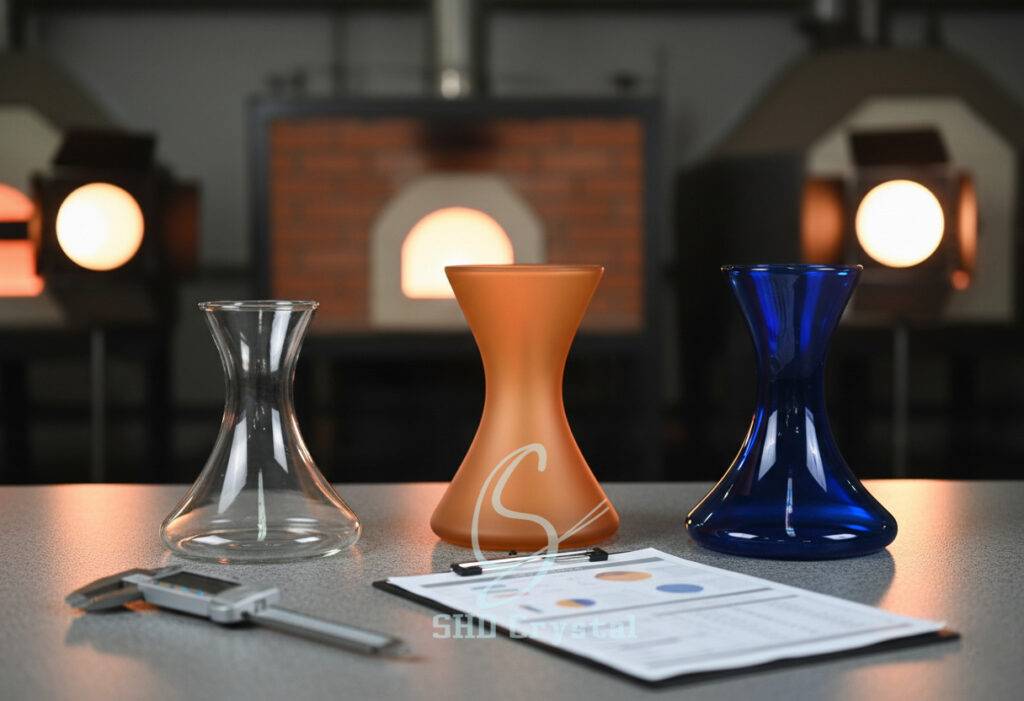
Glass behavior under thermal stress is another critical dimension. In the hookah OEM process, each base undergoes controlled forming and annealing at 520–560 °C for soda-lime compositions (higher for borosilicate). This removes residual stress and stabilizes wall thickness, which typically ranges from 4 mm in standard bases to 8 mm in lounge-grade heavy models.
Thermal imaging and polariscope inspections detect hidden stress lines. Studies show that annealing deviations of more than 15 °C can double the probability of micro-fractures during cleaning or transportation. By stabilizing thermal processes, validated designs minimize breakage rates and ensure clarity retention over years of use.
4. Scalable Quality Control
Validated designs form the foundation for scalable quality control systems. Measurement gauges and tolerance checklists are embedded in the production line to monitor neck roundness, base alignment, and surface finish. Statistical process control (SPC) tracks deviation trends, ensuring that over 98% of produced units meet target specifications.
Some factories integrate coordinate measuring machines (CMM) to scan random samples and verify 3D geometry against CAD references. These methods turn abstract design validation into quantifiable, repeatable standards—critical for OEM consistency at scale.
5. Strategic Impact on Production and Design
Effective validation in the hookah OEM process does more than reduce defects—it accelerates new product introduction cycles by up to 30%, according to internal factory benchmarks. Once a geometry is validated, OEM partners can confidently scale runs, introduce finish variants, or adapt stem fittings without requalifying the entire base.
This flexibility shortens lead times, improves glass hookah base fit consistency, and enhances the overall user experience. It also allows brands to maintain visual variety while preserving standardized functional performance.
Conclusion
By mastering design validation within the hookah OEM process, brands gain more than accuracy—they secure production resilience. Tighter tolerances, validated thermal behavior, and standardized QC protocols result in better sealing, cleaner airflow, and consistently reliable glass hookah base fit across product lines. As modern glass factories adopt advanced inspection and prototyping technologies, the hookah industry is transitioning from craft approximation to true precision manufacturing.
📢 Partner with SHD Crystal


