
Blogpost keywords: prototype validation for new hookah models, hookah product testing, pre-production validation process
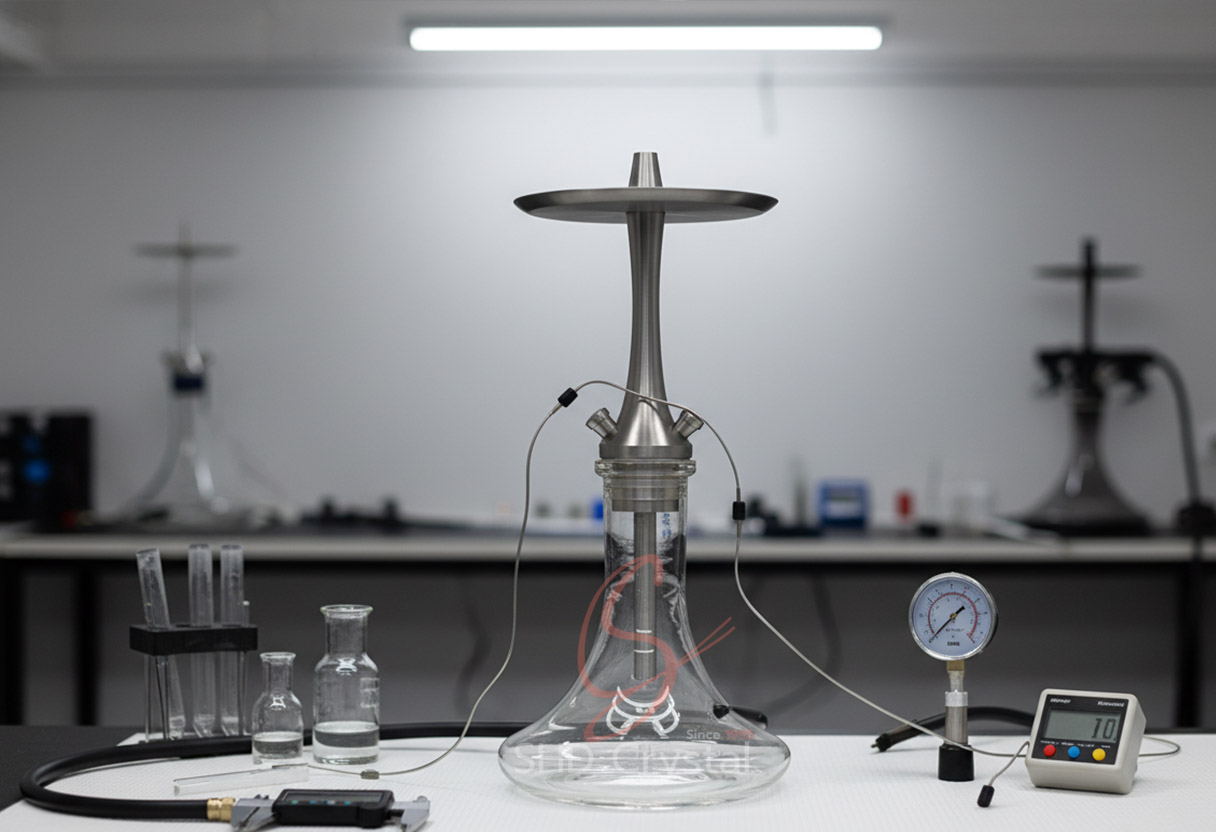
In a market shaped by aesthetics and precision, prototype validation for new hookah models serves as the bridge between creative intent and manufacturing reliability. While design teams often focus on visual elegance, unseen structural weaknesses or airflow inconsistencies can undermine even the most promising concept. Sustainable innovation in hookah manufacturing depends not on novelty, but on repeatable performance proven through disciplined hookah product testing and a controlled pre-production validation process.
Prototype Validation for New Hookah Models: Building Reliability Before Production
A rigorous approach to prototype validation for new hookah models combines engineering measurement, real-use simulation, and structured documentation. Each phase—testing, analysis, and refinement—ensures that visual appeal aligns with mechanical integrity. This is not an optional step, but the foundation that protects users, brands, and long-term production stability.
Establishing Measurable Performance Standards
Effective hookah product testing begins by defining performance benchmarks. Airflow resistance, thermal equilibrium, and structural stability must be quantified before comparisons are meaningful. During the pre-production validation process, prototypes should be tested under identical conditions—consistent water levels, standardized coal weights, and repeatable draw pressure—to eliminate subjective bias.
Transforming design intuition into data-backed evaluation allows teams to identify deviation early, long before tooling or large-scale production begins.
Materials and Construction Consistency
Material behavior directly influences safety and lifespan. Variations in glass density, joint thickness, or internal symmetry can create long-term stress points. As part of prototype validation for new hookah models, material consistency must be verified through weight distribution checks and visual inspection for optical distortion.
In advanced hookah product testing workflows, even decorative elements are evaluated for their thermal and structural impact. The pre-production validation process ensures that aesthetic detailing does not compromise mechanical balance.
Thermal Endurance and Airflow Evaluation
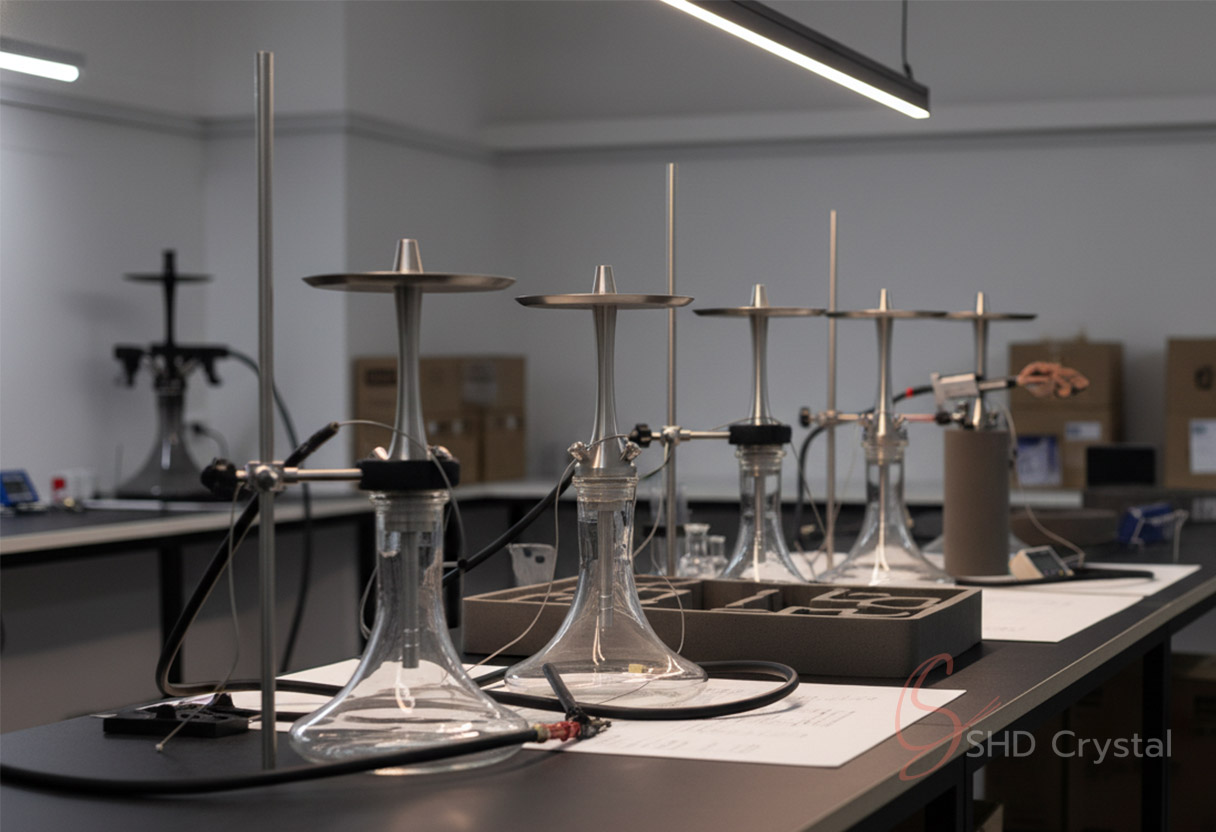
Thermal testing is central to reliable performance. During prototype validation for new hookah models, full-session heat cycles are simulated to observe temperature distribution across joints and seals. Infrared mapping highlights localized stress areas that may weaken materials over time.
Airflow analysis complements thermal testing. Measuring vacuum stability, turbulence, and leakage under standardized inhalation conditions confirms whether the internal system operates as a cohesive whole. These steps define the technical core of hookah product testing within a professional pre-production validation process.
Mechanical Stability and Safety Assurance
Beyond laboratory metrics, prototypes must withstand real-world handling. Controlled tilt testing evaluates resistance to tipping during hose movement, while vibration and handling simulations reveal weaknesses that static tests cannot capture.
Packaging integrity is also part of the pre-production validation process. Drop simulations inside shipping cartons assess how products survive logistics stress—an often-overlooked element of comprehensive hookah product testing.
Expert Insight: Integrating Craftsmanship and Data
Experienced glass engineers emphasize that prototype validation for new hookah models is where craftsmanship meets analytics. Skilled artisans often detect subtle imperfections—changes in resonance or vibration—that instruments later confirm.
When artisan feedback is documented alongside test data, the pre-production validation process evolves from simple inspection into a continuous improvement loop. Craft knowledge becomes measurable input rather than anecdotal observation.
Documentation, Traceability, and Iterative Improvement
Validation concludes with structured documentation. Test photos, tolerance ranges, material identifiers, and revision notes create traceability across prototype generations. Comparing successive iterations through consistent hookah product testing reveals drift before it becomes costly.
This documentation enables design refinement, supplier calibration, and production alignment—ensuring each validated model represents a measurable improvement over the last.
Field Performance Verification
Final validation occurs outside the lab. Controlled field trials in lounge environments provide real-use data on comfort, handling, and cleaning efficiency. Many manufacturers report that products passing full prototype validation for new hookah models experience fewer returns and higher satisfaction, demonstrating the business value of a disciplined pre-production validation process.
Conclusion
Systematic prototype validation for new hookah models transforms craftsmanship from creative risk into industrial confidence. Through structured hookah product testing and a disciplined pre-production validation process, manufacturers ensure that design excellence translates into long-term reliability.
At SHD Crystal, prototype validation is embedded into every development stage. By combining precision glass expertise with advanced hookah product testing, SHD Crystal supports brands through the full pre-production validation process—helping new hookah models move from concept to scalable, dependable production.